
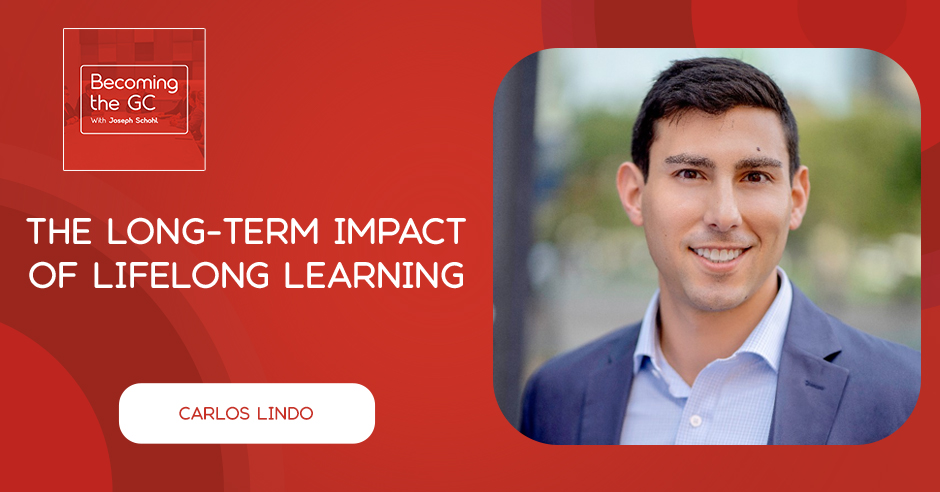
When you land in the GC chair, you cannot sit back and relax. If you want to perform well in your role and inspire others to do the same, you must learn to embrace lifelong learning. Joseph Schohl sits down with Carlos Lindo, a newly minted general counsel at Lucet, to talk about the importance of being a constant learner who does not back down from all kinds of challenges. He explains the right way to educate your team and why being comfortable with the unconventional is the path to becoming a GC. Carlos also emphasizes the importance of managing your time, emails, and relationships well to become a highly effective general counsel.
—
Watch the episode here
Listen to the podcast here
The Long-Term Impact Of Lifelong Learning With Carlos Lindo
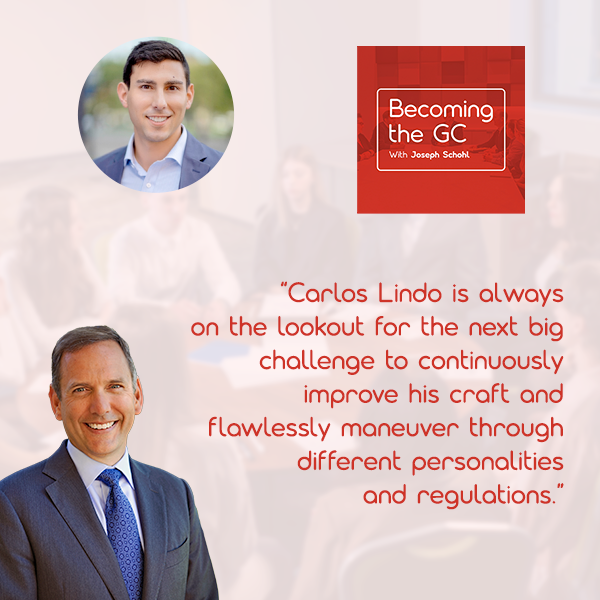
Our guest is Carlos Lindo, a newly minted general counsel. I think you’re going to enjoy hearing his story. If you have a preconceived notion of how someone gets from law school to the GC chair, this episode will challenge that. Carlos started as a criminal trial attorney before moving in-house with Xerox. That is an unusual path to begin with. We talked about the benefits of stepping into a role where outside Council spending is out of control and the contracts are a disorganized mess. Stay with me to the end, and I’ll share my biggest takeaways.
Here’s Carlos’s bio. Carlos leads the legal and compliance department of Lucet Health and serves as corporate secretary and executive sponsor of the Impact and Responsibility Council. In addition, he oversees an operational business unit, and we’ll hear more about that. Lucet is a behavioral health optimization company that provides a platform of services to help health plans, providers, and members improve access to and quality of mental health care. Carlos’s experience in both the courtroom and the boardroom has provided him with a set of skills that help organizations reach the right balance of risk aligned with corporate objectives. With that, let’s get into the interview.
Carlos, it’s great to see you.
It’s good to see you, Joe. Hope you’re doing well.
Where are you zooming in from?
I am down in Florida. I cannot do the weather, so I need the warm environment down in Florida with the beaches to keep me nice and warm. Anything below 70 degrees is too cold for me.
Did you grow up with that?
I did. I grew up in Florida. I was born and raised, stayed here, went to undergrad here, went to law school here, and my entire career has been down in Florida, so it’s been great.
Florida all the way through. If you had to live somewhere outside of Florida, do you have a favorite spot?
That’s a loaded question, but I would almost say it’s going to be Europe. I love Spain. Spain is such a beautiful country. If I could live anywhere other than Florida, it probably would be Spain.
What’s your number one recommendation for people to see in Spain?
Everything. I love Barcelona. I’ve done running with the Bulls, and it was a great time that I probably will never do again. The adrenaline rush you get from that is great. Sevilla is an amazing place. Madrid is great. The food is delicious. Up on the coast, there are just so many great places. It’s such a vibrant culture that has so many things to offer.
What Inspired Carlos To Pursue A Legal Career
Very good. Let’s talk about the law. I want to hear your origin story. What inspired you to pursue a career in law?
For me, going to law school was something I wanted to do probably since I was in middle school. I’ve known I wanted to go to law school, and really, it was either become a lawyer or become a doctor, and that was my track. I don’t know why I just loved all of the TV shows about legal. I just loved the environment. I liked to read and I liked to argue because of those things, everyone said you should go be a lawyer. I think it’s one of those self-fulfilling prophecies.
It is funny, isn’t it? It’s one of these professions where people tell you should do that. It seems.
The seed is planted, then it takes a mind of its own. You just have to go with it. When I was in high school, I worked at a home health care agency. When I was working for that home health care agency, I had a lot of interactions with nurses. I had a lot of interactions with care managers. When I told them in high school that I wanted to go to law school, they looked at me and they said, “Carlos, if you go to law school and you ever sue a nurse or a doctor, we will find you and we will do things to you that are unspeakable.” I said, “Okay.” From that time on, I knew if I went to law school and had this career as an attorney, I could never sue a doctor or a nurse. That laid the groundwork for why I ended up wanting to get into health law.
Very good. I do find myself, whenever I’m like a patient, in front of a health care professional, and they ask what I do, after I say I’m a lawyer, I’m quick to say, “I represent the good guys.” Did you go straight through undergrad to law school?
I did. I went from undergrad, went to undergrad at Florida State. Go Seminoles. I also went to law school, and I went straight through. From there, I did about three years doing criminal defense, which I loved.
What kind of cases?
I had everything from DUIs, misdemeanor marijuana, up to arson, first-degree murder, sexual assault, sexual battery, and child pornography. All types of felony cases I’ve handled. It was fun. When I say fun, I will never experience, I think, another environment like that where your adrenaline is rushing. I was in court every day. It changes constantly. You always had to be on your toes. In terms of problem-solving and really adapting to your environment, that is a great training ground.
The gravity of that, where you’ve got somebody’s future in your hands, had to be, make quite an impression.
Absolutely, which is part of the reason why I ended up switching out, is, I spent so much time there. I was spending all day Sunday at the jail. I would have family members call me on Sundays and say, “What are you doing?” I said, I’m on my way up to the jail. I have a list of clients that I have to meet with.”
There were clients that you talked to and had conversations and you’re really behind, and those are the ones that take the most out of you because you were actually defending their freedom. You were litigating so that if they were wrongfully accused that you could actually give them the freedom they deserve. Also, on the other hand, the other side of that too, there are clients that I wish I didn’t have to represent.
I’m curious, and I won’t ask you about your own personal statistics, but imagine a hypothetical criminal defense lawyer. What percentage of people do you think are guilty versus not guilty?
I would actually reframe that question.
Go ahead.
I would reframe it as not guilty or not guilty. It’s did you commit or are you guilty of the crime that you were accused of? I think so many times they did something, but the punishment or what you would do if you got what was required by law doesn’t meet what the actual crime would be. There are all these scenarios where, if you have what’s called a scorecard in criminal defense. If you go by that specific requirement of your scorecard, you could be in jail for 30 plus, 40 years.
Career Transition To A Paper Company
Well said. That resonates with me. It’s more like, “Are you trying to get justice so that the outcome here fits with the culpability in the act that was committed?” Sometimes, obviously, in certain cases, people deserve to go away for a long time. It seems like we tend to put like there are a lot of times where it’s disproportionate, the offense and the ultimate penalty. That’s what you’re fighting for in that realm. Interesting. I haven’t thought about that before. That’s a big shift. How did you make the shift to where you are now?
After I did that, I made the switch over to Xerox. Xerox is a paper company. Many people don’t know that Xerox actually had a healthcare services arm of interactions.
I didn’t know that.
They had the paper company, and they had the healthcare arm. They ended up doing a divestiture, and then it went from Xerox, and it became Conduant when they split up.
Is it like imaging machines?
They did a lot of Medicaid recovery. They actually held contracts across the nation with different states to run a portion of their Medicaid program. From third-party liability, from subrogation to actually managing claims out of Medicaid. There were a lot of state-run contracts through Medicaid.
I see. How long did you stay there?
I was there for between two to three years. That was fun. It was a fun role. It’s my first in-house role. I really enjoyed it, but I was looking for something more. I really wanted to grow in my career, and Xerox was a great breeding ground. I learned a lot from there. I had a lot of autonomy, but I really wanted to take my career to the next level. I just started looking for roles. I ended up finding the role I’m in now in the company. I’ve been with my company for about eight years. It was New Directions Behavioral Health at the time. We have since rebranded as Lucet. That’s how I was led there. I found the role online after applying to many jobs. I flew out to interview, and here I am.
What were your responsibilities? How did they change from your position at the Xerox company to what is now Lucet?
Xerox, I would say I was really a generalist, and I had a specific focus on a small portion of what Xerox did. I focused on third-party liability and Medicaid contracts. It wasn’t an enterprise view of the work that I was doing. When I shifted to this new company, to New Directions, now Lucet, my scope expanded to include that I’m not just doing one piece of work at a company. I was doing a majority of the legal work for the company under the general counsel at the time. I came in just a legal counsel position.
How was it the GC and you, or were there other people as well?
The GC hired me with another attorney. They hired two attorneys at the same time. There were already two attorneys who worked there. There were a total of five attorneys. They went from 3 to 5.
Got it. What’s the size of the department now? We’ll talk about your evolution and your role, but I’m just curious.
On legal, I have five. From compliance, we have 10 to 15. What ended up happening is that the GC had oversight over both the legal and compliance teams.
Paying Attention To Relationship Management
It sounds like a pretty easy path, but I’m sure it wasn’t. What were the challenges and setbacks that you faced along the way?
It sounds like an easy path. It was definitely an interesting route to take. For me, actually getting in the door was probably the most difficult path, or one of the most difficult things. It wasn’t built on networking or relationships. I was looking for specific roles. I was looking for healthcare companies. I was looking for a remote who I could really be inspired by the mission, which is one of the reasons why I was really attracted to this role. From there, I felt like I was doing a good job as a lawyer.
I think, as a beginning legal counsel of the company, I felt really strong about my skills as an attorney. Was thinking, “I could climb up pretty quick.” There was a lot that I learned over the last many years. It makes me realize now that if I were given the same opportunity I’ve been given now, I don’t know that I would have been quite ready for that position back then. While I thought I was ready, I was very mistaken and going through and getting the experience and the reps of deep diving in different aspects of the company, of the departments, of speaking with individuals that really primed me to be able to have a larger scale view of how I view the business.
What didn’t then that now?
Relationships are more important than textbook legal knowledge. What I was doing then, which was helpful, I would reading as much as I could. As much as I read, I would learn. I would look at case law, and I would see how any cases could have impacted me. Now I know it’s not just about the things that we learn in law school.
Relationships are more important than textbook knowledge. Share on XIt’s not just about the cases and how the cases apply, or it’s not about how the regulation or the statute applies. You have to have that as a foundation, but understanding the business is what I think really takes it to the next level. It’s how you can apply that statute and give advice that can span the entire enterprise, versus being very specific to one problem that you’re solving in that narrow lane.
What do you think you still have to learn?
So much. Probably one of the biggest things I’ve learned from starting my career and where I am now is that there’s always something else to do. There’s always something else to learn from relationship management, from how to interact with different individuals. I think from a personal side, building those relationships with the executives and the leadership at a company is always something you’re going to be learning.
You’re going to be learning how to interact with different types of personalities on both the good and bad sides. You’re going to be learning how to give positive and negative feedback in a manner that’s productive. Learning the people side and how to engage and inspire someone, in addition to learning the constantly changing regulations that our government is in, especially now with so much change at the regulatory level, it’s constant.
I can think of a few other jobs where you have to be learning every day, all the way from the first day you step into the role until you’re done. The nature of the role is you’ve got to be on top of evolving trends, laws, etc., or you can get yourself or your company in big trouble.
The trend issue is so important because there’s not a day that goes by that I don’t get a phone call and say, “Did you see this article?” or “Did you hear what this congressman had to say?” If I’m not staying up to date on that, then I will have lost so much context and how to help the company make a decision.
Importance Of Reading News Articles Thoroughly
How do you do that? There’s so much information and noise out there. How do you cultivate information so that you’re getting what you need, but in an efficient way?
I think you have to scour news articles. If you’re only scouring news articles and reading the headlines, then I think you’re doing it wrong. I think you have to read all sides and all views of a different article. The best way is to go back to the text. If there is a regulation that’s been proposed, I don’t want to get my information and understand what has been proposed in headlines or articles, because I think they miss so much context.
The One Day Beautiful Bill Act was passed, which had a lot of health care implications. For me, I had to read that for myself, and I couldn’t rely on summaries, even though AI does create summaries. I had to read it for myself to really get a good grasp of what are going to be the requirements or how my company has to change because of it.
How big was that document that you had to read?
A lot of pages. I almost brought you back to law school when the first day our assignment was, “Read this 500-page group of pages and then be prepared to discuss.”
We’re trained to do that. It’s important to do that and important to remember to do that in the age of AI, which can give you a bunch of tempting shortcuts and some real shortcuts, at least not yet a substitute.
It’s so true. Even with my attorneys. The attorneys at Lucet are amazing. They’re great. You can always tell if you’re speaking to outside counsel who just has a superficial understanding because they viewed AI. If they’ve used AI just to get up to speed, you can tell there’s a big difference between someone who’s actually read the text and fully grasped what the requirements are and thought them through.
Understanding Risk Tolerance And The Lack Of Predictability
For sure. While we’re on the topic of AI, how much do you get business people using AI to try to know more than you do about the law?
So often. I would say we are pretty good. We are very involved in the business. There are very few times that legal and compliance are not pulled in at the outset of a conversation, which is amazing. It’s a great place to be in a company. You do have to combat the AI. I put this in ChatGPT, and this is what it told me. Are you sure this is right? Of course, you always have to deal with those with tact and say, “Is the actual requirement. This is the law, and this is how you apply it.” Again, it’s not just the content of what the law is.
It is how you use the regulation or the statute and then balance it to make sure you’re hitting that right level of risk. The risk tolerance is something that I definitely did not understand when I first entered in in-house world. It was just here is the black letter of the law, here’s how you apply it, it’s a yes or no, or this is why you guys make the decision. Now it is a balance where you have to say, “Is this a risky issue? Should you move forward? Is there a business objective? What is the level of risk that we have to decide on?”
One thing that’s evolved for me over time with experience and the way the world has shifted is, and I’m sure you’ve experienced this, I used to get a lot of questions. I understand what the law is, but has there been any enforcement activity? You’d look for, like, has there been any enforcement activity? Now, whether there has or hasn’t, my answer is I can give you like five other examples of where there was no enforcement activity, and then there was. It mattered what you did in the past. That’s no longer a relevant question because the enforcement, especially in health care, and in the country generally, has really intensified and been less predictable, I think, than in the past. Have you experienced that?
The lack of predictability has been a hot topic of conversation. It is so unpredictable in the sense that I’ve joked around, bringing a magic eight ball to our next board meeting when we start talking about the regulatory environment and saying, “What answer do you want?” “Yes, this is it.” It is very unpredictable and it changes. Because enforcement actions have increased or decreased, you have to be prepared.

It’s one of the scenarios where you have to really balance the risk, but you’re not going to learn how to balance the risk until you really understand the direction of the company. You have to balance the commercial components, the financial components, how you’re doing member care, if you’re at a healthcare company, how the patients are being treated. All of that has to be balanced before you can get to the right decision. It just cannot be driven from one lane because if it is, you’re going to miss the mark, and there could be things you’re overlooking.
How GCs Should Navigate Difficult Situations
It sounds like a really hard job. How do you keep yourself mentally up for it day after day?
It is hard. We like to do hard things. We say that a lot at Lucet, “We do hard things.” I think what keeps me going, number one, is that an exercise regimen has to be on point. If there’s no exercise, then mentally I don’t function as well. You can ask my wife. She will vouch for that. Sometimes she’ll tell me, “You need to go for a run.” I’ll say, “I’m going to go for a run and then I’ll be better.” It is hard, but I think being a challenge is what makes it fun.
I come across something new almost every day. There are different topics, there are different complex experiences that I have to maneuver through different personalities, different regulations. I think that is what keeps me coming back is because it’s challenging and being challenged is fun. I’m not the type of person who likes to sit and just coast or sit and do the same thing every day. That’s what really makes it enjoyable for me.
That’s great. I think that’s an important mindset to have in the role is not to be resisting anything that happens that isn’t exactly the way you would want it, because it wouldn’t be a very interesting job, and people certainly wouldn’t get paid what they get paid to be the GC if it were only sunny days. It’s the weather and then how you deal with it that make it a challenging, interesting, and invaluable position to the company.
I 100% agree with that. It is how you respond to different scenarios. It’s the response that matters. There’s going to be so many things that happen that you can control and that you cannot control, but it’s how you react to the things that you cannot control that I think makes a really strong legal department.
Carlos’ Journey To The GC Role
Before I ask this question, I want to just read people in on your path within Lucet to the GC chair, to the formal title and role. Take us from when you started, there was a GC, there were three other attorneys, and now you run the department. How did that evolve?
I originally came in as a senior counsel under a GC. From there, I think there were a series of changes within our board where, in 2020, we had a real change of control activity. With that change of control, we had a lot of leadership leave. When they left, there was a spot opening. I went from legal counsel, I went to senior counsel. Before that change of control, I was getting moved up in my role at the time before any of that happened.
When the change of control happened, circumstances just so happened that I was the only attorney there. From there, I was the sole attorney. I had a lot of work, and those were some trying times. At one point, it was just me and then a paralegal whom I brought in, and the workload across the company doubled or tripled, but we were managing to really put some systems and processes in place.
When the change of control happened, I was presented with an opportunity to take more of a leadership role and really run the legal department. Shortly after that, I was also allowed to take on the compliance, and then from there, my role has grown. Currently, I have the legal department, I have the compliance department, and then I actually have a business operational unit as well. I think there are about 130 or 140 people in that lane, separate from legal and compliance. It’s more operational. It’s one of those things where I had some capability, and it got matched up, and I still have it.
Nice. What does that business do?
That portion is the employee assistance program for a federal government contractor. We call the federal contract for a governmental entity to run their entire employee assistance program. We cover approximately 600,000 lives plus all their dependents. It’s a large contract. It’s a great contract. I enjoy working with it. I enjoy working with the team.
Very good. Tell me about what the most important systems and processes were that you had to put in place, given that you had two people, first one and then two people, doing the work that many more people had been doing previously. You said that work had doubled and tripled. How are you keeping up at that time before you start hiring more people to help?
There are two ways I can answer this question. The first way I want to answer it is by immediately managing your outside counsel spend and contract management. Those were two big things that needed to be set up. From outside counsel spend, we had no oversight or control over what our outside counsel was doing. The first thing I did was put in and implement outside council guidelines.
It was from engagement letters. These are the types of arrangements that I’m looking for. These are the outside council guidelines that I would need to abide by. Working with councils to make sure that we’re reviewing the invoices and setting the right behaviors. Outside council guidelines and that whole management of the process. From a contract management side, it’s really getting organized to identify how many contracts were coming in, where they were coming in from.
You can start categorizing to see how you actually need to respond to those. Your commercial agreements are going to get priority from your BAAs or your quick vendor agreements. You have to be able to know what types of contracts are coming in before you can figure out which ones you need to address first. Commercial obviously should have some precedence. I will say that’s the system and process immediately that I took.
Once I was put over to the legal department, which didn’t happen as fast, and now I have learned, probably one of the most important processes that needs to be is the education of your leadership team. It is not just a process that has to be implemented, but it’s making sure that your leadership, your CEO, your CFO, all of your execs, understand what some of the pain points of your organization are from a risk standpoint.
General counsels must know how to educate their leadership team. They have to make sure the CEO, CFO, and every executive understand the pain points of the organization from a risk standpoint. Share on XIt is if we know that we have a lot of concerns on the patient or member side of things, then we should be flagging to say, “I want to make sure you understand where our highest risks are, so that when you were building within the technology department, you can maneuver this as an individual.” It’s even coaching on how to have these different types of conversations.
If you’re dealing with an HR client who has to go through terminations, you want to make sure that they’re educated on the things they can and cannot say. I think that training is almost more important than the processes and systems you put in from a pure legal optimization standpoint. It’s making sure that your executive, your leadership, understands how to use legal and work within their lanes efficiently in a legal and compliant manner.
Establishing Strong Rapport With Outside Counsel
Great, so much there. I’m going to touch briefly on the first part of your answer, which is outside counsel. I get this a lot when I’m working with people who are new to the GC role. Outside counsel spend is out of control, to which I say great, because then that creates a great opportunity for you to manage that, for you to then be able to build a department and still be saving the company money overall. There’s no contract management system, everything’s a mess, great. It’s not that hard. You can fix it, and that’s going to be a way to demonstrate two quick wins, a lot of value. Now, on the education of your leadership team, I want to hear more about that. What does that look like for you? That’s a harder one.
That’s much more difficult, and it depends on the personalities of each individual. I think the first thing you have to do is really establish a rapport. You have to make sure that they see you as someone trustworthy and reliable. Otherwise, you’re going to get into conversations and they’re going to go nowhere if they don’t really value your insights. It’s how can you establish rapport with those individuals?
It’s having constant communication with them. I think with our leadership team across our senior and our exec team, I have conversations multiple times a day of just talking and saying, “These are some of the issues we need to work through.” When there becomes a specific issue that we’re dealing with, so say there’s a more sensitive area with an employee or a more sensitive contract, then we’ll get really granular and specific and we’ll start, I don’t want to say role playing, but we’ll talk about scenario planning and saying, “If this scenario happens, how is this response?”
If they give me a response and I say, “If you do that, this is what the result will be.” We’ll have result A, B, or C happen. If that happens, then we have to go to a separate response. It’s really this scenario planning that I think adds the most value to that education. I will tell you, there’s nothing more satisfying than someone coming up and saying, “Carlos taught me the right way.” I have to ask this question. If that’s on a group call, that is how I really know I’ve actually made an impact because I’m retraining leadership’s way of thought to think more like a lawyer.
Challenges Of Board Management, Hiring Process, And Compliance
For sure. I love that. What about substantively, when you went from being a lawyer on the team to being the lawyer on the team? What’s a substantive area or two that you hadn’t had to deal with previously that are now critical?
Board management is one of the biggest focuses that I would have to deal with, working with different personalities on the board. Executive compensation is another area that you normally wouldn’t have to work with. All sorts of HR or higher pieces of litigation. I was always involved with things. Most of my work at the beginning was related to commercial activity, but the scope of legal services extends well beyond that.
Finally, it’s really the strategy. We’re in a highly regulated field within healthcare, specifically behavioral healthcare is extremely regulated. With that regulation, and regulatory has to be able to help drive the strategy of the business. That is something that I didn’t really have that experience when I first started out at the company.
That makes sense. What about compliance?
You always need compliance. The compliance officer I work with is fantastic. When I interviewed for a compliance officer, she knew that I had said this story a lot. Whenever I was interviewing for a compliance officer, if any compliance officer would bring up the seven elements of a compliance program, it was an automatic turnoff for me. I would say, “No, I need somebody else.” It’s because to me, the seven elements of a compliance program, that’s bare bones, that’s table stakes. I don’t need to hear about those because I know what they are.
I need to know how you are going to incorporate compliance into the business. From my standpoint on things that I was expanded, it was driving the compliance function and having it partner with the business to increase your integrity and your ethical component, but also make sure you were doing things the right and proper way. That was an area that was very new because lawyers and compliance, while they’re related, are two different things. If you don’t treat them as two different things, then you can fall into some gaps.
Even though lawyers and compliance are related, they are still two different things. If you do not treat them as two different things, you can fall into some gaps. Share on XPractical Tips To Improve Email And Time Management
Right on. Can I get really granular?
Sure.
I want to hear how you manage your email and calendar. Do you get a lot of email? Do you have a lot of meetings?
It is endless. I think for me, one of the hardest parts of making the transition from in-house counsel and going up to GC was the requirements of being more of a strategic level instead of an operator. I think that before, my expectations for email management were that I would respond to every email within a certain amount of time. I will hit and attend every meeting.
I will be available at any and all hours of the day. If you take that mentality, as an operator, people do it and you can, but when you take that step to a general counsel, if you try to do that, your mind is going to go a little wonky. You’re not going to empower your team, and you’re going to be missing out on a lot of good work that you can be growing as a company. For me, email management is making sure I’m responsive and reviewing.
I think I review every email that I go to, but it’s deciding, is this a me thing? Do I need to handle this? Do I need to have a conversation? Can I empower one of my VPs to take this on and really take ownership and accountability for this? Is this not a legal issue? I think out of those three areas, it’s important to really direct and guide, because some things come to legal that are not a legal issue.
It’s a quid pro quo, because you want them to come to you for a lot, but you also don’t want them to come to you for an accounting question. I would say tactically going through emails, setting those focus times has been a game-changer for me. One thing that I have done because the emails are so luminous is set a period of block time where I’m really focused on, “Let me respond to these emails.”
Let me get through this chunk of email on this block. That way, no one is throwing meetings on my calendar. I say I have an hour in the morning to get through and prep my day. I know where to take the rest of my calls. That’s not to say I will never have a meeting during that time period, because you frequently do, but at least you’re giving yourself the room to think. I think giving yourself that breathing room to think and strategize is more helpful than just putting your head down and grinding.
I couldn’t agree more 1,000% on that. People will say, “I don’t have time to do that.” I say, “You don’t have time not to do that.” If you’re going to really be at the top of your game in a world-class, you have to discipline yourself to do that outside of here and there in between meetings and other people’s priorities. Our jobs are service jobs. Responsiveness and helping others are the name of the game. The way that we do that is not 100% letting other people dictate. It’s a balance between reactivity and proactivity. How do you make sure that you’re spending enough time on things that you’ve identified that are important, but nobody is maybe clamoring for you to do them?
I think it’s by picking up the phone. I am on the phone quite a bit. If I see an email come through, I’m a faster talker than I am a typer. Sometimes it’s easier just to say, “Let’s talk about this issue that you just emailed me about.” Oftentimes, what I will do is I will categorize it. “This is a me issue.” This is a “Let me provide this and get some accountability.” This is not a legal issue. From those categories, I will take a look and say, “All the me issues or the things that are on the fence, let me pick up the phone and call someone.”
You let me call our CFO and really ask this question, and get is this an actual issue that we need to address, and what is the time component of it. It’s really about prioritization, and a lot of times when you’re providing the services to multiple departments, everyone is going to have a hot button issue. Sometimes you’re not going to be able to fully grasp how immediate or urgent it is until you get them on the phone and really flesh out what the issue is.
Giving Your Team The Opportunity To Excel
Right on. You mentioned your team. I want to know what your philosophy is as a team leader. What’s the most important role that you serve for them?
That is the alerted question. I would say that probably the most important role, there’s so the many good ones from holding them. I would say holding them accountable, but really, it’s more of giving them an opportunity to excel. When I first started managing a team, one of the mistakes that I made was that I was managing the team like I was still working and doing the projects.
I was in a position where I was saying, “I have this contract. Will you review this section of the contract for me and tell me what you think?” In doing so, I wasn’t empowering them to take ownership. I was getting just a pinpoint of information. They were losing information on the strategy of what the contract was for. Their focus was narrowed so they couldn’t actually register the full risk profile of the contract.
The advice they gave was incomplete, and they were just sitting there reviewing contracts. To me, that wasn’t empowering. I learned that later on, instead of just sending them a section of the contract and saying, “We’ll review this.” It is more of a, “We have a big contract coming up. The deadline is coming up, and I could really use some support. What are your thoughts on this contract? Can you take a look at me and raise any red flags?”
Handing over and turning the ownership, and making sure that they were accountable, and they knew that they were accountable for this, for the success of the contract signature was on them. I think that really helped my leadership style and really connecting with them. You can connect on a personal level, all you want, but when you empower them there, make sure that they are continuing to grow. That’s when you really start to see the positive success. I’ve done historically what I call sink and grow.
When you empower your team and make sure that they are continuing to grow, you will start to see positive success. Share on XI took this from a mentor of mine before, where it was once a quarter, I would meet with my team members, and in Q2 and Q3, we’d focus on sinking. Let’s make sure our holes are sinking together and that we’re aligned in where we’re going. In Q2 and Q4, we were focused on growing what growth opportunities you have. Is there something in the company that you want to hit or handle that you’re not accessing right now? Is there any leadership that you don’t feel like you’ve had exposure to? Doing those and figuring out what they want in their career and trying to be able to match what we can offer for them, I think, has really helped.
Keep Reading And Never Stop Learning
What would you tell Carlos if you went back in time as you’re making the transition from being a criminal defense lawyer to your in-house, first in-house role?
Keep reading, keep learning, and you have a lot more to learn. It’s not just about learning from a book. It’s about the experiences you get. If you’re not putting yourself out there and getting exposed to those experiences, whether it’s in a role that you’re currently in or you’re not actively seeking those experiences, you’re not going to be excelling as fast as you could. I would say go continue to get those experiences and value the experiences, whether you have a title or not, it’s the experiences that’re going to make you learn to eventually get to the title.
Don’t necessarily chase the title, chase the work that you’re doing. If you are continuously increasing the caliber of work that you’re doing, if you’re starting to have more contacts with the C-suite, with the leadership team and your exposure is more, don’t focus on the title, focus on those experiences because those experiences are what you’re going to learn from and make you a better attorney and make you a better GC down the road.
Why Legal And Compliance Should Focus On Building
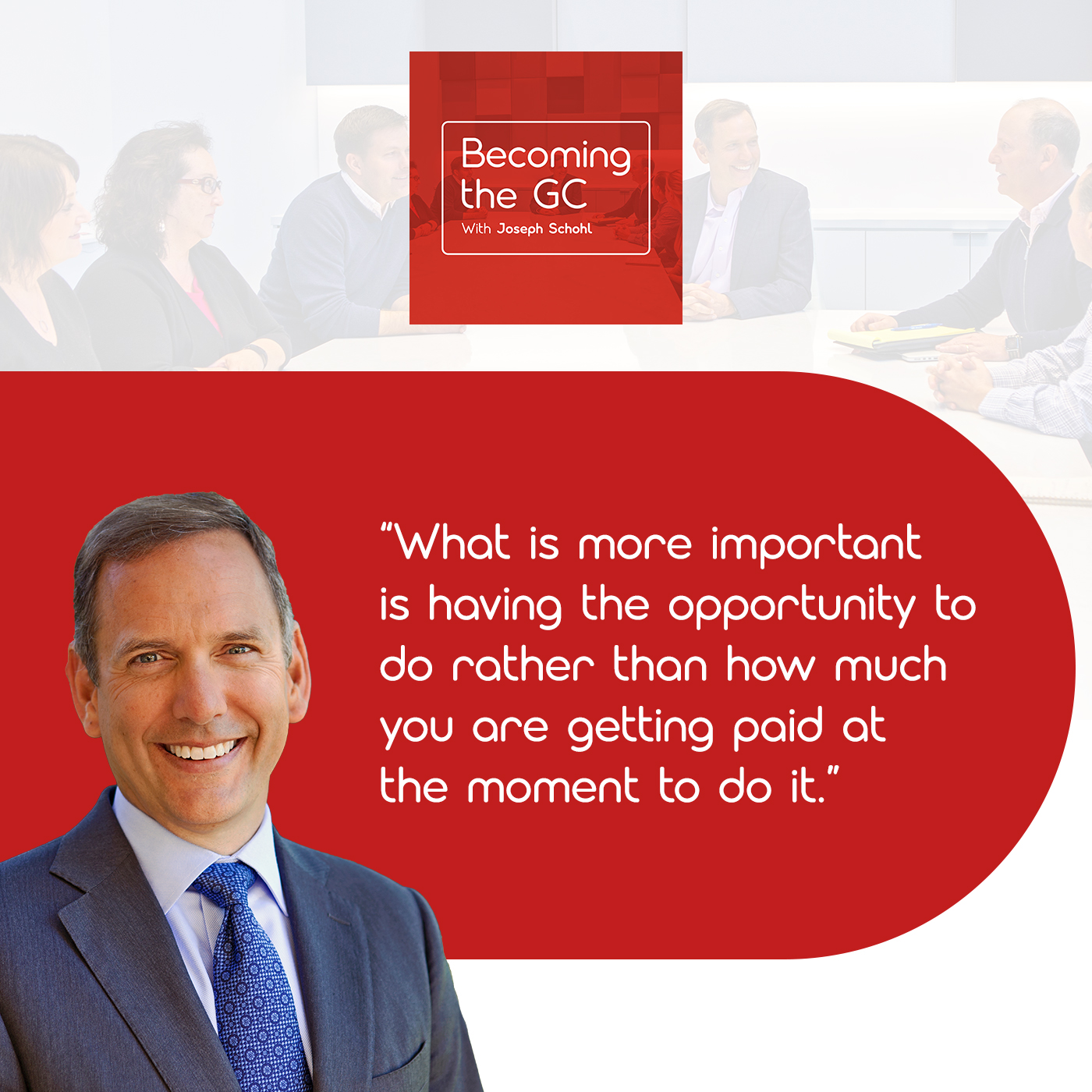
Ultimately leads to so much more value for your company and for yourself personally. I tell younger lawyers, “The way more important is what you’re going to have the opportunity to do rather than how much they’re paying you at that moment to do it.” Let me shift to the future. What are you most looking forward to?
I love challenges. I think my personality type is that I love challenges. My company, specifically, we just recently went through another acquisition. Going through that acquisition and having a new company presents ourselves with a lot more challenges. For me, I’m looking forward to blending two more companies and working from a legal and compliance side to really build.
Lawyers are a lot of times, and GCs are focused on defensive play. I really like to see legal and compliance be focused on the building. At the point that you bring companies together and you can learn to build together, build a product together that can ride the regulatory tailwinds, that is a lot of fun. That’s what I’m looking forward to is continuing to build within our company.
Why Carlos Decided To Join An Ironman Marathon
Great. That’s exciting. I know you’ve recently signed up to do an Ironman. For those who don’t know is a long-distance triathlon, a 2.4-mile swim, a 112-mile bike, and a marathon all in the same day. What possessed you to do that?
I have no idea. No, I do. It is always something that I’ve wanted to do. It’s a milestone that I’ve wanted to hit. I’ve always wanted to finish an Ironman. I think it is mentally challenging, physically challenging. Again, I enjoy challenges. This is something that lines right up with my personality. Hopefully, in several months, 7, 8 months, I will be making it across the finish line to my first Ironman. I say first. I don’t know if it’ll be my last, but it’ll be my first for sure.
What are you strongest in, the swim, the bike, or the run?
I would probably say I’m strongest in the run. I grew up surfing because I live in Florida, so I’m very comfortable in the water. The biking that I’ve done, I normally ride a beach cruiser. I’m upright, and I just like to take my time. That is probably going to be the most challenging for me, but I am ready to learn as much as I possibly can while balancing my family and my work life.
Which is really the challenge. I did an Ironman years ago, and when I think back at the training that was required back to back Saturday and Sunday, you’ve got to have a really strong why to do that. You’re seven months out from Ironman in Florida. I remember January one for a September race. My life was different that year than any other year. I personally wouldn’t do it again, but I’m glad I did it.
We’re going to have to edit that portion now because I don’t want my wife to hear that, but no, I’m just kidding. She is definitely a supporter of me.
This will be a great test to see if she listens all the way to the end.
Maybe I’ll hear a comment of, “What did you say?”
Episode Wrap-Up And Closing Words
It’s been a real pleasure talking with you, Carlos. I’m excited to see what you’re going to do next. You’ve got such a bright future ahead and such a great list of accomplishments up to this point. It’s a real pleasure getting to know you.
Thank you so much for the opportunity. It’s been great. I could talk about this stuff all day. I love the legal career. I love the general counsel role and the legal and compliance department. This is fun stuff. It’s challenging, but also very rewarding. Thank you for having me.
Right on. Thanks, Carlos.
—
Thank you for listening. My takeaways from the interview with Carlos. Number one. The importance of educating your legal team. That way, you aren’t going it alone or seen as separate from the executive team. You’re deputizing them to spot legal and compliance issues. Now they’re on your side. Number two, no amount of legal knowledge is going to matter if you haven’t built relationships with the people you serve so that they trust and rely on you for your advice.
Number three, any good lawyer has the opportunity to rise to the GC chair. You don’t have to start out in big law before moving in-house, or have only done corporate work. Every one of the GCs I’ve interviewed has had what I’ll call an unconventional path in one way or another. Until next time, this is Joe Schohl. I’d love to connect with any in-house lawyers or outside lawyers serving in-house lawyers who are interested in maximizing their potential. Please reach out to me on LinkedIn and let’s start a conversation. Thank you.
Important Links
- Carlos Lindo on LinkedIn
- Lucet
- Lucet on LinkedIn
- Lucet on Instagram
- Lucet on X
- Joseph Schohl on LinkedIn