
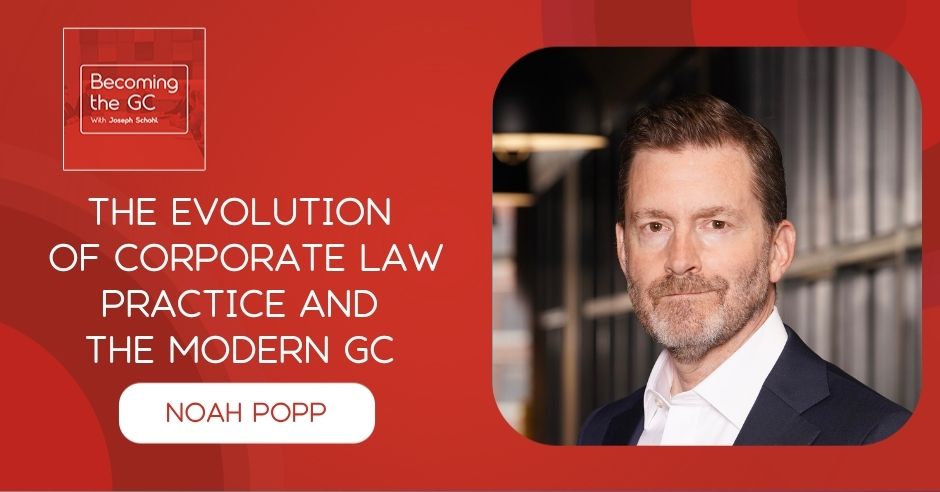
The role of the modern GC has evolved from being a technical gatekeeper to a strategic business partner who must balance the “speed of light” provided by technology with the “speed of right” required for sound judgment. Noah Popp, Executive Vice President and General Counsel at Enerpac Tool Group, joins the show to trace the transformation of corporate practice—from the era of hand-carried SEC filings and physical corporate seals to the current age of AI-assisted due diligence and global compliance. Noah shares candid insights into navigating the 2008 financial crisis, the shift toward “mile-wide” generalist expertise, and why a GC’s value is actually enhanced, not diminished, by the rise of ChatGPT and data-driven decision-making. This conversation is essential listening for aspiring legal leaders looking to build the pragmatism and global perspective necessary to lead in an increasingly fractured and automated world.
—
Watch the episode here
Listen to the podcast here
The Evolution Of Corporate Law Practice And The Modern GC With Noah Popp
The Evolution Of The Arms Race: From Typewriters To AI
In this episode, I talk with Noah Popp, Executive Vice President, General Counsel and Secretary at Enerpac Tool Group Corp. If you started practicing before 2000, this episode is a trip down memory lane. Friday night FedEx runs to the airport, associates hand-carrying SEC filings in duplicate cabs, on-site data rooms, minute books and corporate seals. If you came up in the Google AI era, it’s a behind-the-scenes look at how different and similar the game used to be and how we got from there to here.
Noah’s career spans that entire arc. Big law at Sidley Austin in the late dot-com days, early in-house roles at Ipsco and Ryerson Holdings, a GC seat at a Russian-owned industrial business through the global financial crisis, and now leading legal and compliance for a global tools company operating in 100-plus countries. He’s lived the shift from paper closings and physical minute books to virtual data rooms, AI-assisted review and business partners who are now doing their own legal research in ChatGPT before they ever call legal.
In this conversation, we talk about what’s been gained and what’s been lost as corporate practice has evolved. Why the speed of light enabled by technology can’t replace the speed of right and how the GC role has actually become more essential, not less, in an AI and data-driven world. For aspiring GCs, Noah also opens up about how he navigated crises, globalization and career inflection points to build the kind of judgment and pragmatism that boards and CEOs look for. Without further ado, I bring you Noah Popp.
Noah, welcome to the show.
Thanks, Joe. Good to see you again.
The Paper Era: Late-Night FedEx Runs And SEC Duplicates
It’s great to see you again. Now, for the readers, Noah and I worked together many years ago. The mid-1990s, back in the 20th century. We worked together at Sidley & Austin. Noah, tell us about what you were doing there. How you found yourself there and where you were going next.
Sure. It was my first job out of college, and I was a paralegal. Probably six months before I got that job, I’d never even heard the word paralegal, had no idea what it was. No family members in law. Had no idea what it was. I’d been in college, wanted to be a history professor, but, frankly, didn’t have the money to go to graduate school. Was working in a warehouse, just biding my time.
I think my mom pulled out an ad from Parade magazine, if for those who are really old and remember the Sunday newspapers and it said,”Become a paralegal.” It had an advertisement for a, I think it was a four-month program in Philadelphia. I was intrigued. Went out there and got my paralegal certificate. Based on that, Sidley & Austin was willing to hire me as a corporate paralegal. I literally went into that job with no idea what I was going to be doing. Within a short period of time, I loved it. I met people like you, young lawyers who were doing pretty cool stuff, and realized pretty quickly I can do that, too.
You were one of those superstar paralegals that anybody wants you working on their transaction and wondering how long you’ll be doing that before you go off to law school. That’s what you did.
We’ve talked about how different life is now, and back then, you couldn’t research it easily. You go to the library, you get the book inside the law schools, you talk to people. It was just such a manual process. It was fun to go through. Frankly, people like you helped me out in filling out applications and signing up for the LSAT and just figuring out what it was I wanted to do and where I should go to law school and then what I should do afterwards.
It’s amazing how little information there was. I think about college selection, but then very much law school selection was, for me at least, basically and I think for a lot of people was based on one book that I happened to get that described all the law schools. A sentence in there could persuade you to want to go or not want to go. It was just one person’s opinion at a point in time. That’s all we had to go on, in a way.
I remember those books, too. I think some of them were published maybe 5, 7 years before you actually went. Again, it’s one person’s opinion. It’s a different era. Better in some ways, worse in others.
The other thing I remember us working on together was we were working in the transactions group, and a big part of being a junior associate and paralegal support were to get out distributions. Distributions of documents, often on Friday night. Having to determine ahead of time where and what time was the latest FedEx center that you could possibly get to, often at the airport.
You knew where to go. Once you did it once, you knew when you had to get the cab, how long it was going to take you to get to the airport. It was just crazy that that was an important factor, frankly, in the practice of law back then.
I remember my first mentor at my first law firm job, we were doing an SEC filing. You’d literally have stories of flying to DC with boxes. The difference between a good associate and a great associate is when you hail a cab to take you to the SEC to make the filing, a good associate will have the box and hail the cab. A great associate will hail 2 cabs and have 1 follow in case something happens to the first cab, they can jump into the second one so you don’t miss the deadline.
I’ve heard those stories before, and it’s mind-boggling. Back then, too, I remember you would order from like a Cheesecake Factory menu. You’d get the list of SEC filings you could order copies of. You would have to, “Give me all the 8-Ks on this topic.” You’d send it in, someone would go into some back room in the SEC and make copies, you’d pay for them, and they’d send them in boxes, and you’d use that as your precedent. The idea that that was how law was practiced then, compared to now when if it takes me more than three clicks to get to the SEC website, not to say use of AI to find things, it’s a different era.
Speed Of Light Vs. Speed Of Right: The AI Superpower
The other thing that’s so different from that time was all due diligence was on-site. We’ve got some great stories about that. Lest this become a, “Back in the day,” what I want to do is relate what happened between then and now, or maybe a few years ago, and what’s happened since a few years ago to now in terms of AI. What somebody like me expects or doesn’t expect to happen based on that experience, which may or may not wind up being right. One of the things I read in the paper reaffirms what I’ve been thinking, and probably a lot of people have been thinking, is that AI is enabling us to do things faster, way more efficiently, and that doesn’t mean that we’re going to have a lot of extra time.
When email came on and we no longer had to make copies of the documents and drive them to the FedEx in the middle of the night, as soon as you could email those distributions, at least when you took it to FedEx, it had to get there. You had 24 hours before the document arrived, the other side could mark them up, get then they send comments back however they sent them. You had some time in between. Email came along and collapsed that time to could be the next day.
Now we know it’s like seconds. It’s just you’re expected instantly to respond, even though there’s a bunch of attachments and people want you to work at the speed of light when you should be working at the speed of right. That takes time. AI, I think, is going to be the same thing. Early adopters, it’s a bit of a superpower for a bit, but now that it’s becoming the norm, it’s like, “I need a letter that says this. Okay, where is it?” Not, “I need a letter that says this, get it to me by tomorrow and I’ll read it.” Pull up your screen and write the letter in front of me so I can give feedback and we can get on to the next thing.
I think it’s very much, frankly, putting more pressure because all this stuff, it’s an arms race from a technology perspective. You just end up doing more. You look back at the size of an acquisition agreement from the 1990s closing books, they were much shorter, way shorter. Again, just as complicated, but now when you don’t have to worry about bringing a set of Post-it notes and a typewriter to a closing anymore to insert little riders. You can make these things as long as humanly possible because we aren’t printing them out anymore. It’s definitely an arms race.
Has it improved the practice of law? It’s just changed it. You’re right, though. I think the need to move quickly, unfortunately, occasionally eclipses the need to do things correctly. That’s something you’ve got to push back on, especially as an in-house counsel, because you’re working with business people who, again, are expecting that quick answer.
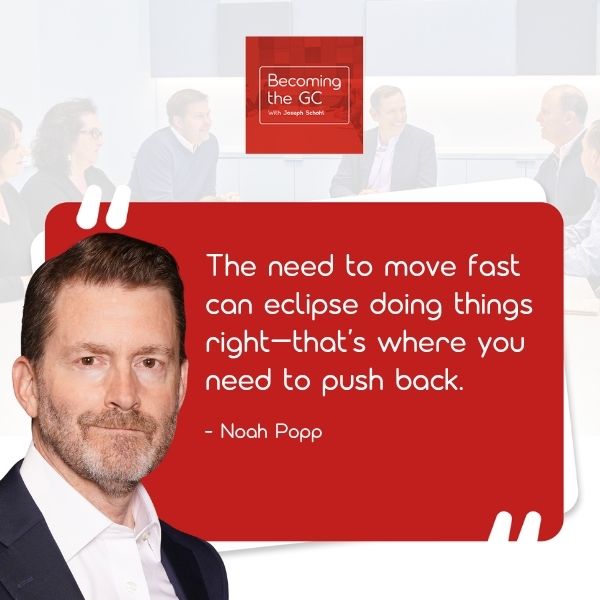
Very often, they’re going to AI themselves before consulting with you and think they know the answer or think they’ve made a conclusion based on the work they’ve done. It’s a matter of just being that sober person in the room that says, “Let’s get the facts here. We’ll act decisively, we’ll act quickly, but we’re going to do it the right way.” In the way that our training has taught us.
I think that is the superpower or will be the superpower for effective GCs in this new age. I find AI to be very helpful. I also find it to be very wordy. Being able to synthesize what really matters in our particular case, I think is critically an important skill for folks to develop. The other thing that I can’t help thinking about and you just reminded me of it is when business people are using AI to get legal answers, none of that’s privileged. I think that will be the cutting edge of discovery. It was emails, then all of a sudden, it was texts, then it was Teams messages and chats and whatnot. I would just cut straight to the AI searches people did before they called their lawyers.
It’ll come out certainly in a high-profile employment case, where you’ve got searches being done by people long in advance or, “How can we make it look like this,” or “What would you suggest?” it’s coming and it’s imminent. Will it change behavior? Maybe yes, maybe no, but you’re right, it’s absolutely happening.
I think the role of a GC is going to be essential well into the future. I think that we’re going to have to embrace the technology and be as much about what’s the right way to get this done quickly, efficiently, and accurately through people, technology, processes than ever before. Just being a great lawyer will get you in the conversation, but if you can’t go beyond that, I don’t think it works.
Being a good technical lawyer is necessary but not sufficient. Very often it’s about choosing. There are more tools now than ever and selecting the right tools from the toolbox at the right price is such a huge part of the job right now. We’ve changed the world of acquisitions, frankly, the old days of, “Let’s send a fleet of associates to the due diligence room and look things over.”
Now, you get access to virtual data rooms, but you’re not going to turn your expensive associates on that until you are pretty sure you have a deal. Part of that is just the deal-making has become much more of a seller’s market and has been for a very long time. At the same time, it’s changed. Don’t deploy the tool until it’s ready, until it’s ripe. Again, all this gets back to needing the judgment and the experience to help advise your client. I don’t think the role of a GC is going away anytime soon. If anything, I think it can be a little bit more enhanced. It’s just a question of how do we train our next generation?
How long do you think it’ll be until the due diligence exercise is, “Load all your documents here so that our bot can do a due diligence memo and summary of all the issues?”
I think it’s very close. In fact, I think that capability pretty much already exists. The problem is getting at the specific nuances of a transaction. Your garden-variety, it’ll be deployed in the PE space of more of a garden-variety acquisition. Again, as we all know, every deal’s a little bit different and putting in the right parameters. AI can very easily identify change-of-control clauses and governing law and all that fun stuff, but there’s usually a lot more than that.
Some of it’s look and feel. We all remember from going to due diligence, you’d look at a company’s minute books and a company that had really kept really solid minute books probably was going to have really good records and was going to run a tight ship. That’s the thing that gets expressed in your memo. Now it’s a little different because the idea of AI reviewing a massive volume of materials, you don’t get that sense, that look and feel, that I still think has some value.
What are minute books? I’m joking.
It’s funny because even as recently as my current position, part of me is like, “I want to keep a nice minute book. Do we have nice thick paper we can print stuff off on?” I think, “I’m getting too old, Noah.”
Where is the corporate seal? I’ve been looking for it.
Still important in some jurisdictions, weirdly.
Let’s go back in time and take us through your career progression from when you graduated law school through, say, your first in-house job.
Career Inflection Points: 9/11 And The Sarbanes-Oxley Wave
Sure, that sounds good. I graduated 1999, which, in terms of graduating law school, don’t know there’s possibly a better year you can do that. I want to say the size of the summer class at Sidley & Austin, which is where I started, was130, something like that. It was the high-water mark of summer associate classes. I think before I even started, there was a pay raise from the traditional associate salary that had been in place for a very long time due to the dot-com era.
I still remember the law firm Gunderson Dettmer, which was based in the Silicon Valley, was the first to move up, and we were all very thankful because before I even started my job, I had a pay raise. I worked at Sidley during that amazing time of the late dot-com era and its fallout. Great thing about working at Sidley & Austin in Chicago is we had a lot of clients that were much more of the brick-and-mortar variety, so there was just this really nice stable of clients.
Great practice group, enjoyed it thoroughly. 9/11 happened. I had some thoughts. I think it made people much more introspective in a lot of ways. I just thought about, “Do I want to be doing this for the rest of my life?” Was I partner material at Sidley? I’ll be honest, no, I don’t think I was. I was a good associate, but I wasn’t going to be partner. I’m not sure I had any particular skills that would have lent me to be as good as some of the people we worked with at Sidley.
Other than perhaps humility.
Honestly, what I really enjoy about law is diversity of practice. There were people at Sidley, and we knew them, who basically memorized the ’34 Act. That wasn’t ever going to be me. I’ve always wanted to be the mile-wide, foot-deep type of practice, because that just keeps me interested and engaged. I realized it was time to look in-house.
I probably didn’t make a great choice on my first in-house position. I had done a bunch of work actually helping some clients that were foreign private issuers for at Sidley. I was doing some Canadian foreign private issuer work and sure enough, I found in the Chicago suburbs a company that fit that exact category. A company called Ipsco, which doesn’t exist anymore, but it was a steel manufacturer based in Regina, Saskatchewan, but had moved its corporate headquarters to suburban Chicago. Sure enough, was a foreign private issuer on the New York Stock Exchange. Started my career there in terms of being in-house.
This is great because when I hear from guests, this is another example of one of these like, “how did you go from doing Canadian foreign private issuer work to general counsel?” It’s good for people to know because wherever they are in their career, if they want to become a general counsel, there’s a path from wherever you are.
There absolutely is. It’s hard to see when you’re zoomed in on a day-to-day basis, but when you zoom out, you realize that whether it’s 3 years, 5 years, you’re part of a moment in business and society and law and culture. That was the Sarbanes-Oxley time period, and this was the post-Enron fallout. You can look at a time period of great opportunity, frankly, if you’re a young lawyer, because Sarbanes-Oxley was new in terms of a regulation. Every company had to comply, and there was just a lot of work to be done.
The global financial crisis was obviously another opportunity and also a lot of people unfortunately their careers were casualties. COVID, another. There are all these opportunities, and of course, AI right now, opportunities to where you’re at parity with the most senior lawyers because it’s new to everybody. That gives you an opportunity to specialize and dig deep into an area. If you find it interesting, great, run with it. If not, the exercise is worthwhile and you were part of that moment. I had a lot of those in my career, and it’s enjoyable to be a part of that.
With AI, you can reach parity with senior lawyers because it’s new to everyone—use that to specialize and go deep. Share on XIt’s a great way to look at it. As you said, I think we’re in another inflection point now. What’d you do next?
I was there for a pretty short period of time, about eighteen months, and then went in-house. Great job at a company called Reyes Holdings, which is one of the larger private companies in the country. Biggest collection of beer distribution companies, they did food distribution as well. Just an M&A powerhouse, they were just constantly acquiring companies. Worked there for about five years for a really great general counsel who’s still there. It was just a lot of fun because it combined what I liked about being at the law firm in terms of the deal flow with some of the great parts about being in-house, which at the time included a decent quality of life. I was just having a young family at the time, and it was just a really nice combination.
What happened next? Why aren’t you still there? It sounds perfect.
Leading Through Crisis: Pragmatism And Global Expansion
In 2008, global financial crisis is just about to start, but certainly the rumblings are beginning. I get an interesting call from the head of HR at the previous company, Ipsco, that I had worked for. He said, “Noah, I don’t know if you’ve been following what’s been happening with Ipsco.” I had. It had been acquired by a larger company, a Swedish company. Here we were in the summer of 2008 and it was splitting into three companies.
Amazingly enough, two of those companies were being bought by Russian companies, sure enough. One of them, a company called OAO TMK, had bought the old Ipsco assets in the oil and gas space, so the tubular assets basically, steel pipe and tube. It had been basically a spin-off, and they asked, “Would you be interested in interviewing for the general counsel position? We knew you back when and we thought you were a solid person and really good.” I said, “Yeah.”
This was a career advancement opportunity. You were going to get to run your own show.
Incredible opportunity. I was 35 years old. It felt like joining a bit of a startup. Sure enough, I took the job I think it was September 2008. Within a very short period of time, the global markets had become in a really tough spot. I was general counsel and part of an executive team at a pretty young age in retrospect, in a cyclical business, honestly. Oil and gas is a business where when times are good, you can’t help but make money, when times are bad, there’s nothing you can do to make money.
In oil and gas, when times are good, you can’t help but make money; when times are bad, there’s little you can do. Share on XMaybe it wasn’t always the top tier, but it was an incredible experience. Ended up working there for five years. Just the cultural issues of working for a Russian-owned company. At the time, it seemed to make sense, this was peak globalization, and the idea that the Russians would buy US assets made sense. Having to be incredibly nimble during the global financial crisis.
Having the perfect indemnity clause in your terms and conditions doesn’t matter when you’re struggling to meet payroll. It was just that thing where you had to manage our way out of the financial crisis. It took a while, but it was amazing to see because we went from the dip and rode it all the way into 2010, 2011, and really came back and did some pretty amazing things.
I can just imagine the additional skills and additional knowledge that you have to acquire to get through a period of time like that.
It just required a certain amount of pragmatism and flexibility that I think the much younger version of me didn’t have. I think that ended up really paving the way for the rest of my career where pragmatism doesn’t mean not doing the thing and not being aware of the issues, it just means really understanding what it is your client needs and wants. I think that’s really helped me. I’ve just rode that here on out.
Being able to make that shift from, “It’s no longer about what’s the perfect legal outcome, it’s the perfect legal outcome is the outcome that helps support what the perfect business outcome is.”
A company doesn’t hire a general counsel for the theoretical. They hire us because we have a good 360 view and we’re solutions-oriented. We can get to a solution rather than the proverbial be the aspirin, not the headache thing. It was tough to do that right away, especially in an environment where I was encountering issues that I’d never encountered before. 2008 was a very different time than now still. The internet existed for sure, but it wasn’t the resource that it is now.
What’d you do? What’d you rely on?
I started building a really good relationship with external counsel and built that proverbial Rolodex. Your younger readers can look up what that is. You build those relationships that, frankly, I’ve been able to keep my entire career now. There was one firm in particular that I relied upon during the darkest hours of 2008, 2009. That’s a relationship that’s continued to this day. Just finding external counsel or even colleagues, other colleagues that aren’t earning an hourly fee, that you really trust and have great advice.
The great thing, too, about the legal profession is I’ve never encountered someone and maybe it’s being in the Midwest, maybe it’s being in manufacturing but everyone is so eager to help and share best practices and lend a hand. I think that’s something that I’ve really enjoyed about the profession that frankly I wasn’t sure I was expecting. Again, I’m not a litigator so I’m not in that battle zone. It’s been really gratifying to see how helpful people have been. My role now is to give back quite a bit in that respect.
How have you built relationships with other GCs?
The great thing, too, is there’s so many different resources available. I think ACC is a fabulous organization, I’ve been a member for very long time. I find that if you can make it to meetings, even the local meetings. Again, I’m not a huge networker, I’m a bit of an introvert, but at the same time, there are opportunities to do that.
I’m also very fortunate I’m married to an amazing lawyer and she’s someone I speak to frequently. We bounce ideas to each other all the time and with her as a network of people she’s met over the years as well that have become confidants and people I work with, some of which have become GCs themselves. It’s been a variety of ways, frankly. The other thing, too, is I’ve had several in-house jobs and you never want to burn a bridge. Sometimes you don’t always leave on the best of terms but at the same time usually in at least legal-to-legal, there’s good relationships there and relationships worth preserving.
Staying Power: Long-Term Tenure And The Move To Enerpac
Keep us moving on your timeline. What happened next?
The only reason I left that company was company moved its headquarters to Houston. Had a young family. Again, my wife has a legal practice, we just weren’t going to move the family down to Houston. It made total sense for the company, I understand. It’s interesting, I got a piece of advice when I was a general counsel that the best way to become a general counsel is to be one. Once you leave that treadmill, it’s sometimes a lot harder to get back on it.
The best way to become a general counsel is to be one—but once you step off that path, it’s hard to get back on. Share on XI’m not sure I believed it at the time, but I think there’s some truth to that. I took a job at a public company downtown Chicago, as a successor to a late-career general counsel. It was a very small legal department, it was just two of us at the time, a small cap. Worked there for eleven years through COVID, in fact, it was the job I had before I came here. Again, great experience. Was part of a company that really advanced both in terms of its size through acquisition, its profitability through some really amazing efforts on that front, and made its way through COVID.
Staying there eleven years, I think when it came time to choose the next general counsel, some of the goodwill I’d built and the relationships had become a little stale, frankly. They went a different direction, they hired someone external. One door closes, another one opens. I got a call from a former colleague who’s the CEO at Enerpac Tool Group, saying, “Ever think about going to Milwaukee?” It didn’t take me too long because I had such a great relationship with him. Our CEO Paul Sternlieb, he had worked with me previously and I knew I saw he had done great things at Enerpac and that was a company I wanted to be a part of. It’s been great.
Do you have a team there? What does your department look like?
I do. We’re small, but very global. Just 3 attorneys and a compliance staff of 3. That’s ethics and compliance but also product compliance and export compliance. We operate in over 100 countries and so having that export compliance within the legal group or legal and compliance group, I think makes sense. It’s working out real well.
Now you’ve piqued my curiosity because most of the businesses that I’ve supported ever since I left Baxter have been domestic, US, but I’m aware of like FCPA and things like that. When the Trump administration comes in and says, “We’re not going to enforce FCPA,” it made me wonder what happened to all the FCPA lawyers at the law firms. It also made me wonder like what do international companies do? I assume you just keep doing all the internal compliance things you were doing before.
That’s exactly right, Joe. What’s been said from the top of the administration and what’s actually being done are sometimes two different things. The FCPA is still being enforced. Enforcement is much less on foot faults because bribery is way more than that. There are certain things you can do that are violative of the FCPA that are maybe not certainly intentional and not as serious as others. The focus has been much more on individuals rather than on companies.
At the same time, I think we need to, again, zoom out when it comes to international law and it’s still very much a non-negotiable. The other good thing, too, is our customer base, and I think most customer bases still expect integrity, and they don’t want their employees. That’s a nice thing as well. I think we’re finding in a world where globalization is fracturing, where maybe governments are less involved as they used to be, sometimes it’s the global multinationals that are stepping in the void and having standards that suppliers need to meet. Frankly, that’s where we come in to be a part of that.
You don’t need the threat of criminal prosecution to behave with integrity, most people don’t. There has been, in my opinion, an over-criminalization of certain areas where inadvertently, people can find themselves in that role when they didn’t have any criminal intent at all. That’s probably a bigger discussion and I’m not sure whether this administration’s changing that or not, quite frankly. These are things you have to think about.
Macro Trends: Navigating A Fractured Global Economy
The other thing, too, is looking at macro trends. Globalization, I think, has reached its apex and we’re heading in a different direction. As a global company, realizing that instead of operating in one global economy, we’re operating in dozens and dozens. It’s created a tougher job, especially where a relatively small company. $600 million in annual sales, that’s not a ton of weight to throw around, and when we’re operating in so many different countries, it gets tough. There’s no doubt about it, but frankly, that’s the stuff that excites me sometimes, too, because it’s again problem-solving and problem-solving in different cultural contexts is exciting and fun.
Globalization may have peaked—we’re no longer in one global economy, but many. Share on XThat certainly adds an incredible layer and dimension. How helpful are the legal AI tools in that regard in the international space?
Less so than domestic, certainly. I view AI right now as very much a tool and very concerned about issues of privilege and confidentiality. It’s mainly used, at least by me, if I’m struggling with some language, if I want to present a hypothetical. Internationally, I find it’s the tools I’ve been using are maybe less helpful because it’s also internationally very different, evolving, most of the large models were not trained on global data and a lot of foreign language data. I would say selling equipment in Germany is very much like it was in 2008 when it comes to just how things are done.
How much of it is you’ve got to find a firm that operates internationally and have them steer you to the right people in the right places versus having to build a network of local counsel?
Yeah. It’s a little of both, frankly. We have a very large stable of global law firms that we use. Frankly, I think there can be economies of scale that we’re going to work on. A lot of those local relationships exist already, and they exist at the plant level and the law firm much more than at the corporate level in the law firm. I’ll work to change that a bit. I think they’re both valuable, frankly.
I think there’s a real value in a reasonably priced global law firm that operates like a law firm and not a confederation of partners to be able to solve problems for the small-to-mid-cap companies like Enerpac. When I find those firms, I hold tight to them and leverage that relationship because it’s incredibly valuable because today’s issue in Thailand will be tomorrow’s issue in Bosnia. Knowing that there’s one phone to pick up is incredibly valuable to me.
Do you travel a lot internationally?
Not currently. It’s interesting, I was originally planning a trip, a round-the-world trip where I would hit Singapore, India, go through Dubai and then Europe that was canceled for a variety of reasons.
Backward Phileas Fogg trip, you were coming the other way. People can look that up.
I do a fair amount, but not the last few months, it’s been a little quiet as again, I’m getting up to speed. A lot of work with our board of directors. I think building that board relationship early in my tenure here has been very important to me and I think we have a great board. Hope to get on the road a bit more probably starting in the late summer or fall.
Did that trip get canceled because of what’s happening in the world?
Exactly.
What are you most looking forward to?
Small team, but incredibly talented and one of the things I always heard is in your first 90 days figure out who your successor could be and again, I’ve got a young, small team but such incredible talent here. Being able to leverage them, it’s a small but very well-regarded team within the business, and that’s something I just can’t take for granted because very often, a legal department is the department of no. The department of slow things down, and our little department doesn’t have that perception. Basically, making sure I don’t break it is going to be something I’m very excited about but also leveraging it to do the department improvement work that I want to do will be something I’m definitely looking forward to.
In your first 90 days, identify who your successor could be. Share on XThe ROI Of Judgment: Why The GC Is More Essential Than Ever
I can’t wait to see how things continue to progress in what’s already an awesome career. Congratulations on that.
Thanks, Joe. Really appreciate it.
Noah, it was great reconnecting with you and I look forward to continuing the conversation.
Absolutely, likewise.
That is so cool. We started in the same place and then similar in some ways careers, but different. Mine was all domestic healthcare. Again, once I left Baxter, DaVita was starting to do some international expansion right as I was leaving, I basically introduced them to Baker McKenzie on my way out. That international expansion led to a lot of spending and not much revenue, and I don’t even know how much they do internationally. Healthcare, it’s very hard.
It’s so highly regulated.
It’s local. All my GC West clients were domestic healthcare services. Radiology Partners was all domestic. That was not a part of my career other than a little bit at Baxter, but only I was seeing other people doing it. I did a little, I got to go to Europe for like six weeks and that was a cool thing and really grateful that I had that opportunity. I wasn’t in the middle of the international work. That’s pretty neat.
The part I’ve loved the most, frankly, is the international. Building relationships with people across the globe. It’s funny, I’ve had enough jobs where I’m on my LinkedIn and I’m just scrolling through names and I’m remembering them but I’m not even sure what job they were from thing. It’s been good and, frankly, it’s been a great resource.
—
Thanks for reading my conversation with Noah Popp. Here are three quick takeaways from his journey and from the evolution of corporate practice we’ve both lived through. First, if you practiced in the era of FedEx runs, on-site data rooms and paper closing sets, you’ll recognize how much the fundamentals haven’t changed. Noah’s path from Sidley deal rooms to Global GC shows that what still matters most is judgment, knowing when to push back on “Do it faster” and how to protect privileged process and quality in a world that expects everything now.
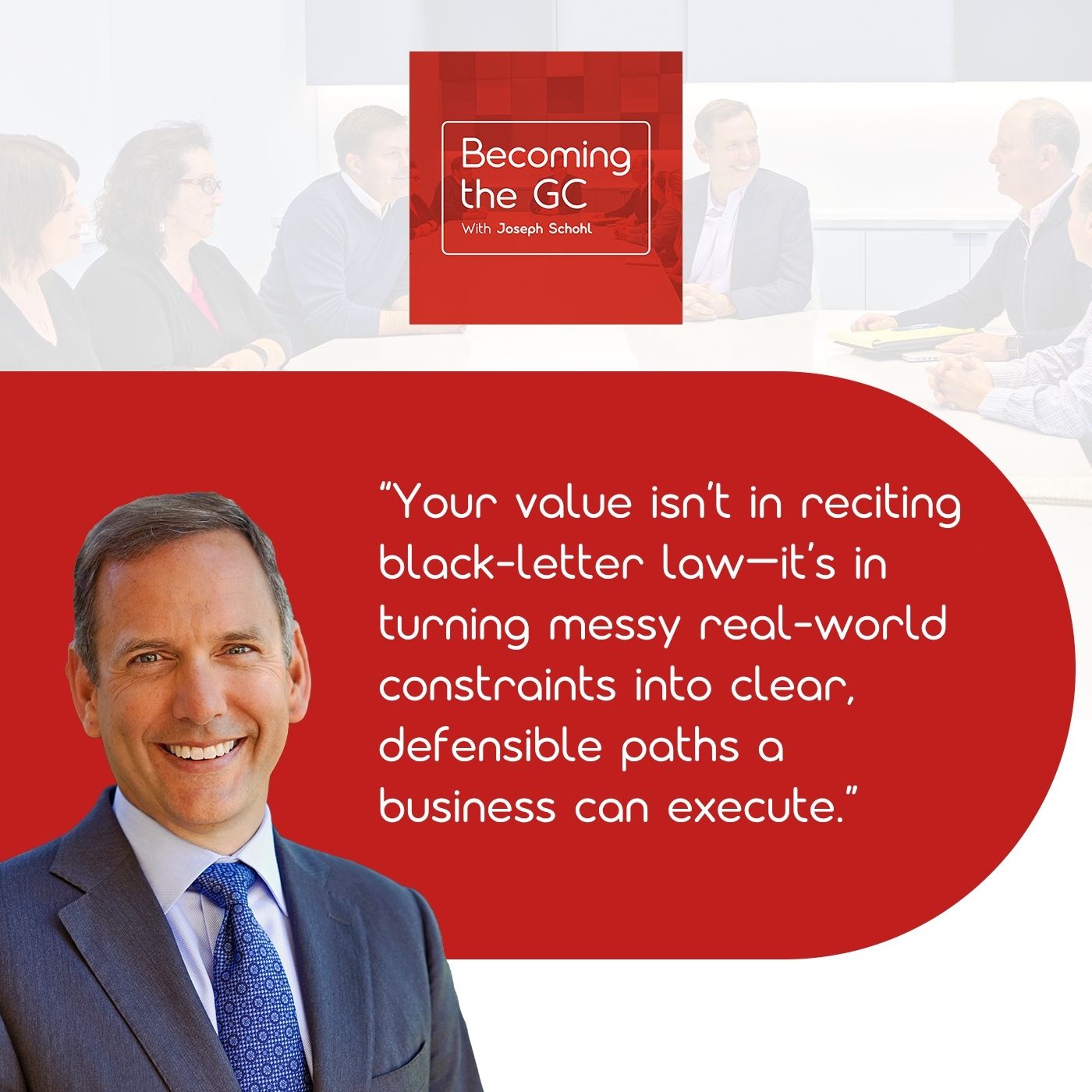
Second, pragmatism is the modern GC superpower. Navigating a Russian-owned cyclical industrial business through the global financial crisis forced Noah to focus on what actually keeps a company alive. Cash, customers and credibility. The lesson for aspiring GCs is clear. Your value isn’t in reciting black letter law, it’s in turning messy real-world constraints into defensible paths forward the business can execute.
Third, we’ve gone from minute books and corporate seals to AI-assisted due diligence and business clients doing their own legal research in chatbots. That’s made the GC more central, not less. Noah underscored that AI can surface clauses and patterns, but it can’t yet read the look and feel of a company, weigh cross-border risks in 100-plus jurisdictions or tell a board, “Here’s the risk, here’s the trade-off and here’s the decision I recommend.” If you enjoyed this episode, please subscribe to the show and leave a rating. It really helps more aspiring and current GCs discover these conversations. I’d love to connect with you directly. Just search for me, Joseph Schohl, on LinkedIn. Until next time, thanks for reading.
Important Links
About Noah Popp
 With over two decades of distinguished experience, Noah Popp is a results-driven legal professional with a proven track record of success in corporate law. He has consistently delivered innovative legal and business solutions for global manufacturing companies, providing strategic counsel to executive leadership on complex, business-critical matters.
In July 2025 Popp became the Executive Vice President, General Counsel, and Secretary at Enerpac Tool Group Corp., an NYSE-listed global industrial tools and service provider.