
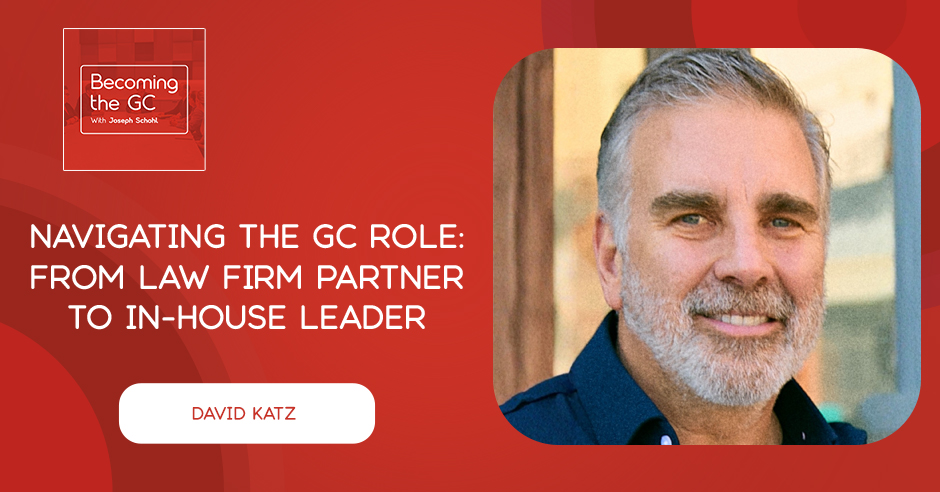
The GC role today demands more than legal expertise—it requires vision, adaptability, and business acumen. In this insightful discussion, David Katz, a seasoned legal professional, shares his unconventional journey from a long-standing law firm partner to a thriving General Counsel. Discover the pivotal moments that shaped his career, the challenges and triumphs of transitioning in-house, and his valuable advice for aspiring GCs. Join us as we explore the evolution of the legal landscape, the impact of technology, and the mindset essential for success in today’s dynamic business environment.
—
Watch the episode here
Listen to the podcast here
Navigating The GC Role: From Law Firm Partner To In-House Leader With David Katz
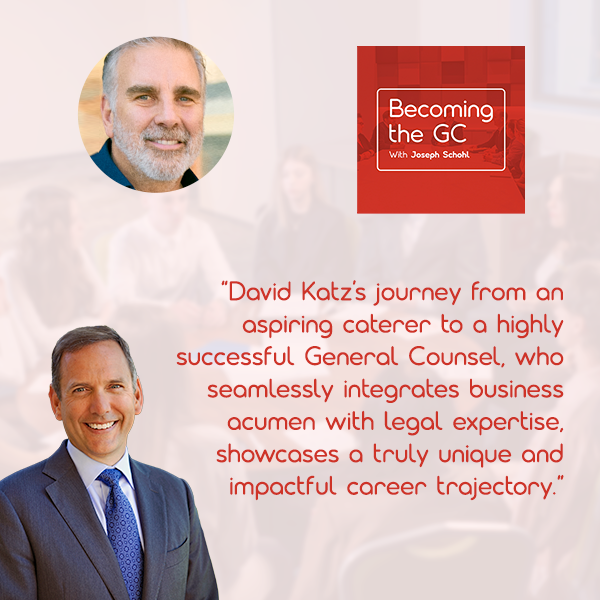
We’re talking with David Katz, the general counsel of RadNet. David took one of the most unconventional paths to the GC chair of any of my prior guests. He spent a decade in the catering business, discovered law through a single business class, and then spent twenty years as a law firm partner before making the leap in-house. It was a simple NDA request that changed everything in his career.
Stay with me to the end, where I’ll share my key takeaways from the episode. David Katz has been the executive vice president and chief legal officer of RadNet since March 2020. At RadNet, he’s responsible for overseeing all legal matters, including mergers, acquisitions, securities, and joint ventures. RadNet is a publicly traded company, and it’s the largest provider of freestanding, fixed-site, outpatient diagnostic imaging in the country. With more than 400 centers, they’ve also been expanding internationally.
David is RadNet’s UK executive sponsor. David joined RadNet from the international law firm Perkins Coie, where, as I mentioned, he was a partner for twenty years. He was in private practice for 30 years before going in-house. Mr. Katz has also served as a Los Angeles County Sheriff’s Reserve Deputy for 35 years. He’s a two-time Medal of Valor recipient from the LA County Sheriff’s Department. He’s also been a finalist for corporate council awards three times with the LA Times and twice with the LA Business Journal. Please enjoy my interview with David Katz.
David, great to see you.
Good to see you, Joe.
David, one of the things about your journey to becoming a GC that’s different from most is that you were a partner law firm for a number of years before you made the switch in-house to a full-time GC role. I’m going to want to talk about that for sure. Before, let’s rewind the clock and go back and tell me first what inspired you to pursue a career in law to begin with?
Unexpected Start: From Catering To Corporate Law
Back in college, I actually had no intention of becoming a lawyer. I didn’t have any lawyers in the family. There was really nothing to point to that would steer me in this direction. I actually had been in the catering business for ten years and intended to become a caterer when I graduated from college. I loved cooking, and it was just pretty easy for me.
That was going to be what I was going to do. In my third year of college, I took a business law class and really enjoyed it, and did very well in it. The following year, I took two more business law and real estate law classes and did very well in both of those. I started to realize, “Maybe this is something that would be my vocation or my profession after college.” That’s how I decided to go to law school.
Did you apply while you were in college and go straight through?
I went straight through. I applied at the end of college, and I went to Loyola in 1987 and graduated in 1990.
Did you grow up here in LA?
I did. I was born in LA. Okay.
You go to law school, and what lawyer did you think you wanted to be?
I didn’t have a problem speaking in front of people, and I was pretty good at thinking fast on my feet. I thought I was going to be a litigator, but I was an undergrad business finance major, and I really enjoyed business. I thought, maybe I’ll be a corporate attorney. I had narrowed it down to litigation or corporate. I did moot court and law school. When I started talking to people in my second year summer job about which area to go into, it became clear that if you went to a larger firm, you were going to be carrying somebody’s bags for a long time as a litigator.
I just didn’t want to be doing that. I went the corporate route, thinking that if I did mostly M&A, I would get the same satisfaction of closing a deal as I would in doing litigation that comes to fruition at the end. I ended up going and practicing corporate law from the day I got out of law school, and have been doing that ever since for 35 years now.
Tell me about your progression from being a first-year associate to a partner.
I spent five years at my first law firm. There were about 55 lawyers. The reason I chose the firm was that they had a significant Pacific Rim practice. At the time, I had a desire to do business in Japan. Why? I have no idea. I just did. They had a pretty good Pacific Rim practice. I joined them, and I was there for five years. The partner that I was working for came to me one day and said, “Can you draft an NDA? We’re going to be looking at merging with another law firm.”
I drafted the NDA and thought, “I’m just coming up on my end of my fifth year. Do I really want to get subsumed in an M&A transaction and have to meet new people, and it’s not going to be on my terms, etc?” I right away started looking for another job and went to another law firm a couple of months later. I was there for five years and made partner. A couple of years after making partner realized that once the kimono was opened, the firm wasn’t the right firm for me.
I had actually thought I’d be there the rest of my career. Tight around that time, a few different law firms came after me, and I talked to a few different firms, and Perkins Coie was very small in LA and only about 400 lawyers nationwide, and they really wanted to establish a corporate beachhead in LA. I took the plunge, and I ended up being there for twenty years while the firm grew to about 1400 lawyers.
I have to ask. Your first law firm, if they hadn’t asked you to review the NDA, you would have found out with everybody else. Maybe things would have been different.
I have often looked back at the intersections that I have faced in my life, not just my career. If you go left, this happens. If you go right, that happens. There’s a movie that was made based on that thought process. I tend not to look backward. I tend to look forward. Thankfully, no matter what bumps in the road I face personally or professionally, it’s always worked out the way it should be.
That’s a great way to look at it. I remember that movie. I don’t remember the name was like Changing Lanes or something. It’s super interesting to think about the path not taken, but more important to think about the road that you’re on. Sounds like it’s been a great one. Take me through what it was like being a partner at Perkins Coie for that length of time, and then deciding to go to an in-house role after so many years invested in the private practice track?
A lot of people have asked me that question because it’s unusual in this day and age that somebody is twenty years at the same firm. There’s a lot of disloyalty in the law firm environment, and for good reason. There’s disloyalty in both directions. Unfortunately, it’s just become much more of a business than a profession. I would say that I actually loved being at Perkins for all those years that I was there.
For many of those years, there was the same managing partner, and the firm was based in Seattle, and he was just a wonderful person. He would fly down every quarter, and he would meet with literally everybody, and he would know your family, and he would ask about your family, and he knew your own personal issues. I always felt that I was part of a larger family there. Things started to change, and they changed in different ways.
They changed in terms of the way management looked at the firm. There were a few 800-pound gorillas that developed over time, and they wanted to throw their weight around. I had been practicing for about 30 years at the time, and I could have gone through my retirement, and I was about 56 or so when I left. I could have easily just stayed there the rest of my career. I was at the pinnacle, frankly, of my book. I didn’t have to leave.
The decision to leave was not an easy one because the devil you know, as they say. I knew every aspect of where I was. I’d been there twenty years and I had a secure position, but this opportunity that came up to come to RadNet, I had known about the company for many years beforehand because one of the senior executives here and I have been friends for sixteen years. There was a general counsel here, and he passed away in 2018.
He had been here for 25 years. There really was never the opportunity. When the opportunity came about, I was like, “Am I going to take this plunge? This is a pretty big risk. It’s something I don’t even know that I can do.” You practice 30 years in private practice, you’ve reached the height of your career, you’re a senior partner, and you’re questioning, “Can I be a general counsel? Do I have any idea what to do?”
The answer is, “I didn’t know what to do. I was used to advising clients over all those years at the top of the pyramid. Now I’m going to have to come in and meet all the new people. I’m going to have to learn new processes. I’m going to have to try to figure out the business. I’m not a healthcare lawyer at the time.” All of those things said when I came in, I faced an opportunity and a challenge. The opportunity was that I could put my own stamp on the department.
The challenge was that there was nothing there. There was no infrastructure. The couple of lawyers that were here were working off their laptops and saving documents that are laptops, not even to a network or to some shared drive. Coming out of an environment where everything is so intended to be secure and be able to find every document, all those kinds of things, and coming into an environment where it was the complete opposite was scary. I had a lot of sleepless nights.
I didn’t realize that RadNet hadn’t been a client.
RadNet had been a client for about two months.
For a short period of time. What was your practice focused on? What industries and what type of work?
I was agnostic to industry. My industry-wise concentrations changed over time. They had been in tech and biotech life sciences. Most recently, at that time, before I left, I was very heavily in the rep in the restaurant industry. I had gotten a little niche going in the restaurant industry and had been really pursuing that aggressively and quite successfully. I was enjoying it. I was doing corporate, securities, and M&A.
You were doing capital markets, transactions, mergers and acquisitions, and then general corporate counseling. That you had some glimpse into it.
I had a good, strong mix.
For a lot of your buy-instances?
No, ironically, and I know this is going to come as a shock, I think in my entire 30-year career, I can count on one hand the number of clients of mine that actually had GCs. Some companies had GCs and then terminated them, or just said, “It’s a cost center. I’m not going to deal with this cost center. We’re going to slice this off.” I was used to working with the C-suite regularly. The president, the CFO were typically my two contacts at all of my clients.
Did you think of yourself, or did they think of you in any of those roles as an outside GC?
The “Outside GC” Mindset: Combining Legal & Business Advice
Yes. One of the things that I always did from day one was couple business advice with my legal advice. I did that based on the fact that I had had my own business that I had started as an entrepreneur during college. I had my undergrad business finance degree, and I was well-read in business. I would try to put my business hat on when I was giving legal advice to a client. I think the last thing that an executive wants to hear is “This is what the law says and this is what you have to do.”
I don’t want to say most, but many, that’s the advice they give. I had one. I remember my second law firm, one of the partners said, “Why did you tell the client that?” I said, “What do you mean?” They said, “You gave business advice.” I said, “That’s what executives want to hear.” I was like a 6th or 7th-year lawyer at the time. This is a partner, and the partner goes, “You cannot give business advice. You’re not allowed to get business advice.”
I just shook my head, walked out, and went, “That person’s never going to be successful.” I was right. The lawyers that are the most successful, in my opinion, and it’s just my opinion, are those that can put themselves in the shoes of who it is that they’re dealing with. Now, if they’re dealing with a general counsel, maybe they don’t have to give business advice.
The lawyers who are most successful are those who can put themselves in the shoes of the people they’re dealing with. Share on XIf they’re dealing with an executive who’s running the business or operating, then that person wants to know, “You’re my trusted advisor. What do you think? You know our business.” If you don’t know the person’s business, you have no business having that client. You need to learn the person’s business, the company, and what their business and their industry are. Not everything. You’re not running the company, but you have to know enough to be conversant.
You have to know enough to understand the pressure points, what keeps them up at night, and be able to help them be prospective rather than always catching up and making mistakes and then having the problems in the rear-view mirror. That was what I tended to do with my clients. That’s what RadNet actually saw in me in those two months, in a few very limited circumstances where they had given me projects to do. They quickly made the decision. “This was the person that we want.”
Clearly, you had the mindset of a GC even when you were outside counsel. Making that transition to the GC role would certainly be supported by that. What were the biggest differences when you moved inside? You mentioned not having the infrastructure and support like you had at the law firm. What else?
No billable hours. I cannot say I missed that. Let me tell you the positives and the negatives. Positives are no billable hours. The positives are you’re not on that January first hamster wheel that you’re on every year in a law firm. You’re actually trying to create value over time. You’re not looking at the short term. You’re not looking at just a twelve-month box that you’re caught in. I think early on, I faced challenges in that people were still caught up in the person who had preceded me.
He was big shoes to fill. Not only as a person, but as a professional. He had been here so long, and he had basically grown with the company, and he was beloved by people. He was the moral and ethical vein and backbone of the company that I came into, being concerned about, “Am I going to be able to just be me? Am I going to be able to put my own stamp on the practice here?” At the time, his daughter was an SVP here.
She was a lawyer, and I think she had hoped that she would have taken the position, and there was one other lawyer. There were just two plus me. Quickly, people that I interacted with, and very quickly within weeks, came to me and said, “Just be you.” I would still hear, “This is the way so-and-so did it.” I said, “I understand. That’s okay. We do things differently, and people have adjusted to it.” It’s five and a half years later, and I haven’t heard that in many years.
Did you ever think in those early days, “I made a big mistake leaving the law firm partnership?”
The Ultimate Loyalty Test: The COVID-19 Pay Cut
I’ll say two things on that. One is that I have never looked back once in five and a half years and wished that I was still there. I’ll say that, but then I’ll say, “My timing was impeccable.” I joined on March 2, 2020, and COVID hit two weeks later. I went from thinking, “I now have a dream job, secure long-term contract.” I’m good at having our stock go from 20 to 5 and to have our CFO come in and call me one day on a Saturday and say, “By the way, we’re all taking a 50% voluntary pay cut,” which is all public knowledge because we’re a public company and we have an 8K for it.
I said, “No, I’m not.” He said, “Yeah, you are.” I said, “The whole idea of a voluntary pay cut is I say, I’m okay with it.” I said, “I have a five-year contract that says this is a good reason.” He said, “You might want to think about that.” That was one of those inflection points or the intersections that I talked about a few minutes ago, where I had to decide, am I going to stand on ceremony or contract, or am I going to show the management team that even though I’ve been here for five minutes?
I’m one of them. I’m going to take the same risk they’re all taking. I had 45 days to make the decision, which was my window in the contract. I had tried to negotiate for 90, but they didn’t give me 90. I decided I wasn’t going to do anything about it. I wanted people to know that I was in the trenches with them. The world was coming to an end, so to speak. They had bigger fish to fry. They had 11,000 employees.
They had bigger fish to fry than worrying about me. I decided not to do anything about it. I think that was one of the best decisions I’ve ever made in my career because it really did. The executives had all been here at least fifteen years at that point. It was almost as long as 25 or 30. I was here for two weeks. I really had to trust. They saw that I was in the trenches with them under the same circumstances, notwithstanding the short longevity here. I think they respected me for that.
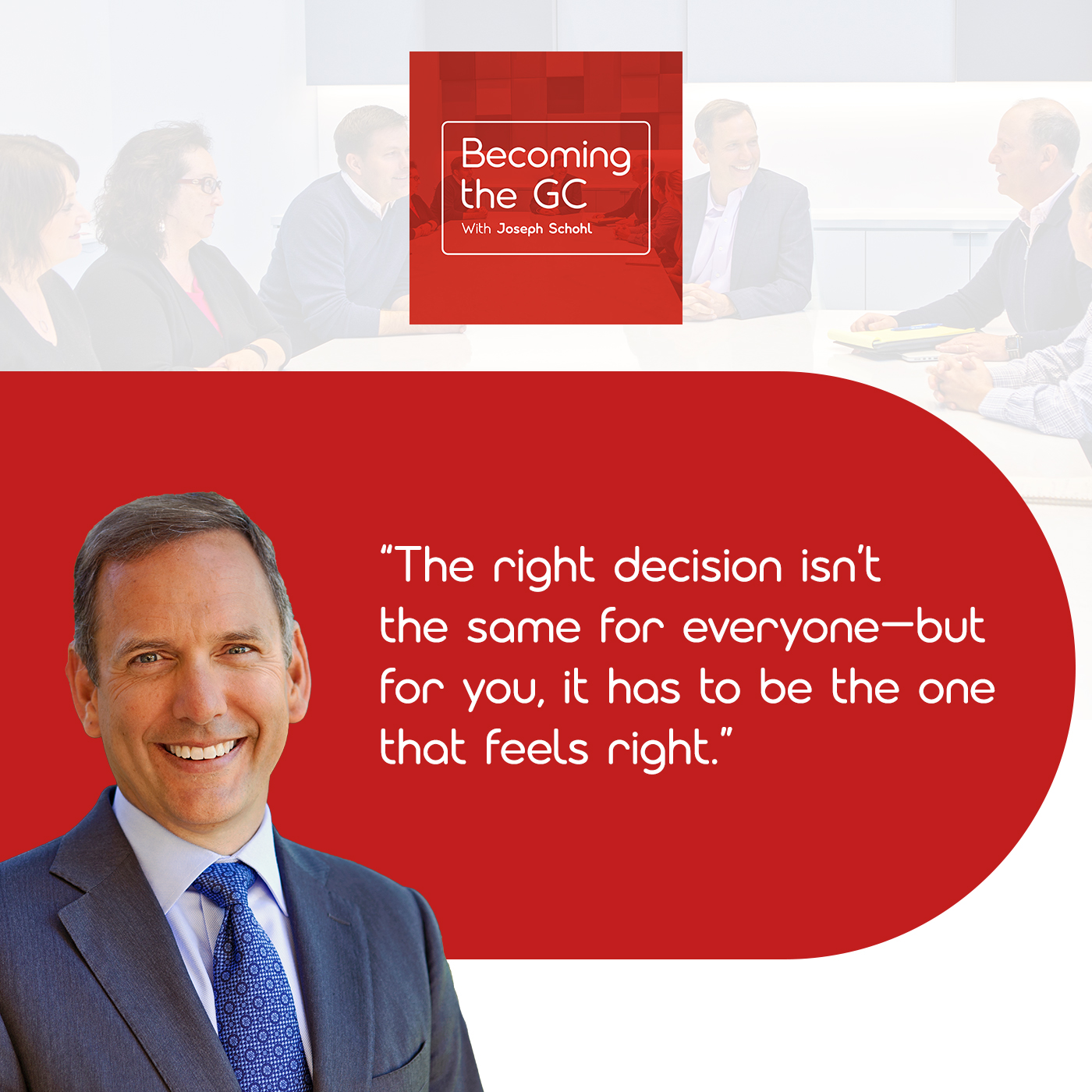
That really resonates because even though the GC is in the C-suite on the management team, there’s always a question of whether he or she is one of us from the business side, from the business folks’ standpoint. You made your choice, or you didn’t exercise rights that you had, which showed that you were one of them. Here we are. That’s a great lesson for people. Hearing, and I’m sure it wasn’t an easy decision, and it may not even be the same decision for everybody, the right decision, but for you, that was the right decision.
Ironically enough, I did also think to myself, if I did trigger a good reason, they have a right to cure. They’ll just put me to 100% and then they’ll probably either find a way to get rid of me or they will resent me. I did not want that to be granted. I had been practicing for 30 years. I was economically stable, fiscally stable. I can make that a decision. If things didn’t work out, I can probably go back to private practice. I had been asked to go back. I wouldn’t have done it with enthusiasm, but I could have done it. If you’re in your second year as a GC or fifth year as a GC, maybe it’s a different story. Maybe you don’t have the luxury.
Since that time, I have followed you guys because I’ve done some work in the radiology space as well. You’ve had tremendous success as a company, a lot of growth. I’m just curious. I didn’t look. What’s the stock price now?
Driving Explosive Growth With Digital Health & AI
It’s right around 75. I pinch myself every day. Don’t sell yourself short. You’ve done more than just a little in radiology. You’re one of the luminaries on the legal side of radiology. I do honestly pinch myself daily. When I joined, we were about $700 million market cap company. Earlier this week, we reached just about under six billion. It was five and a half years.
Why do you think that is?
Are you throwing this off all over the plate to say it’s because of me?
No, I don’t want to hear it, but I’m also doing the math like that’s worth a lot more than 50% of your salary.
Let’s just say it’s been a good ride, and more than I could have ever dreamed about. We’ve done probably 70 plus acquisitions in that time period. I would say that the most significant of those acquisitions now is in the AI space, which is it’s where we’re going from a standpoint of digital health, because it’s all new in the last 5, or 10 years, but it’s accelerating at lightning speed.
We are doing them all over the world. I would say that is a significant driver. We’ve done lots of tuck-ins over the years where we’ve acquired other radiology companies. Our legacy company, the outpatient radiology, has freestanding locations. We’ve grown from, I think, when I joined, we were in the low to mid twos, we’re now at 401 across in about eight states.
I think we were in five states when I joined. What has really launched everything is the digital health initiatives that we’re doing, both in AI as well as in OS. We’re building an OS in the cloud for our industry, which is, you might remember, RIS and PACS, the Radiology Information System and the Picture Archiving System. If you go get a scan, it ends up in the picture archiving system. If you call a facility or the billing and collection, or any other staff that goes on is in risk.
All of that has been on-prem in the entire industry and really around the world. We’ve been building for almost two years a cloud OS system that’ll be proprietary, but also will be commercialized outside of RadNet. That’s really, together with all of our AI applications, what I think has launched our evaluation to where it is.
How has the legal team evolved over time to support those initiatives?
As I said, when I came, there were three, including me. Those two are not here anymore. I’ve built a team where, if you look at both professionals and administrative, we have about fourteen now. It doesn’t hold a candle to what your former place had that you were involved with, but it’s still pretty good-sized for what we are.
We’re handling most of our acquisitions and our California litigation internally. We handle all of our leasing internally now with 401 locations. There’s always tons of leasing going on. We do our international acquisitions using outside partners, legal partners in those jurisdictions. The department has changed completely. I think that our management team looks at it and says, “We never thought this was what we needed, and we cannot believe we went this long without it.”
I frankly never intended to build a mini law firm, managing a department. I had those opportunities when firms would come to me and say, “We want to open up a corporate department and such and such. Why don’t you come to our firm?” I just had no interest at that point in my career. Maybe if I were 35 or 40, okay, but in my mid-50s, do I really want to take on that responsibility? I came here, and I wasn’t asked to take on that responsibility. I created it by necessity. I wouldn’t have it any other way now.
When I came here, I wasn’t asked to take on a responsibility. I created one out of necessity, and I wouldn’t have it any other way. Share on XThe company is more than tech-enabled. That’s where the present and the future are in radiology. What about in your legal department?
The AI Revolution: A “Complete Disruptor” For Legal Practice
We’re a little tech-challenged in the department. We’re not early adopters. We did take on iManager as our DMS because several of the team members, including myself, had used iManager at our other firms. It was like that’s a natural fit since we know the product. We test drove a few different products, and that’s the one we landed on. Is it perfect? No. Is it good? Yeah, it’s good enough. We are behind on AI for legal.
It’s amazing how fast that has come into Vogue for legal departments. We’re currently evaluating different AI products for in-house legal departments, and we’ll settle on something pretty soon here. They’re quite expensive, but in what little I’ve done using ChatGPT, it’s absolutely mind-boggling how incredibly efficient and how quickly you can access information. I’ve lived through fax machines. Some people listening to this will not even know what I’m talking about.
In my first law firm as a summer associate, we had memory typewriters. Starting with that, from fax machines to 286 Pentium chips for computers, to scanning printouts, and cleaning them up in the word processing department, and then getting to the internet and email. All these different things that made lawyers and many others more efficient at their jobs. This is a complete game-changer, a complete disruptor in terms of being able to help a legal practice. There are plenty of dangers and pitfalls associated with it. If used correctly and cautiously, it is going to be amazing. We’re moving to that area.
I agree with that. I think it’s going to change some of the attributes we look for when we’re hiring attorneys. Their ability to leverage AI tools, I think, will become more important. You take a really good lawyer and give them really good tools. You start to separate dramatically from the pack. How do you manage your day-to-day? What gets on your calendar? What doesn’t get on there? How do you get your work done?
I never answer my office phone. I never give out my office phone number.
What’s an office phone?
There are some Cisco bricks sitting on my desk here. If my office phone rings, the receptionist knows that I don’t know the person. It doesn’t ring all the time. It rings like once a week. The people who need to get to me know my phone number. They know my mobile number, and that’s how they get a hold of me, or by email. I have always kept my own calendar for 35 years. No one else has access to my calendar to actually see my calendar. If you want to have a meeting, you need to talk to me.
That way, I know that I can juggle my calendar. It has gotten more complicated over time here because we now have a pretty good-sized infrastructure on the business side, and they love to just pop stuff on your calendar, whether you have something there or not. I generally handle my own calendar and handle my own calls, and that way I can juggle what I need to juggle. How do I get everything done every day? I have a really good team, which allows me to focus on the things that I’m interested in focusing on or that I need to focus on.
You spend some time in Europe. How do you manage the time zone challenges when you’re there?
Managing The Global GC Role: Time Zones & Face-To-Face Interaction
I have time zone challenges everywhere, wherever I’m at, because we have a subsidiary in Australia, which we just bought a few months ago. The only time that works for them and us is 6:30 AM our time, 11:30 PM their time. That’s a challenge. We have a large East Coast presence. I’m dealing with the three hours there. We have subsidiaries in the UK and the Netherlands.
They’re eight hours and nine hours ahead, respectively. We’re looking at other opportunities in Europe. I’m done trying to figure out time zones because I have so many that I have to contend with. If I’m in Europe, then I’m on the same time zone as our subsidiaries in Europe. The East Coast is only six hours behind at that point. I’m on the board of directors of all of our European subsidiaries. I’m actively involved with every one of those from a relationship management standpoint.
I’m our UK executive sponsor. I’m on the business side in the UK in addition to the legal side. I’ve just given up on trying to worry about time zones. If I’m in Europe, it’s not a vacation. I’m definitely working, and I’m always looking at my phone and my email. If people are impatient, it’s because they had to wait six hours instead of an hour for a response, which is what they’re used to.
You rely on Outlook to make sure you’re in the right place at the right time.
I’ve gotten a little better at setting my meetings to the local time zone in advance of being there. That’s when I’m there, it will show up at the right time. In the Outlook at the top and the name of the meeting, I will put the time here so that when it’s on my calendar or showing two weeks from now at three in the morning, I realize, “That’s not what time it’s going to be. The local time will be 4:00 PM.”
What do you do to stay on the cutting edge of legal developments and just keep up to date on changes in the law, regulations, etc?
That was one of my biggest worries when I came in-house was how am I going to keep up to date? The beauty is that now law firms are really generous at sending out all kinds of free information regularly. I signed up for probably about the top 10, 15 law firms for updates. I read a lot daily, and I read a lot of those updates, and that pretty much keeps me up to speed. We have a bi-weekly department meeting. We talk about things that are happening in the law. We have a lot of jurisdictions that we have to pay attention to, not only in the US, but internationally. It’s a lot. It’s absolutely overwhelming.
Do you have an in-house lawyer who’s responsible for your international business?
You’re looking at them. We have a lawyer in the Netherlands who handles our GDPR and handles a lot of our national contracting on the commercial side and those types of day-to-day things. As far as overseeing all of the international subsidiaries, that falls under me.
You’ve got a lot of hats, a lot of jurisdictions, a lot of substantive areas, a lot coming at you in different forms. What part of your workday do you enjoy the most? When you see it on your calendar, you’re like, “I’m excited for that?”
Work Philosophy: Prioritizing “Fun” & Face-To-Face Interaction
It’s more when I look at the stock price than when I look at my calendar, be honest with you, because that definitely puts a pep in your step.
It makes it all easier.
It makes the day go easier when it’s up. When it’s down, it’s depressing. I don’t know if there’s anything specific on my calendar that I look forward to. I have to say, when people talk to me about my job at this point, I tell them I’m having fun. I’m having fun, and it’s not a chore. The chore is the drive. I do come into the office. I used to come five days a week. Now I come to the office three days a week. The chore is the drive.
Do I need to make the drive? I make the drive because I want to be around the other executives, and I want to be around my team because there’s no replacement for face-to-face interaction and communication. The current gen, whatever we have, they’re missing out on that. The people who are all working from home regularly, no disrespect intended, it’s really hard not to actually have face-to-face communication. I know that our CEO won’t pick up the phone to call me for things that he would walk into my office and talk to me about.
There’s no replacement for face-to-face interaction and communication. The current generation—whatever we call it—is missing out on that. Share on XIt has to rise to a level of super importance for him to pick up the phone. If he wants to just run something by me and then come back fifteen minutes later and try me again in a different way. An hour later, come back and try me again with a different way of doing something. I might’ve said, “You cannot do it that way.” That happens because of the physical interaction of being in the same place. I love that. That is probably what I enjoy the most about my day is having that interaction. There you go.
That hallway interaction. For young lawyers, it’s very difficult to get the benefits of mentorship through unscheduled Zoom calls.
I agree.
That just happens naturally when you were at the law firm, I’m sure, as a young associate, and now you’re on the other side of that with your team.
My boss used to make me come in on Saturdays when I was like in my first five years. “Come in on a Saturday and we’re going to sit and train together.” He would sit next to me and literally we’d go word by word in a contract. Like, “This is why I made this change.” What was your reasoning for saying this? What was your invaluable? Two years of that, of him mentoring me in that way, and it just doesn’t really exist anymore.
That gives me chills because it makes me think about similar situations when I was a young lawyer trying to figure out which way it up. If you could give one piece of advice to your younger self now, what would it be?
I say this phrase to a lot of people, “This too shall pass.” I think that has been something really important. My father used to say that to me, and with all the struggles I’ve had in my life, I always remind myself that this too shall pass. Each time it has, that includes the death of my wife from cancer thirteen years ago, and dealing with three years of her being ill. When I say this too shall pass, it was not like, “She’s going to pass.”
Through every struggle, I remind myself that this too shall pass. Instead of being defined by hardship, I choose to move forward—and that keeps me positive. Share on XIt was more like you hit bumps in the road, divorce, you have death, all these, you don’t lose a job, all these kinds of things that could happen in your adult life. A lot of people define themselves because of each of those things. I’ve just chosen to take the view that this too shall pass, and I’m going to move forward. I think that is what’s kept me going and kept me positive about life.
There’s a lot of wisdom in that, and it works in both directions. When things are going the way you want them to go, you have to recognize that this too shall pass, and we have to savor those moments. We’re often in the middle of some of the best times in our lives. If we don’t stop and reflect on that, it can be gone. That’s great. Thank you. I always ask this question. I’m going to predict your answer in my mind. If you weren’t a lawyer, what career would you think you’d be in today?
I think I would have been a caterer because that was the direction I was going. Now I have to tell you that that would have been the worst decision of my life because the hours are worse as a caterer than they are as a lawyer.
Which is hard to beat.
It means every weekend until midnight, 1:00, or 2:00 in the morning, a great business, fun business. You’re always around people who are enjoying themselves. They’re at a party. They’re at a wedding. They’re always enjoying themselves. It’s a fun environment, but boy, it’s rough.
David, what are you most looking forward to?
That’s the big R, the retirement question that people ask me all the time. I’m not in a rush to retire. I’m loving what I’m doing because I’ve been given the flexibility to have this business role in addition to the legal role, and whatever I volunteer to take on, people have been supportive. What more could I want? I’m also getting the opportunity, as you said, to go to Europe regularly. I’m getting to travel, I’m getting to enjoy those things. If I decided to retire, what would I do?
I love it when the answer to the question what are you most looking forward to is more of the same, which is what I’m hearing from you. That’s a great place to be in your life. Anything else you want to leave our listeners, folks who are seeking to become a GC someday, moving up the ranks? Any other words of wisdom you want to leave them with?
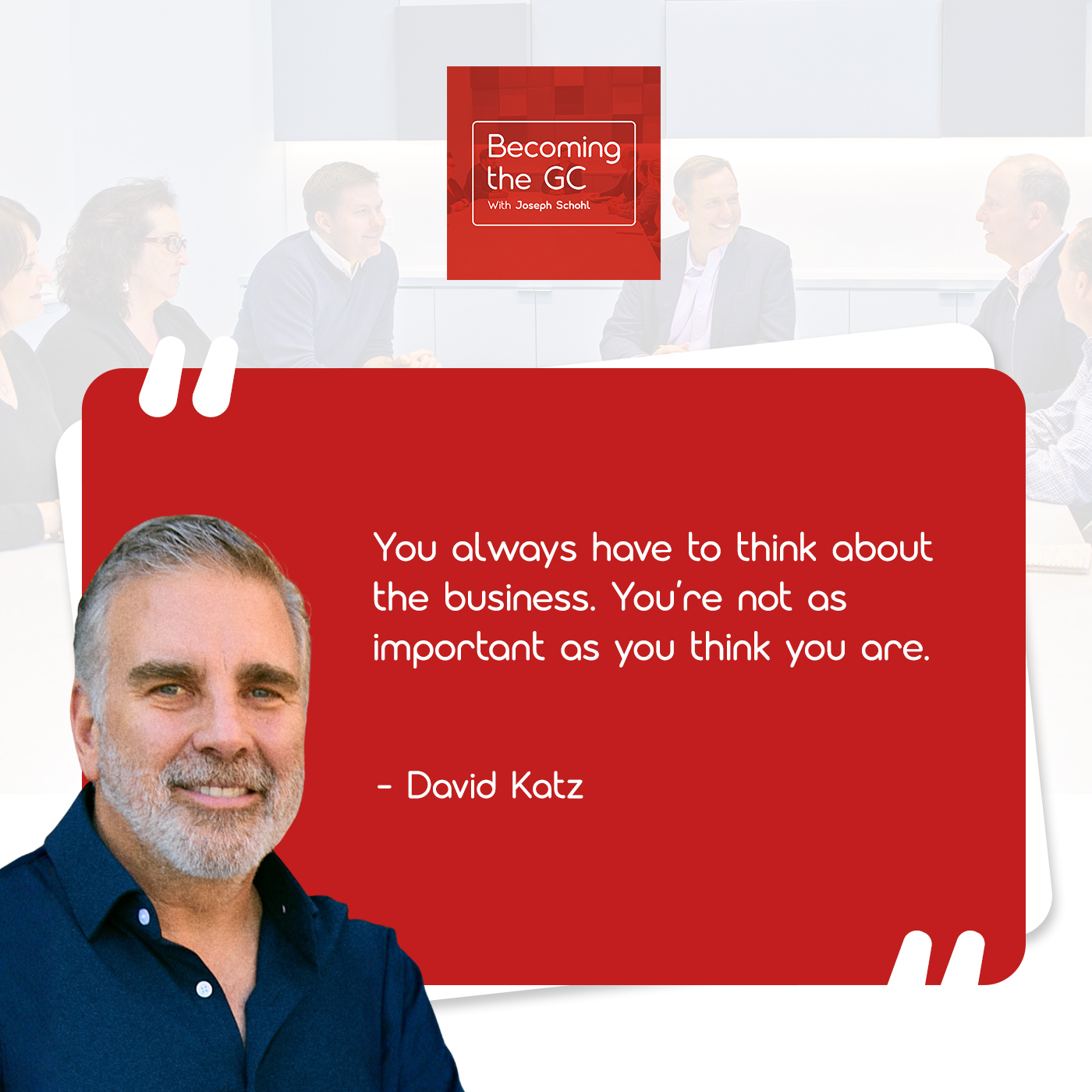
There’s one piece of advice I got early in my career, probably 30-plus years ago, from the then general counsel at Guess Jeans. He said to me, “The legal tale should not wag the business dog.” I have given people that advice for 30 years, because it just resonates so powerfully that you always have to be thinking about the business. You’re not as important as you think you are.
You always have to realize that without that business, you have no client. Your legal tail should not wag that business dog. I’ve lived by that both in private practice for 30 years, and I’ve lived by that. I tell people that that are now law firms that I use, including folks I used to work with in my old firm. I tell them the same thing. You need to be more conscious of the business part of this decision when you give me this legal advice.
Brilliant. I cannot think of a better note to leave it on, David. Thank you so much for joining us.
My pleasure, Joe. Take care.
Take care.
—
Thank you for listening. I hope you enjoyed our time with David. A few key things I’ll take from this episode are that David’s story reminds us that career pivots can happen at any stage. Reminds us that business acumen is just as valuable as legal expertise. Perhaps most uniquely, that sometimes you have to be willing to put trust in the CEO and the company and be willing to lock arms with the management team, versus trying to rely on whatever legal rights you may have in your employment contract.
His advice to let the business dog wag the legal tail and not the other way around is something every aspiring GC should remember. Until next time, this is Joe Schohl. For more tips on accelerating your path to becoming a world-class general counsel, subscribe to my newsletter at InsightCounselAcademy.com and connect with me directly on LinkedIn. Thanks.
Important Links
- David Katz on LinkedIn
- RadNet
- RadNet on Facebook
- RadNet on X
- RadNet on Instagram
- Insight Counsel Academy
- Joseph Schohl on LinkedIn
About David Katz
 David J. Katz serves as Executive Vice President, Chief Legal Officer, and UK Executive Sponsor of RadNet, Inc., a NASDAQ-listed healthcare company with the largest network of outpatient radiology centers in the United States.
Since joining RadNet in 2020, David has led the extraordinary growth and global transformation of the company’s legal department — expanding it from a one-person operation into a highly diverse international team of fourteen professionals and staff. Under his strategic leadership, the department has played a central role in nearly 70 acquisition transactions, providing legal guidance across traditional radiology services, advanced technology, and artificial intelligence initiatives.
As RadNet’s market capitalization has grown from $1 billion to over $4 billion, David has built a legal function that spans more than a dozen practice areas — including mergers and acquisitions, corporate governance, compliance, employment law, real estate, healthcare regulation, intellectual property, and international law. He has established the department as a comprehensive, business-oriented legal partner, earning recognition for excellence, innovation, and operational impact.
Beyond overseeing legal operations, David serves as a trusted advisor to RadNet’s executive leadership and Board of Directors, offering strategic counsel on high-stakes legal matters and enterprise risk. His foresight and proactive approach have helped the company successfully navigate complex legal and regulatory landscapes.
As RadNet’s Executive Sponsor for the United Kingdom, David also oversees both legal and business operations for the company’s UK entities. He currently serves on the boards of RadNet’s subsidiaries in the Netherlands, United Kingdom, India, and Australia.
David brings over 35 years of legal experience to his role, but his leadership extends beyond the corporate world. He is a two-time Medal of Valor recipient from the Los Angeles County Sheriff’s Department, where he has volunteered as a reserve deputy for 35 years and served as Team Leader of the Malibu Search and Rescue Team for the past 12. With over 10,000 hours of volunteer service, David has risked his life by dedicating himself to saving the lives of people he has never met — a testament to his character, resilience, and unwavering commitment to service.
Mr. Katz joined RadNet from the international law firm Perkins Coie LLP, where he was a partner for 20 years. Mr. Katz was in private practice for 30 years before joining RadNet.
Mr. Katz has also served as a Los Angeles County Sheriff Reserve Deputy since 1990, and is a two-time Medal of Valor recipient from the Los Angeles County Sheriff’s Department.
He has also been a finalist for corporate counsel awards three times with the Los Angeles Times and twice with the Los Angeles Business Journal.