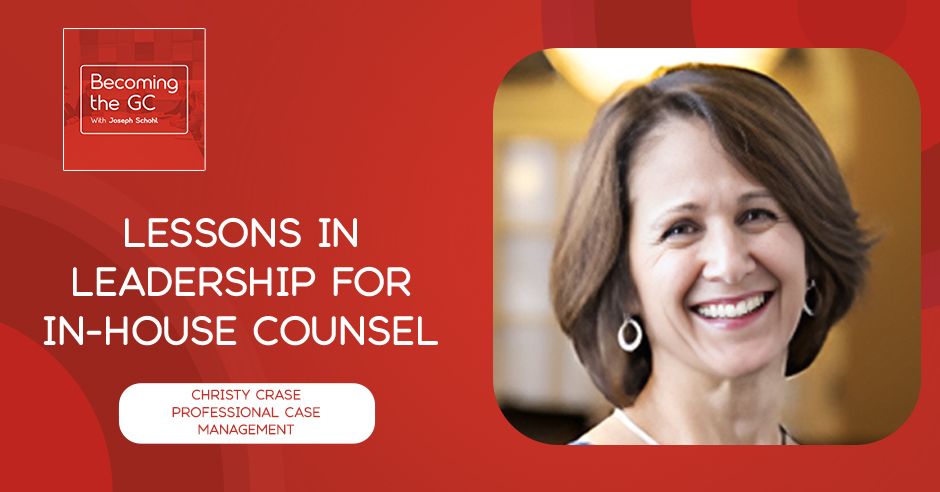
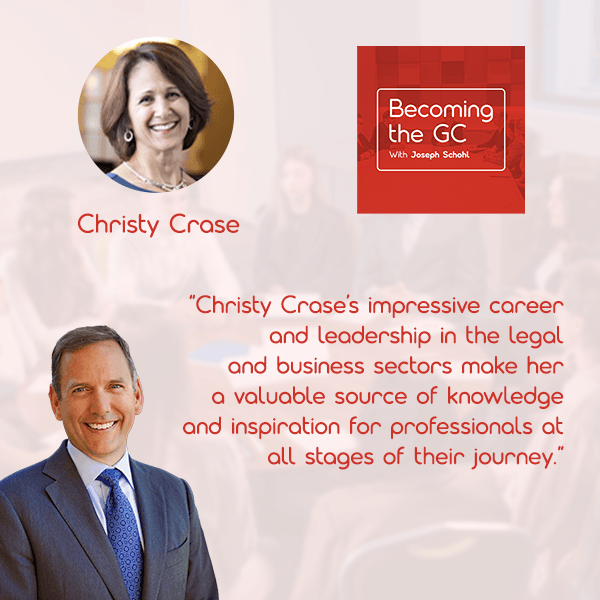
Christy Crase shares her remarkable journey to becoming in-house counsel, transitioning from intense law firm work to leading legal teams at Professional Case Management and PCM Trials. In this episode, Christy opens up about what it takes to succeed as in-house counsel — from balancing legal risk with business growth to building a legal department from the ground up. She shares the challenges of stepping into a leadership role, learning business strategy on the fly, and how listening and adaptability became her superpowers. Whether you’re already working as in-house counsel or considering making the leap, this episode offers invaluable insights to help you grow in your career and confidently navigate the corporate legal world.
—
Watch the episode here
Listen to the podcast here
Lessons In Leadership For In-House Counsel with Christy Crase
In this episode, we spoke with Christy Crase. We had a great conversation about her career and I identified with so many of the things she had to say, as I’m sure you will, too. Stay with me to the end where I will share my key takeaways from the episode. This show is sponsored by Inside Counsel Academy, where in-house counsel go to elevate their careers while enhancing their lives. Also by GeneralCounselWest, a law firm that supports GCs of healthcare companies and their teams with an inside counsel mindset.
Our guest is Christy Crase. Christy is the Chief Legal Officer for Professional Case Management and PCM Trials. Professional Case Management is the nation’s premier home care provider for nuclear weapons and uranium workers suffering from chronic illnesses contracted in the course of their employment.
PCM Trials brings research nursing services to the homes of clinical trial participants worldwide who are enrolled in pharmaceutical and medical device research studies. They completed an acquisition of EmVenio research, which is a scalable network of clinical trial sites strategically located in underrepresented communities to engage a diverse patient demographic. Christy lives in Colorado and loves outdoor sports and her beautiful family. Christy, welcome to the show.
Thank you. I’m glad to be here.
A Journey From Law Firm Intensity To In-House Leadership
I want to start out back at your first lawyer job doing M&A work at Jones Day. What was that experience like?
Intense. It was the prototypical, the name of the company, Jones Day night, holidays, weekends, that type of thing, being at the printer around the clock, but it was also an amazing environment to learn how to be a lawyer. How to put together documents, respond to partners, see how everything comes together, and the training they gave us, but it was an intense environment.
Where were you located? Which office were you in?
The Dallas office.
Did you know at that time that you’d eventually want to move in-house?
I did. I started thinking about in-house way back in law school for summer internships. One internship was six weeks at Jones Day. The other one was in-house at a development bank in Chicago. I’d come to know the development bank before I ever went to law school. I did economic development in communities. We got to know the development bank and their in-house lawyer brought me in for one of the summers.
It was then watching him and how he was such a key factor in not only the business strategy but also the values and integrity, and how the whole company looked at him and came to him for big problems. He was always involved. I knew before, even when I went to the firms, that eventually I was working towards going in-house.
Having had some insight because a lot of people don’t get insight to what in-house life is like when they are still associated with a law firm, do you think that helped you in your work?
Transitioning To In-House: New Challenges And Developing Business Acumen
Yes, because I got spoiled at the law firm. Back in those days, you’d mark up an agreement, put it into the typing center that would turn it around, have it on your chair the next day, and you had all these resources. You could go to the library for everything. Being in-house, it was you and your computer. You didn’t have access to Westlaw, you didn’t have access to this. I had a clear vision going in-house. The difference between that in firm life was big.
It’s so funny you mention what we call word processing groups because sometimes you’d put it in and wait for it to come back the next morning. Other times, you are standing over their shoulder, trying to hurry them along.
Yes. I love the word processing group.
Tell me then how it came about that you moved from the law firm to in-house.
When we left Dallas after my first daughter was born to be closer to family, I came back to Colorado and was at another firm. It was when I was on maternity leave with my second daughter that I got a call from a partner at the first law firm, Jones Day, and it was, “What did I do that 3 or 4 years later, he’s calling? I screwed up or something.”
He was one of those partners who never gave you an idea of how he thought about your work or what, but he said, “I have got a client in Colorado and they are looking for in-house counsel and I can’t think of anyone better.” I went to meet with the general counsel at the company and we hit it off right away. That’s when the move was made. Needless to say, I came back to the firm that I was at after maternity leave and packed up everything and left. It was a little uncomfortable situation going on maternity leave and not ever coming back.
When you stepped into that role, what from your law firm days do you think helped you the most and then what were some of the new things that you had to learn?
What helped me the most was a little about what we talked about. That was an engineering construction design. It was a large company, complicated contracts, very complicated transactions, and so the law firm helped me see that and how to put those things together. It came very second nature to me how to put deals together, and it helped me understand how businesses work because I have done a lot of due diligence and how HR fit to compliance, the business, and the strategy.
Executive presence is about people who are thoughtful and calm. Share on XThe hardest thing to change or the things that I had to address and adapt to was, “Guess what? It’s no longer all about legal and the advice you give anymore.” It’s a piece of everything, and as the lawyer at a big law firm, you are paid to track down everything and make sure it’s right because companies are calling you to make sure that they have looked at everything.
You don’t have time to do that, and you have to start evaluating what’s most important. How do you pare it down to the issue and sometimes I felt like I wasn’t giving the full complete answer, but it was like you had to adjust to understanding what the risk was with the company. It wasn’t about, “Here, align such and such verse so and so subsection.” They don’t care about that. They are like, “What’s the answer? What’s the big idea?” It’s getting a better business mentality, the business acumen piece of how does all of this fit into what they are trying to do.
Did that come about through more reps or did you do anything to accelerate that? How did that grow?
It’s still growing. It’s experience. It’s the school of hard knocks when I had a couple of great business people say, “I know that you are trying hard, but this is what I need.” I was fortunate at that company, the CEO, was a lawyer. The perspective he brought and the rigor that he brought. Every time we did a huge infrastructure contract, we had to go and there was a matrix of ten things we had to brief and where did we end up.
It quickly helped me focus on what is important in their mind. Whether or not I got the choice of law is important to me. It was learning about what was important and then how to not only talk about what was important about where we ended and what we gave up and why, on balance, we got the better thing, and so that it was a lot through a business person who also understood the legal aspect and framing it that up for us. It was through that process, and then, reps years later, you still fell at times and then you got to, “Here we go. We’ll do it again.”
When did you make the transition into healthcare?
Embracing Healthcare And Expanding Responsibilities
Around 2008, the engineering and design company that I was at was purchased, and I began to see my role pigeonholed a little bit into doing certain things. An opportunity came up and I went and looked at this was a med device company and went and looked at it and it felt like finally coming back together. I had started undergrad as going pre-med, going pre-dental.
I didn’t know that.
I came from a family of dentists and doctors. It brought a lot together for me, and I liked where healthcare was going, and so I moved to the medical device company and it was one of those things that was one of the hardest decisions because I had a great company where I was. It was a smaller PE-backed company that I knew was going to be bad, but it was the mission, being able to feel like you were touching people. It was cool in the engineering company driving by something and saying, we helped build that, but this was people and it was getting into that aspect of it. It was the mission.
At what point in your career did you start to have responsibility for areas outside your core legal expertise? Say litigation or investigations.
It was at the med device company in that company. I was the deputy GC. It’s a small legal department, but there were a couple of us, but I was the deputy GC for the whole Americas region, and so all of a sudden, it wasn’t drafting the contracts. I had to work with HR, logistics, and finance. I started sitting on Americas region leadership team and seeing all the different pieces that were coming together, starting to look at the regulatory impact. That’s when it became a lot broader and that’s when I started managing other people as well.
Did you enjoy both aspects of those right away or did that evolve over time?
I enjoyed it. I’m one of these people that’s probably a weird lawyer in terms of I like. I love being in some of those strategy and business and leadership meetings because I like seeing how it all comes together and doing a lot of those leadership development courses and things. I would hear a lot of people say it’s such a waste of time. “I just learned about this new model of how people work,” and I always thought it was fascinating. I enjoyed it pretty much right away. That was one of the things I was looking for.
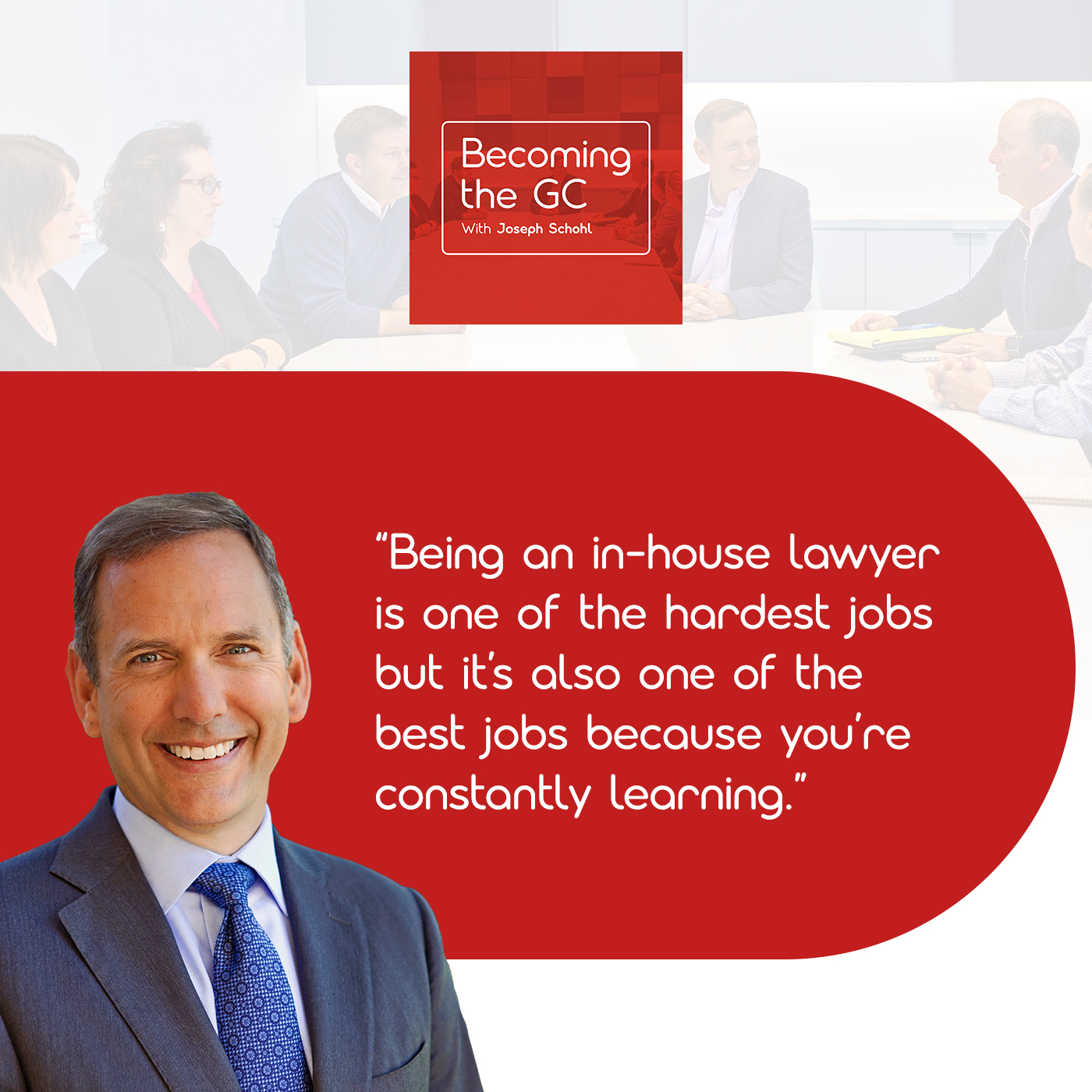
I often say being an in-house lawyer and certainly a general counsel is one of the hardest jobs, but I also think it’s one of the best jobs because you get paid to learn. You are constantly learning.
You do. Going and learning about all sorts of business stuff that’s going on.
Balancing Legal Expertise With Business Partnership And Leadership
Now that you are in the role that you are in, where you are not a legal advisor but a business partner and a corporate leader, how do you manage those competing demands?
Sometimes well, sometimes not as well. Constantly coming back to what the business priority is and where the most risk is for the company. I see it as my role, my job is to protect the company, and so it’s trying to come back to where I see those gaps all the time. There are a lot of things that can be done, but somehow, for me to fit into, “This is where the company’s going. We are acquiring a business or setting up a framework for how we are going to expand into these markets. What are the things we haven’t looked at?” I have got to continue to focus on those. The hardest part is always with our jobs. There’s the urgent, it’s coming up, you have to do it, and there’s the important, and it’s finding time for that important part, but it’s tough.
That’s a great segue. I like to get tactical and practical here and ask you, what does your calendar look like at the start of the day?
Time Management And Productivity Strategies For A Legal Officer
My calendar at the start of the day is always meetings blocked here and there. I tend to look at it on a weekly basis versus a daily basis. I spend a lot of time looking at the week and trying to figure out, “I have all of these things to do,” and then plotting out when I’m going to have that focused time to do them. If you don’t have something that you are going to do, it’s easy to wander off to email, checking everything for everybody else, and so I have got to pull it back to those blocks of times I have got to focus on certain things.
Peter Drucker called it dribs and drabs of time. It’s something like together, when you add them up, even if it’s a large number, it’s insufficient to get the work done in dribs and drafts.
You have to block chunks, big long chunks at times to focus.
That’s what I was going to ask you. Do you manage your calendar on Outlook?
I do.
Do you block time at the beginning of the week then when you’ve sized things up?
My GSDs time.
When one of those blocks comes up and nothing’s happened because you have to move it or put something else over it and then it happens, how do you start? What’s your ritual?
It depends on what it is. If it’s drafting, I have got to get some background music on. I start outlining it and jump in. That’s a great question. You have to be comfortable, but it’s mainly trying to pull everything in front of me and turn everything else off. I have to turn off the popup messages. Sometimes I will put my phone away.
In Outlook, the notifications are often new emails, but now people text as well. You mentioned your phone. When do you respond? What’s your method for managing those inputs, emails, texting? When do you get to that?
Managing Communication, Meetings, And Maintaining Work-Life Balance
Usually, at the start of the day, it’s certain in between those breaks, like you say, a lot of times, I will start and get rid of a number of the quick ones and then when I know I have taken off the low-hanging fruit, then I can focus. There are always those certain people that can break through. My kids, my husband, and my boss.
When those come through, you pull yourself out, but for the most part, I usually try to do those before a big block of things because I feel like I have at least gotten through all the ones pretty quickly and then can put it away knowing there’s nothing immediate that’s licking me in the face. Even if there was something, like a lot of times, it’s just, “I’m going to get to this at this time.”
For example, something came through and a whole bunch of questions kept pinging up because I forgot to turn off my Outlook little bell and lots of questions. Finally, it was like, “I will get to this tomorrow afternoon.” Sometimes, that’s the biggest thing. People want to know that it didn’t go in a black box. They don’t need the answer. They just need to know I got it. Here’s the time I’m going to work on it. That’s what I try to do.
Listen to the business where they're trying to go. That helps you narrow and focus. Share on XYou then block that time for when you are going to do it. You put it in a box, put it on the shelf, and you’ll pull that down when it’s done. How much time do you spend in meetings on a given day or on average over the course of a week?
I would say easily two-thirds of my time is spent in meetings.
Are you in-person or hybrid?
There are people that are in-person, but I’m still primarily working at home. It’s click off one meeting, click on to the next. Click off, click on, which, in some ways, is more efficient. You lose some of the niceties, but it’s fine.
Does your day start early?
Not too bad. I have always had the philosophy that you can control when you come in. There are a lot of times you can’t control when you leave.
I have never heard that, but it’s so true.
It’s the famous M&A lawyer. Someone told me that. I don’t know if they were famous, but it’s so true. One of the acquisitions we did was with an international office, and so most of the time, international stuff will start, but it’s usually not before 7:30 or 8:00, at least now. During the acquisition, there were a lot of early morning calls and as we start looking at more things internationally, there may be more of that, but for the most part, it’s back down to an 8:00 or 8:30 type of start time.
What do you do to personally recharge?
I’m a Peloton junkie. I love it, so I have my time.
In the morning?
It used to be in the morning. Until the pandemic, I was a workout person all the way through. Up until the pandemic, I was like up at 5:00, hit the gym by 5:30, and that was my time, because again, I couldn’t control that. I couldn’t control it at the end of the day. It completely flip-flopped in the pandemic. I don’t have young kids at home anymore. Now, because I love doing it, that’s what’ll get me off the computer and I will give myself that time to go do that and then eat. If I ever have to come back, I will, but that’s my recharge type of thing.
That’s super interesting, that transition. I wonder how much it has to do with not having young kids in the house anymore, like pandemic versus that or combination.
That’s a big part. They happened at the same time for me, but that’s a big part because you are not driving, picking up, doing all that stuff or whatever. All of a sudden, it’s like, “Why am I getting up at 5:00 in the morning? That’s silly. I can do it at this time.” Big change for me.
I’m still a morning person myself, but I heard some advice from somebody who said that they work out at 5:00 because they don’t want to give their best thinking time to working out because they are not a professional athlete. They are professionals. It wasn’t a lawyer but some other knowledge worker, and I thought that hit home a little bit.
Were you talking about 5:00 in the morning or 5:00 PM?
Learn to listen to understand. Share on XThey were saying they work out at the end of the day instead of the beginning of the day because they don’t want to sacrifice that best thinking time.
There is some of that. I get a real lull right in the afternoon and it’s that pick me up and there are times I notice if I do that, then I will come back if I have to. If you get a lot going on, you come back and then you are a little more recharged and you can do it if you have a long day.
The Importance Of Self-Reflection, Executive Presence, And Looking Ahead
You’ve been exposed to so many things, and you’ve learned so much over the course of your career. How do you keep that knowledge so that you are retaining it and growing from it? I found earlier in my career, I did very little self-reflection. Everything was happening so fast, and if I could give advice to my younger self, it would be like keeping a journal or something to be able to draw upon so you are not missing out on those lessons as they are happening. Is there anything that you’ve thought about or done anything about?
I have kept a journal at different times. It seems like it fits and starts, but there’s a lot to be said about that. We, as a company, have been doing executive coaching and keeping that side, that time apart, and then that self-reflection is so important because it’s like, “Why does that trigger me so bad?” When you start peeling it back, then you can start addressing it. Holding time for that is super important.
One question that comes up often for people earlier in their career is around executive presence, this somewhat elusive notion of executive presence. What does executive presence mean to you and how do you advise people who are looking to get more of it?
A couple of things come to mind. The first one is being your authentic self. I once took this speaking course and I’m high energy. I bounce around, I talk with my hands, I do a lot, and I keep trying to stand there. They are like, “Your energy, it’s great. Use it.” I was like, “Some people may not like it when I pop up and start writing all over the board or whatever.”
I see that. It’s being authentic. It’s connected with people, most leaders particularly. The other thing is, when I think of executive presence, I think of people who are thoughtful and calm, particularly in our field, because people come in and they are like, “Guess what just came in the door? This type of lawsuit.” It’s okay. If you fly, they fly as well. It’s people who are able to be calm, centered, and then be thoughtful. Those are the words that come to my mind when of executive presence.
It’s easier as you gain more experience because you can stay calm in those situations because in your mind, you think, “I have dealt with worse than this.” Earlier on, maybe you haven’t dealt with worse than this. People, when bad things happen, maybe there is too much internalization. We are lawyers, so we inherit problems, then we are asked to fix them. We are often not the ones that caused it, and reminding ourselves of that is helpful as well. We talked a little bit earlier about your job in protecting the organization. We also talked about your job as being a partner to the business and helping them accomplish their objective. Do you see a tension between those two? How do you see that?
At times, protecting the business may not exactly do what they want to do. That’s the tension where I have come to understand it is all not no, but maybe we can do it this way. We’re trying to figure out other ways to do it and figuring out what’s the best way to accomplish the need. You feel like you have protected the company.
In some ways, my first response is their attention, but in a lot of ways, they are not. You can be an advisor and somebody who’s helping them get what they want done, but protecting the company at the same time, at times, involves a little management or helping guide the path and showing what it could look like in different ways, and this might be the best path to go down.
Speaking about looking, how do you look over the horizon at what might be impacting the business in the future? Especially now that you’ve been in this company, where you’ve got to look at different horizons because you are in multiple businesses and you are growing through acquisition, including into some adjacencies that present new risks.
A lot of it is continuing to understand and get in and understand what the business is and what they are trying to do. I learned a ton from our business partners all the time. For example, on the clinical trial side, when we acquired EmVenio. It was a lot about the FDA wanting to get more clinical trials out to more types of people.
I didn’t know that the FDA had come out. Should I have known? Probably, but that was like, “They are out in front of me. I need to understand how to get going,” and then jump off from there. Listening and seeing a lot of the themes are similar, but where do I need to spend my time? It’s listening to the business where they are trying to go and that helps me narrow where there’s a lot of focus for me.
It’s understanding the business piece of it as well. You have to keep up with all the legal theories and the things that are coming along. I rely a lot on my team, which has a lot of specialists to do that. I spend a lot of time one-on-one with them capturing some of that because they are each, they are experts and I’m the jack of all trades.
Are you like a visual learner or somebody who learns through other people having conversations or both?
Both. I’m also a very tactical learner. I have to do it and go through it. It’s like I can learn the theories and that kind of thing, but it is totally different when you go through it and do it. Especially like when we did all of this international work. I knew from doing it, our issues are going to be data privacy and security and employment as we go over, but it wasn’t until I was in it that I was like, “I kind of knew, but now I know what it was.” It was doing it.
Advice For Her Younger Self And Final Thoughts
If you could give advice to your younger self, what would it be?
Probably two things. One, I’m still working on listening a lot better in terms of what problem are we trying to solve. As a young lawyer, you are like, “Here’s the issue. I have got to go off and show everybody. I have got the right answer.” What’s the issue you are trying to solve? It’s listening and asking a lot more questions.
I don’t know how you get over this, but I had a feeling like, “If I ask too many questions, they are going to think, ‘Why do we hire her?’” It’s like really listening to understand. Probably the second thing, at least for me, is appreciating at a much younger or earlier stage in my career the value that I bring to the management table. Having that confidence and awareness probably would have helped me or younger people a lot earlier in my career.
What are you looking forward to?
When I came to this company, I wanted to do this because they didn’t have a legal department and I wanted to create a sustainable department that could go on. We are starting to, I’m starting to see that come together, and then with the company as a whole, we have added all these pieces and we are in a painful part of organizing chaos.
I’m looking forward to seeing how all of this comes together. We are trying to take off in an area and seeing how all these pieces can come together to build what the initial vision was, and we are in it, so it’s messy. I’m looking forward to seeing us become, on the clinical trial side, this company that we have been envisioning, and we can do it, but it’s not going to be easy. It’s going to be messy.
I love your style and I learned so much from this conversation. Is there anything else we haven’t covered that you would want to pass along to folks reading?
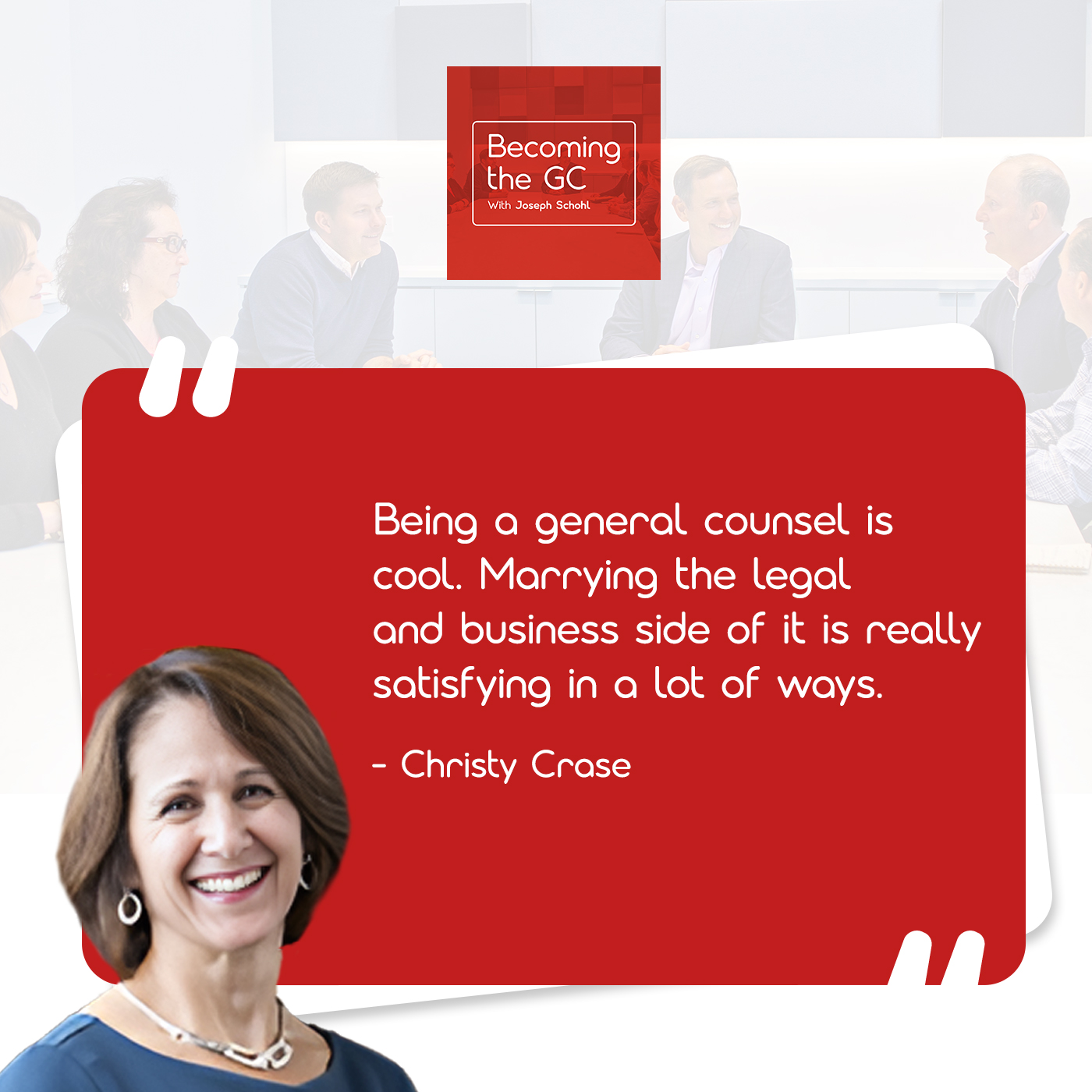
I don’t think so. I feel like I have had a great career and it’s fun to be on the side of it and to start having other people come in and do some of the same things and watch them grow, too. For me, being a general counsel is cool to marry that legal and business side of it. It’s satisfying in a lot of ways. We get to see a lot of cool stuff.
Thanks for being with us.
Thank you.
—
Thank you for reading. I hope you enjoyed our time with Christy. I know I did. A few key things I will take from this episode are, Christy was already thinking about being an in-house lawyer when she was still in law school. That’s rare. She did this because she was able to observe an in-house lawyer during a summer internship at a bank and how he was such a key factor in the business strategy and beyond. She’s yet another get stuff done adherent and uses time blocking. That’s near and dear to my heart. Until next time. For more tips on accelerating your path to becoming a world-class general counsel, visit InsideCounselAcademy.com and connect with me directly on LinkedIn.
Important Links
- Christy Crase on LinkedIn
- GeneralCounselWest
- Inside Counsel Academy
- Professional Case Management
- PCM Trials
- Joseph Schohl on LinkedIn
About Christy Crase
 Christy Crase is the Chief Legal Officer for Professional Case Management and PCM Trials. Professional Case Management is the nation’s premier home care provider for nuclear weapons and uranium workers suffering from chronic illnesses contracted in the course of their employment. PCM Trials brings research nursing services to the homes of clinical trial participants worldwide who are enrolled in pharmaceutical and medical device research studies. In 2024, PCM Trials acquired EmVenio Research, a scalable network of clinical trial sites strategically located in underrepresented communities to engage a diverse patient demographic.
Christy began her practice as an M&A attorney at Jones Day in Dallas, Texas. She joined Holland & Hart’s corporate practice group when she moved to Denver in 2000. In 2003, Christy transitioned from private practice to working as in-house counsel. Since that time, she has worked in a variety of different legal rolls including Associate General Counsel at Washington Group International; Deputy General Counsel at Gambro Renal Products; and Associate General Counsel of Payor and Commercial Contracting at DaVita.
Christy grew up in Colorado and enjoys skiing, running, cycling and ballet. She and her husband, Scott, live in Denver and have two adult daughters. Christy has served as a board member on several non-profit organizations including KidPower of Colorado and the Denver Public Schools Foundation.