
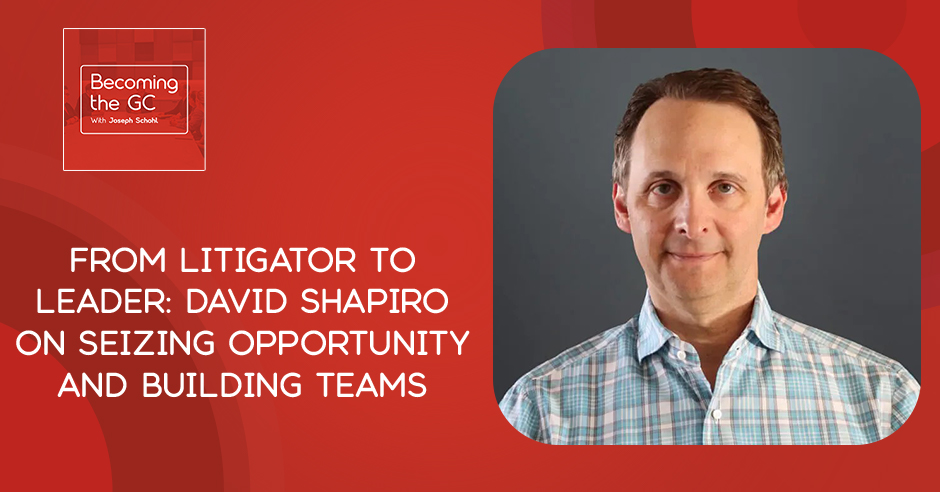
The path to becoming a top executive in in-house legal leadership is rarely conventional, but always a masterclass in career agility. David Shapiro, the General Counsel who shaped legal strategy and culture at major companies like DaVita, Vail Resorts, and Ibotta, sits down to share his remarkable journey. He reveals why accepting a massive pay cut to join the Department of Justice was the pivotal move that changed his entire career trajectory. You’ll learn about the intense process of leading the billion-dollar acquisition of Whistler Blackcomb at Vail Resorts. You’ll also learn what it takes to guide a company like Ibotta through its IPO process. David shares his invaluable, non-traditional advice for aspiring GCs: the power of “collecting experiences,” building a unique professional brand, and learning to bring “calmness to a chaotic world.”
—
Watch the episode here
Listen to the podcast here
From Litigator To Leader: David Shapiro On Seizing Opportunity And Building Teams
Our guest is David Shapiro, the general counsel who has shaped legal strategy and culture at major companies like DaVita, Vail Resorts, and Ibotta. I know you’re going to be inspired by learning about his journey. We talk about how binge-watching legal dramas as a kid set David on the path to becoming a litigator and why he never doubted his calling. You’ll learn about how a spur-of-the-moment decision to take a government job ended up changing the entire trajectory of his career. We dig into David’s philosophy on leadership, why he believes growing and stretching your team is the surest path to long-term success.
Here’s David’s bio. David Shapiro is a seasoned legal executive whose career has spanned private practice at top law firms, significant public service at the Department of Justice, and transformative in-house leadership roles. At DaVita, he rose to Chief Compliance Officer and then General Counsel. At Vail Resorts, he led the legal team through major growth and acquisitions, including the landmark Whistler Blackcomb deal. He’s the General Counsel of Ibotta, where he’s helping lead the company through its transition to a public company and beyond. With that, let’s get to the interview.
David, welcome to the show.
Great to see you.
From Law School To Leadership: The Beginnings Of A Litigator
It’s great to see you. I’m excited to talk to you. You and I overlapped for a period of time at DaVita. We both worked for Kent Thiry. You then went on to Vail. We’re going to learn all about that, where you worked for Rob Katz. These are two larger-than-life CEOs. I can’t wait to hear about your journey along the way, but let’s go back in time and start closer to the beginning. We were talking. You grew up in Connecticut. You went to undergrad and law school there. During law school, what were you thinking your career path might be like as a lawyer?
I was always focused on litigation. It always surprised me to meet friends and make friends in law school. They didn’t know what they wanted to do, or even if they wanted to be deal lawyers. I had no desire to do anything other than be a litigator. That’s why I went to law school, and that’s what I focused on in law school. That’s what I pursued in the early years after law school. There was never any consideration for anything else.
With that, then, I want to go back further in time. Before coming into law school, when did you first want to be a litigator? What was it that you saw or experienced that made you want to go down that path?
I wish I had a great story of the involvement in some court procedure, but unfortunately, I suspect, like many litigators and folks who go to law school, I liked legal dramas. I watched way too many episodes of Law & Order, or whether it was My Cousin Vinny or A Few Good Men. I gravitated towards those movies. I knew it was a potentially good career. That’s what led me down that path. It’s not the best reason to go to law school, but ultimately, it worked out okay.
Those are two great movies. We all want to be Tom Cruise, and maybe not as much as Joe Pesci, although he was hilarious in that movie. That’s great. Upon graduation, then, what was your first role?
I went to a firm, Kelley Drye & Warren, which was a New York-based firm. It was a very large firm at the time, which was doing a variety of commercial litigation. I didn’t know quite what I was getting into. I remember I didn’t have a place to live in my first week.
I was going to ask you. Did you move into the city?
I was in their office in Stamford, Connecticut, which was in Southern Connecticut. I didn’t have a place to live. I thought, “I’ll probably be doing training and stuff those first couple of weeks.” That first day, I stayed until probably 2:00 in the morning. I don’t know that I ever went home much earlier than that. I jumped right in and wrote motions and pleadings. It never let up.
This is why it’s nice to have a sofa in the office. Why pay rent?
I did eventually get a place and had a great roommate. We never saw each other.
The Career Pivot: Leaving Private Practice For The Department Of Justice
Keep going. At some point, you take a government job at the Department of Justice. Was there anything in between there?
I did spend all of my early life in Connecticut. I loved Connecticut. I had a great experience there, but I did wake up around 29 years older and said, “I think I should go live somewhere else,” and started pursuing other jobs. I wanted to be in the government. I wanted to be a prosecutor of some sort. I thought that would be an amazing career opportunity.
I realized that a lot of the older litigators in the big firms spoke most fondly of their days in the government, and there must have been a reason for that. I moved to DC with another firm and worked at that firm, Mintz, Levin, which is a large firm out of Boston, for four years or so. It was an awesome experience. It was going well, and then a job became available at the Department of Justice.
It wasn’t on my radar at the time. I had gotten married and bought a house in DC. I was on a track of, “I’m going to be in this law firm forever,” and then I upended everything and took this job at Justice. That was probably the biggest career move and the biggest change I made that changed the trajectory of my career from there. It was a great experience and a great momentum from that experience.
What’s it like going from private practice into the government? Is that a pay cut? What does that look like?
That’s what I was subtly alluding to by changing my path in my very understanding life. It was a massive pay cut. Given the timing, I even walked away from my year-end bonus, having had probably my best year. It was an investment. It was something that I always wanted to do. When I was early in my career at Kelley Drye, I would go home at lunch and watch Law & Order. I was like, “I want to do that and pursue that interest and passion.”
It’s a huge change economically. It’s a huge change structurally in the sense that if you’re in a law firm, you are the epicenter of economics. When you go to the government, those resources aren’t there. That support’s not there. What’s cool is the cause that you wake up for every single morning. You feel like you’re doing justice, and you’re doing good. People are there with a mindset of loving the law and wanting to do good in the world. It was great camaraderie and an awesome experience.
If you're in a law firm, you are the epicenter of economics. When you go to the government, those resources aren't there. Share on XThat’s great. Did anything surprise you that you weren’t expecting?
Not really. It played out the way I thought it would, where great people were doing good work. I still worked hard. Everyone was committed to the cause. I loved it. I liked the process of it.
Did you have good mentors?
I did. I had good technical mentors. Law firms and in the DOJ, I had good technical mentors who were like, “Here’s how you write a motion.” Probably in the early years, it was like, “Here’s how you work hard.” It wasn’t until going in-house that I had mentors who changed who I am as a professional and, frankly, as a father and partner to my wife.
Why Go In-House? Transitioning From The DOJ To DaVita
Let’s go there. Tell us about the transition back out of the DOJ.
I left Justice. I did a short stint at another firm. Being in-house was never on my radar. I thought I had completed my resume. I’ve had this great experience in the government, working on healthcare fraud cases. I was very fortunate to work with a well-known group of attorneys out of Philadelphia doing big cases. I had some good momentum out of a case that had a lot of publicity around it, certainly in the healthcare area. Our former company, DaVita, reached out. It’s an interesting story. I didn’t respond to the recruiter reaching out several times. We won’t get into the details, but I had a bad day.
This is why they keep calling.
It’s a great lesson in leadership on how important it is. Everyday matters. I felt misaligned on a personal issue with the firm. I took the call, and one thing led to another. I’m like, “This could be even a more interesting experience to go in-house.” I had two game plans. One game plan was, “I’m going to go through the interview process. They’re going to be so impressed with me that they’ll hire me as outside counsel.” That didn’t quite work.
The second was, “I’ll do this for a year or two, and then I’ll go back to private practice. My resume will be complete because I’ll have worked in the government, having prosecuted these healthcare fraud cases. I’ll have worked in-house, managing them, and I’ll have worked in private practice, defending them.” I never left in-house practice. Once I was in, it spoke to me on so many different levels. I loved being in-house. I can’t imagine a different career path at this point.
What did you love about it?
A handful of things. One is the broader experience. There’s nothing wrong with saying, “I’m going to do these types of litigation cases for the rest of my career.” You develop deep expertise, and that’s wonderful. That appeals to many people. What I didn’t recognize and what I developed by going in-house is how cool and fulfilling it could be to do a whole bunch of different things once you’re in-house. I’ve done internal audit. I’ve done health and safety. I’ve done government affairs. These are things that you wouldn’t do if you’re outside counsel. Having that broader experience has led to a more fulfilling career for me.
Second, the impact you can have and change things. There’s a positive aspect to being outside counsel, writing a great memo, having some great guidance, and giving it to your client, like, “Good luck with that.” I love the fact that I can take that guidance, and I can implement that guidance, see it through, and have a real impact. I’ve seen that at a variety of different jobs I’ve had, where the work I’ve done has had a direct impact on the trajectory of that enterprise and business. That’s super fulfilling. Those are a couple of things that stand out to me.
You get included in a lot of things. You can make an impact beyond what maybe you were hired for when you’re not getting paid by the hour, or when people aren’t thinking about the meters running. It’s like, “We’ve got this smart person we hired over here to solve this problem. If they’re interested, they can solve a lot of problems for us.”
I’ve been fortunate to work with CEOs who have that mindset.
That’s coming into DaVita. At that time, I was the general counsel. You got hired into the Compliance Department and then became the chief compliance officer. Your role got broader and broader, which then allowed you to be a great candidate for a big GC job that we’re going to talk about.
That’s spot on. Certainly, I didn’t realize that heading in and how that would change everything for me. That has meant everything to me to have those opportunities. As a leader, fifteen-plus years later, that’s my selling point when I’m recruiting people. I’m committed to paying back that same type of environment where I’m going to hire you as an employment lawyer or as an SEC lawyer, but my goal is to grow you and throw other things at you, if that’s what you want. Those are the people who I think thrive on my teams. Those are the people whom I love working with, who are saying, “Give me anything, and I’ll go do it.”
The Power Of Perspective: How A Defense Mindset Changed His DOJ View
Law school, after college, whether you’ve worked in between or not, is a period of intense growth. It attracts people who thrive on learning, growing their skills, etc. Tapping into that, most people in this profession are going to respond and want to over-deliver. That’s what makes it so great. Were you doing healthcare litigation before you went to the Justice Department?
I was. I was doing a lot of nursing home defense work. The firm I was at was a national council for one of the largest nursing home chains. We served as a national council, managing a bunch of cases throughout the country. I had a chance to do some of those cases in the DC area. They’re great cases to learn how to litigate on. They’re heart-wrenching, gut-wrenching cases, but that was my entry to health care.
Do you think that experience affected you when you went into the Department of Justice? Some people I talked to who started at the Department of Justice, and then they went into private practice later, are like, “It gave me a different view. Maybe I wouldn’t have been so skeptical of everything.” You had it ahead of time.
I’d say more so now than going in. Going in, I certainly had a defense mindset, but very quickly, I became a little overly zealous in advocating for the government.
In retrospect.
I’ve been sitting on the company side now for fifteen years. I can think of a couple of cases where you heard stories of people doing this and doing that. When you’re in your early 30s, a couple of years into law, and you’re with all of these seasoned DOJ lawyers who have spent their career in the DOJ, all you see is the bad stuff.
One hundred percent of what you’re seeing is the bad stuff. You think everything is bad. I look back on some of the facts that I think drove a lot of those cases. I could understand and have a little bit more perspective where someone could say something that a year later in an email doesn’t sound great, but doesn’t mean they were trying to. I’m far more understanding now. Maybe some of it is age.
It could be your own emails.
Having that perspective. It is also so valuable over the years to have that government perspective and be able to say to in-house business leaders, “This is how this is going to look.” They’re like, “Don’t worry,” and I’d be like, “I’m telling you this is how it’s going to look, so we need to think through this.” One of the keys to my success is having that DOJ experience in that mindset of skepticism. That’s been very helpful.
One of the keys to my success is having that DOJ experience and that mindset of skepticism. Share on XIt gives you authority from experience. People will listen more because you have that experience. What’s equally important is that because you’ve had the experience, you’re much more certain that the advice you’re giving needs to be listened to, and that conveys authority.
In fact, that was a big challenge for me in the early years at DaVita. I didn’t have enough distance from the DOJ. I still had that mindset of, “Everything is black and white. Don’t do this.” I came out very strong. One of the senior leaders there had a chat with me, who was like, “Maybe you need to tone it down. Get to know people a little bit better, develop relationships, and think through these scenarios before everything is so black and white.” That was a big shift for me because that’s not how you are necessarily when you’re a young person in the Department of Justice. That was a forcing mechanism for me to think more broadly about these situations.
Wise advice. I bet it was hard because, at that time, and perhaps still because so much of the business model in a dialysis company is government pay, it was a heavily scrutinized environment. It wasn’t theoretical.
I was at the epicenter of that.
I remember. Before we pivot, all this time that we’ve been talking up to this point, are you a skier?
I am a skier. I wasn’t a skier until I moved to Colorado. I was about 40. I never skied, and I had never mountain biked. Now, every weekend, I am either skiing or mountain biking. We moved here, and I said, “My kids have to learn how to ski.” I didn’t know what I was doing, but I knew I had cousins back East who knew how to ski. My kids had to ski better than my nieces and nephews if they were going to live in Colorado.
Do you ski back East at all?
I have skied maybe once back East.
It’s harder.
It’s like bricks. It’s icy. I love bringing friends who I grew up with and went to school with from the East of Colorado, and between the altitude and the powder, they get hammered pretty quickly.
It makes you look pretty good, huh?
Yeah.
I learned to ski when I turned 42. Let’s have a whole chat about that on a different episode, maybe. It’s one of the greatest sports, especially with family, because you’re spending all day outside in nature having fun. It’s hard to be on the phone during that.
That’s like a good commercial. Maybe some ski company should put that up. It’s true. The ski lift time is 5 to 8 minutes. You’re talking. It’s wonderful.
Aiming For The Top: The Decision To Pursue A General Counsel Role
It’s all these built-in things. Afterwards, you get to have a nice meal and warm up. You take your boots off, and it feels great. Tell us then about that transition. When you were still at DaVita, did you start thinking, “I’d like to go even broader and become a GC.”
The short answer is yes. I loved DaVita. DaVita changed my life in so many ways, more so than any other experience I’ve had, hands down. I had a great run there, but I needed a change. I had this change of jobs. I went from the chief compliance officer to this new department I created called the Office of Special Counsel. Then, I was the general counsel for the kidney care business.
I didn’t own it all. I wanted to own it all. I wanted to have that full responsibility on my shoulders and scope. I wasn’t looking, but if you want to be a public company and GC in Colorado at a certain scale, there are only a handful of companies you can work at. I heard about the Vail opportunity and got connected with Rob Katz. We hit it off very quickly. It happened quickly.
You and I both were pretty young at DaVita. I was 36 when I became the GC. You were a little younger than I was. Maybe it was a similar age when you became chief compliance officer. Kent was pretty young when he became CEO, so he was willing to take a chance on younger people. I was looking at Rob Katz’s bio. He was young. When I did the math, he was 29 when he was on the board.
He worked at Apollo. Apollo was the major investor for Vail, so he was the Apollo rep on that board. He was young.
Ten years later, he came in as CEO. I don’t know how much time after that you joined the team.
A good time later.
I keep wanting to say Icon Pass, but that would get me in trouble. Was the Epic Pass already invented?
It was. It was several years in. I started with eleven ski resorts. Over my tenure, we had 42 ski resorts. While I couldn’t tell you the number of Epic Passes that increased, it was a huge shift, because as we were bringing online additional resorts, those people are going into the Epic Pass.
That becomes their annual pass. When you gave notice at DaVita before you started the job, how much time was there in between?
A couple of weeks, maybe.
What were you thinking during that time? This is a completely different industry. How do you get yourself ready for that?
I’m not a skier.
Not yet.
I’ll get to your question, but as a quick side note, I started in the late spring. I was there three months later for the season opener. I had only skied for a couple of years and a couple of times a year. One of the major lifts was a brand new left. The whole executive team goes skiing. We get to the top, and I’m frozen. They’re all flying down.
I don’t know if she was the president at the time, but she ultimately became the president. It was this most kind gesture of sensing it. I’m talking about it because it’s also a moment of leadership. She was like, “Why don’t you follow me and come with me?” She took me down an easier way. That moment captured all the lead-up time of like, “What did I get myself into? I don’t know anything about skiing. I don’t know anything about hospitality.” You get ready by rolling up your sleeves and diving in.
Even though I wasn’t hired for my litigation experience, it’s the litigator’s mindset of, “I know how to see a fact pattern and a subject matter and dive in.” Whether it’s a health issue at a dialysis clinic, a nursing home, a complex Medicaid or Medicare payment scheme that we’re working on, or some other statute or regulation, I feel like I’ve learned. Litigators learn how to dive into something.
You start spending time on the mountain. You spend time in the hospitality venues. You learn it and realize, “Today, I don’t understand a thing they’re talking about in the meetings.” At some point, and you’ve probably been there, whether it’s 9 months, 12 months, or whatever it is, all of a sudden, a sentence comes out of your mouth, and you’re like, “I know what I’m talking about now.” You hope that the time period from, “I have no idea,” to making that great statement is truncated as much as possible.
The Rob Katz Interview: Selling Leadership, Not Just Legal Skills
That’s incredible. During the interview process, I assume it was like, “Are you a skier? Do you have a passion for the mountains?”
The interview process is a good story. I was having lunch with someone in town. I had heard that Vail was looking, and I said, “Do you know Rob Katz? Can you make an introduction?” He makes an introduction, and I talk to Rob. He asked me to come in that week, and I said, “I can’t. I’m traveling. How about next week?” He said, “I’m sorry, I’m traveling. Let’s get together.”
It was leading up to Memorial Day weekend. I said, “I’ll talk to you after the holiday.” He said, “I’ll talk to you, but I’m going to make someone else the offer in the meantime.” I said, “How about I come on Friday night?” I was doing it naturally, but I’m shocked by how many people I’ve hired over the years and interviewed are not willing to do stuff like that. I went in on Friday night, and we sat there for two hours.
This is before Memorial Day?
Yeah, two weeks before Memorial Day.
It’s so that you at least have a chance to talk before you decide.
I go in, and we don’t talk about litigation prowess. We don’t talk about deals. We talk about leadership the entire time. As you know, coming from DaVita, I’m like, “Bring it on.” We connected over what it means to lead a team and how you think about those things. I was very candid with him and said, “I’m not an SEC corporate governance guy. If that’s what you want, you should go hire that person.”
“That’s an important skillset, but this is what I do. I’m a risk person. I’m a leader of teams. I can do A, B, and C for you.” I wasn’t going to try to pretend I was a corporate governance or even a deal lawyer because I hadn’t done a deal at that point, either. We hit it off. I spent the weekend interviewing. I came back the next weekend, interviewed some more, and had the offer.
You could speak very confidently about what you could do, which was leadership. Leadership was front and center of everything we did at DaVita. Many people have gone on to lead organizations as CEOs, GCs, and all kinds of things because of that experience that we had. That’s great. That was the right decision because all that other stuff, you figured out.
We can all figure it out. If you can’t, you hire someone, and they figure it out. As GCs, we’re general. You have to be a generalist. You have to be able to take in that information, process it, and distill it. A lot of the technical experts are wonderful and essential, but they struggle to distill it to a handful of bullet points for your CEO to understand. I feel like that’s where I’ve earned my credit at that point. I do that for the executive team.
As GCs, you have to be a generalist—able to take in that information, process it, and distill it. Share on XThe Biggest Deal: Leading The Acquisition Of Whistler Blackcomb At Vail
No question. Probably nowhere was that more important than in a company like DaVita. You become an expert at that. It was expected and required to be successful there. What were some of the most interesting things that you started working on when you got to Vail?
The first one would be the acquisition of Whistler Blackcomb. I came to work on my first day. I had my first day meeting with my CEO. He said, “Take it easy for the first couple of months. This is a long-term play. We’re in no hurry to do anything.” He then came into my office a few days later, shut the door, and said, “Forget everything I told you on Monday. We’re going to go buy Whistler.”
Whistler is the biggest mountain in North America. It was in a Canadian public company at the time. It turned out to be a billion-dollar-plus deal. I had never led a public company deal before, so I had my work cut out for me. Fast forward a year-plus, and it finally closes. That was an amazing experience. I was talking earlier in our discussion about impact. I can always look back on that. I can always look back and say, “I had a big role in bringing Whistler Blackcomb into the Vail Resorts Network and what that meant for the company.” It catapulted the company.
That was right after you joined, right?
Yeah.
That’s interesting. Did you have good outside counsel?
We did have good outside counsel.
You were able to learn the ropes from them.
Can I sit down and write an asset purchase agreement? No, but I can certainly review it and go through it with my outside counsel. Fast forward eight years, and I have a much bigger role in the deal process. I had the fortune of assuming responsibility for the business development as well. I was going out and sourcing deals, negotiating the deal, and understanding it. When you think about that opportunity for growth and the change, I give total credit to my CEO for giving me the chance and to my team for creating the capacity. You have to have a good team, or you can’t do those things.
When you think about the opportunity for growth and change, I give total credit to my CEO for the chance and to my team for creating the capacity. You have to have a good team, or you can't do those things. Share on XThe trains have to run in the meantime when you’re off sourcing deals, etc. What team did you inherit when you stepped in there?
I inherited a good, solid team. I forgot the exact scale of it. Maybe there were a dozen lawyers.
It was a mature department.
We changed a lot of the structure, composition, and mix. It was very top-heavy when I came in. We needed more junior folks to create capacity and create a different structure. I loved that team. Probably one of the hardest parts of leaving Vail was the team. They’re my people. I love them.
We’ll talk about your transition, but I can’t leave Vail without talking about what the best perks are for the chief legal officer at Vail.
The best perk is the thrill and fulfillment. This is maybe not going to be what you’re getting at, but being part of that and creating that experience. We ski at Vail. That’s where my family goes. We spend a lot of time there. Skiing around that mountain while I was working for it and seeing the kids and the families having fun, knowing that I helped in some part to create that, whether it’s making things safer on the mountain or getting that new lift approved to be installed, was the best part to me. That was fantastic. I got a free ski ticket. I don’t know that that’s going to make me or break me as a free ski pass and the ability to use certain facilities and stuff, but that was very nice. Being part of that creation is so motivating and fulfilling. That, to me, was the best part.
I love it. It’s such a beautiful place. I’m a runner, and I remember you telling me about having run a marathon. Have you continued to be a runner? Are you a runner? Do you trail run at Vail?
Good memory. I don’t run anymore at all. My knees and my back cannot handle it. I mountain bike and road bike religiously. I probably bike 5 to 6 days a week. I’m not outside every single day, but I’m outside every weekend.
That’s your thing. My wife and I ran a race called the TransRockies. It comes up the Vail Back Bowls. We spent a night there in Vail. It was beautiful. I’ve skied less there than I’ve been there in the summer.
Where do you ski? In Tahoe?
We ski at Mammoth. Southern Californians ski at Mammoth. Northern Californians ski at Tahoe because of the way the roads are, what’s open and closed in the winter.
It’s not bad being able to ski, and then go home and go to the beach. I do miss the water, I have to say. I very much miss seeing the water.
One of the perks. When you joined DaVita, had it already moved to Colorado?
No. I moved to California. I lived in California for two years before I moved to Colorado. In fact, when Kent called me up one day and said, “Can you come over tonight?” It was 11:00 at night. I have no idea why I’m going there. I’m very nervous.
To the company apartment?
Yeah. He said, “I know you moved here.” I had moved there with my wife, who’s seven months pregnant, and a three-year-old. He said, “I think we’re going to relocate the headquarters.” I’m like, “Wait a minute. I’m from Connecticut, and I have a palm tree in my front yard right now. I’m not going anywhere.” As things played out, we ended up coming here. I couldn’t be happier here. I love Colorado.
I know. It’s an incredible move. That’s around the time that I left when the company moved to Colorado. I remember going to the new headquarters when it was built a couple of years later, and I was impressed. I looked around and was like, “This is incredible.” What a great place to put it, because Denver and Colorado were a great choice. If you like the outdoors, which I do, that could have been idyllic in another life.
Not that I’m a native because I’ve been here for fifteen years, but all you West Coasters and East Coasters are moving here since COVID. It’s intruding on our time. I’m hardly a native, but it’s a big debate.
The Next Peak: Leaving Vail To Lead The Ibotta IPO
You identify as a Nutmegger. I’ll always be from the Midwest, no matter how many years I live in Connecticut or LA. I live in LA now, but we spend time in Connecticut. Tell me about when you decided it’s time to do something else.
It’s not dissimilar from what happened with DaVita. I’ve had a great run at Vail. I was there for eight years and felt I was ready for a new challenge. I had this great team in place and wanted them to continue to grow. The person whom I was training as my successor was ready to take over, and she did take over, which was amazing.
I got to know the CEO here. He called me about, “Do you know anyone who might be interested in this position? We’re going public. Here’s the company.” I’m not sure he was looking for a referral. He may have been testing the waters. As you start having these conversations, it seems like, “This could be a cool next step.” He’s a very dynamic, gifted CEO. He’s a lawyer. My work is difficult. He is a well-credentialed lawyer, including a Supreme Court clerk. He gave up the practice of law to start this company from nothing.
You’re having these conversations with him. It’s so inspiring to hear the story of someone who’s got this amazing career, who has an idea, and is willing to take a chance to pursue that idea and pursue it to the point of, “After a decade, I’m ready to go public.” Hearing that story and talking about the potential was super exciting. There have not been a lot of people doing IPOs in the last couple of years. There was a team here, a very good team. When you build a public company, you need a team that is going to grow as the company grows, which is a cool challenge and another opportunity.
When you build a public company, you need a team that is going to grow as the company grows. Share on XNFL Quarterback: The Essential GC Skill For In-House Lawyers
Anything else you want to say about that? We talked about leadership. We talked about developing teams. What would you say to people on your team or on anybody’s team? Somebody who’s tuning in who is an in-house lawyer and wants to someday have a position like the positions that you’ve had, what would you tell them they need to be doing?
There are a couple of things. One is, I hope at least my story is one of how there may be a conventional path, but there is not one set path.
That has been so clear from interviewing people for this show.
It is?
Yeah. I say it almost every episode, so I’ll stop there.
That’s great to hear.
Everybody has such a unique background.
You follow this path of corporate law, and that’s how you become a GC.
That’s what I thought because that was my path, but almost everybody I interviewed didn’t have that path.
That’s good to hear. That then goes to my second point, which is what I try to emphasize. Collect experiences. Early in my career, I was so focused on that lockstep, which is a very much a law firm mentality of how you go up the ladder. That’s not it. Go out there and pursue opportunities and experiences, either new ones or ones within your company, that add to your portfolio and make you a richer, deeper, more interesting attorney. I think about all the things where I’ve raised my hand and said, “I’ll do that.”

I was at Vail. I had offered to take over food and beverage because I always wanted to run a restaurant, and I was told I wasn’t qualified to run food and beverage. I got to health and safety, which is an adjacency to compliance. You develop this portfolio and learn how to lead. CEOs, executive teams, and boards realize, “That’s the skill that we need for GC.” Collect experiences. Two would be to establish a brand. Be known for something and use that as your ante to get into the room. That is your calling card, but that doesn’t have to limit you if you’re collecting experiences.
I was listening to an interview. It was one of the NFL quarterbacks. It made me think about how an NFL quarterback has all this stuff pounding down at them. These monsters are coming at them, and they have to slow it down. They got to calm it down and think about the play. They have to have the vision down the field and execute. Maybe a conductor of an orchestra might be the same thing.
That’s the skill that a GC needs. How do you bring calmness to a chaotic world, have the vision down the field, and then execute? Learning how to do that in small incremental steps through these collections of experiences and establishing your brand to do that is how you grow. That’s how you get that opportunity to be a GC one day or whatever it is you want to do. Those are probably my top considerations.
Looking Ahead: The Next Chapter For Ibotta And Personal Life Transition
I love it. I love the analogy of an NFL quarterback with all these things coming at you. It is your job as the GC to stay calm because otherwise, you’re not going to be effective and get the ball to the right place. That is how the job feels sometimes. You’re going to get sacked. Here we are. What are you most looking forward to?
Professionally, I am looking forward to working with Ibotta and taking it to the next level. We had this IPO. It turns out being a public company is challenging. It’s working and helping to transform this company into a real powerhouse public company. We’ve got the people, the technology, and the tools. We’re on the path, but it’s a lot of hard work. I’m looking forward to building the infrastructure to support that. That’s top of my list professionally.
Being a public company is challenging. It's working and helping to transform this company into a real powerhouse public company. Share on XPersonally, my wife and I are getting ready for a little transition with our daughter getting ready to graduate from college and our son getting ready to go off to college. What does that mean for us? How does life work when you don’t have your kids to worry about as much? Not that you ever stop worrying about your kids, but it’d be a big change.
I read an article, which was in the Wall Street Journal, about a couple who have been riding a tandem bike across the country once a year. They spend four months doing it.
That’s not going to happen. Maybe we’ll play golf together or something. I don’t know.
It’s an exciting inflection point. I’m half there in that I have two older ones who are out in the world. They’re doing amazingly well. One is married, and one is about to get married. I’ve got two younger ones, 9th grade and 8th grade, so we’re still in the thick of homework, sports, and all kinds of things.
It is so fun as they reach these milestones in life. Your relationship with them changes. We’re at such an exciting period with both of our kids. Watching their growth is fantastic. It is so fun.
Your relationship does change. My oldest daughter became a lawyer, so all of a sudden, I had some things that might be interesting to her. She’s a third-year associate. She’s so far ahead of where I was as a third-year student. It’s the way of the world, too. There are more ways to get information. When we were young lawyers, it was an apprenticeship. You’re only going to become as good as the people who are teaching you. Now, there are so many more sources that people can tap into in order to help them develop. Mentors are still very important. They come from a wider variety of places.
Dad mentors are particularly important.
They’re the most important. It has been a real pleasure reconnecting and hearing about your story. Anything else you want to leave our audience with?
This was great. I appreciate the invitation. It was wonderful to catch up. Thanks again.
Thank you.
—
Thanks for tuning in to my conversation with David Shapiro. Here are three takeaways that stood out from David’s story. First, sometimes the best career moves aren’t the obvious ones, like when David left private practice for the Department of Justice, taking a big pay cut for a chance to make an impact and find real meaning in his work. Second, embracing unexpected moments can change everything. David described how a single rough day led him to finally take a recruiter’s call, turning what felt like an interruption into a pivotal chapter that shaped his path as an in-house leader.
Third, leadership isn’t about fixed roles or titles. As David showed, both at DaVita and Vail, it’s about creating opportunities for your team, challenging them to do more, and always looking for ways to help others grow beyond what they imagined possible. If you enjoyed this episode, please subscribe and share the show with a friend. It means a lot to me. I’d love to connect with you directly. Just search for me, Joseph Schohl, on LinkedIn. Until next time, thanks for tuning in.