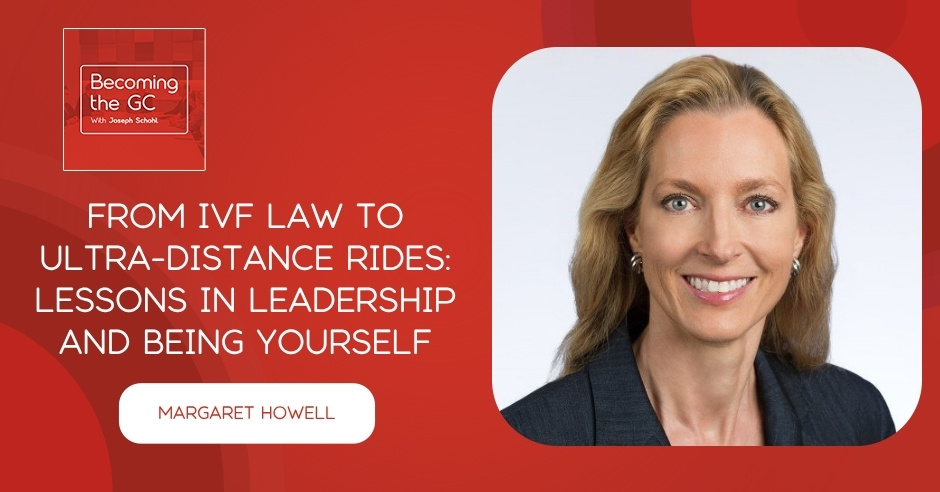
To excel in your professional spaces, you must not only learn how to do your work with persistence and determination. Being yourself at all times without trying hard is also key. Joseph Schohl sits down with Margaret Howell, a general counsel in the fertility space, to talk about the power of showing up in your authentic self. She shares how this mindset allowed her to help expand a business internationally after just one transaction. Margaret also explains the benefits of having a good contract management system and talks about her passion as an ultra-distance cyclist.
—
Listen to the podcast here
From IVF Law To Ultra-Distance Rides: Lessons In Leadership And Being Yourself From Margaret Howell
My guest is Margaret Howell. She’s a General Counsel in the fertility space, and she shares her professional story, which overlaps with mine for several years when she joined our team at DaVita, she also shares her passion outside of work, which blew me away. Something that is next level in terms of requiring grit and determination.
Here’s Margaret’s bio. Margaret Howell has been an In-House Counsel for over twenty years, with the last decade as a General Counsel in the ever-evolving fields of IVF and women’s health, working for publicly traded companies and several private equity groups. She honed her corporate healthcare and compliance skills over eight years as group general counsel with DaVita, and then entered the IVF Arena with the management services organization that supported the largest network of fertility clinics in the US.
As a result of that work, she became General Counsel at Generate Life Sciences, which owned the largest donor egg bank, sperm bank, and newborn stem cell preservation company in the US. As a member of the executive team, she helped expand the business internationally and position the company for a significant transaction, which resulted when they were successfully sold for $1.6 billion. Margaret’s been advising entities that are interested in entering or expanding into IVF and women’s healthcare businesses, or expanding into the us. We’ll learn all about that and more on this episode.
Yeah, so no, it’s been really fun interviewing people because I said this before on the show, so I won’t say it again, but everybody’s journey is unique. Before the show, I thought most people followed the same path that I had. It turns out very like nobody I’ve interviewed has followed the same path because everybody’s path is different, and that’s certainly going to be the case with you. With that, Margaret, welcome to the show.
Thank you very much. It’s an honor to be here, so thanks for inviting me.
Margaret’s Inspiration To Pursue A Legal Career
It’s so great to be reconnected with you after all these years. We did work together at DaVita. We’re going to talk about that, but I want to go back further in time, even before you and I knew each other. What inspired you to pursue a career in law?
I think it was out of familial necessity for me. My family was very conservative and I think very naive. Both my parents were teachers and my mother had left school one day and was going back into the school well after hours, and she was hit over the head by a kid who had a brick who was trying to get into the school for a drug deal, and she was seriously injured. I was a kid, like, “How do you take care of this?”
My mom was like, “The school has a lawyer. It’ll be fine.” Lo and behold, no surprise to those of us who are here, but at the time, it was a big surprise to my family. The lawyer took care of the school and not my mom. It’s like somebody in the family has got to take care of my family and not be so naive. It’s planted in my head pretty early on.
That is unbelievable. This front and center, right in your own family, feeling that you could impact justice in the future for people like your mom. That brought you to law school from undergrad?
No, actually I didn’t because, like I said, my parents were both teachers. There was the paying for law school that interfered. I got my BS in Business and then I went into business. I was publisher sales representative for Prentice Hall for four years. When I realized that it had taken me four years to pay for one year of law school, this was not going to work. I incurred some debt and worked through law school. Yeah, that was my path, but that also helped me understand business.
Saving for twelve years to go to law school would definitely have been a long path. Okay, great. Did you enjoy law school? How’d you find that?
Yeah, I did. I love learning and I guess that comes from parents being teachers. I love learning and I hope to always be learning. My mom and I used to say, “When I’m done learning, I’m done.” Yeah, I like learning and growing and expanding horizons. That was law school.
What kind of teachers were your parents?
Dad taught history, and this was back in the day when the history teacher was also the coach. The coach of all things, basketball, baseball, football, and everything. My mom taught sciences and home economics and the school set them up so that, because he was the high school, he was the coach, they had her be the cheerleading sponsor.
Between the two of them, they had everything covered.
I got quite the education at home.
What was your favorite subject in school?
It wasn’t math. I like foreign languages. I like Spanish, even though my Spanish is horrible now.
How Margaret Landed Her First In-House Job
Okay, so language and so then after law school, what are you going to do?
Actually, I knew I wanted to be a corporate lawyer because of my business background and everybody said, “You can’t go straight in.” I went to work for the firm that I had been working for when I was in law school and got to do corporate business work there. Also, a little bit of litigation to find out that I didn’t want to do that. I did that for four years and everybody said, “It’s going to be seven years before you can go in-house, so just be prepared to spend your seven years.” I’m like, “I’d rather do it a little faster than that.”
After four years, you went in-house, which nowadays isn’t uncommon at all. How did you get your first in-house job?
Not the way you would expect. I was married at that time and living in North Carolina. I had taken and passed the North Carolina and South Carolina bars simultaneously. My husband was from California and we moved, in his case, back to California with an eighteen-month commitment and didn’t know we were going to move back and I was going to go to the same firm. You can’t use a North Carolina, South Carolina license in California. I did due diligence for Edison when they were selling or refinancing, I can’t remember, the San Onofre Nuclear Generating Station. I read all of the contracts and summarized those, a job that would be done by AI now.
Due diligence is only one of the manual tasks in law that can now be done by AI. Share on XNot as well, but yes, and I love AI.
With a lot of supervision. Yeah, that was my first like foray into corporate work. After that was done, I think I told you I’d put myself like through law school doing real estate work for this firm. There happened to be company that made vitamins and over the counter drugs in El Segundo. You just can’t make this stuff up. They were opening up a plant in South Carolina. They needed a South Carolina lawyer who understood South Carolina real estate to help them.
Was that your first in-house job then?
It was, yes.
Did we hire you at DaVita from there?
You did. Yes, thank you very much.
What attracted you to DaVita?
It was real healthcare. I learned a lot. I learned about FDA from the NDEA, from the vitamin and over-the-counter drug company. I learned a ton about compliance. DaVita was very attractive as a really good training ground. There was you, of course. I remember when I met you and I was like, “I really respect this guy. He is buttoned up,” and I wanted to learn from you personally.
How Margaret’s Time In DaVita Helped Her Become A GC
Thank you. We had created the group general counsel positions. You filled one of those, I think we may have had five, and I think every one of those five people have gone on to be GCs.
I’m not surprised. It was a really good training. It was like many GC for your fifth of the country.
Totally. I tell people who want to become a GC to look for one of those jobs because you are the GC of your business unit, of your geography, however the company is structured. Look for an opportunity to be the go-to person, the first call attorney for some business leader and some management team. That’s what that was. What did you learn in that job that helped you then become a full GC in the future?
It is communication with your client, getting to know your client, knowing when to reach out to the experts. One of the benefits of that group general counsel position is that you have people to help you in the background. You need to identify what the problem is and get it to the right person. When you have an HR issue, you don’t have to deal with the HR issue. You have to get it to the labor and employment lawyer. You build relationships with those people who are also DaVita in-house lawyers, but subject matter experts. It was issue identification and client communication and fitting the pieces together.
Much like you would as a GC engage outside counsel, except in that case it was sourced from the talent we had within. You, as the GC, the group GC in that case, the thing that I loved about it, and you certainly did this, was you stay involved as the client’s primary point of contact lawyer. You’re using that expertise of the labor and employment person, etc., to partner with them, but you’re not just handing it off.
Right. I learned mergers and acquisitions from that also, by remaining in that context and getting to know what the business people needed and communicating that with the attorneys who did the M&A transactions and with the business development team.
Margaret’s Venture Into The Fertility Arena
All good things come to an end. At some point, you left DaVita, it was after I had already left, and that brought you into a new space. Tell us about that.
That’s when I went into the fertility arena. There were several people from DaVita who went there, people I respected and had learned from. I had been talking to them, I was like, “That’s a really interesting field.” I don’t really know anything about it. It’s not really my area of expertise, but starting to talk to them and it’s a fascinating subject matter that once I started to delve into it, I was really interested. The science around it is incredible and the patient population is really inspiring and, at the end of the day, makes you feel great like you’ve made a huge difference in a family.
The patient population is inspiring. They always make you feel great. Share on XTell me about the legal department that you joined when you made the switch.
It was small. It was private equity-owned, and there was a general counsel who had a lot of international experience. I think his BS was in Mandarin from Harvard and his JD was also from Harvard, so super wicked smart guy. He very much wanted to expand the business. He did half M&A and half GC. The company was based in New York, and they wanted to have somebody in California with a California license to support the West Coast operations while he was growing the company. There was another lawyer who had been in IVF and I learned a ton from her. I learned more business aspects and certainly the international aspects from him. I learned IVF from her and she was just a wealth of information and welcomed me into IVF and taught me about risk and things.
What were some of the things that you had to deal with that were totally new to you? What are some of the legal challenges that you saw?
There are things that you just can’t make up. The world of IVF, that’s the thing with families. People are different. Back in the day, thank goodness for technology, there are less mistakes that happen in IVF now, but there are things that hits the new. When things go wrong, they go really wrong. There are mistakes that happen, fortunately, less frequently, but there are also disputes over who owns an embryo. Is this life? Is it property? Those are things that I could not have anticipated and really help to have this subject matter expert lawyer guiding me. Some things you just have to learn the hard way because you can’t make that stuff up.
Yeah. It’s very much state by state.
You know how they say bad facts make bad law. There have been some unusual family fact patterns in certain different states that have resulted in some bizarre laws. It is difficult to know what those are. Difficult to stay up with all, especially we’ve had a lot of changes in state laws and it is difficult to stay on top of that.
Bad facts make bad laws. Share on XDifficult to predict what might happen with a certain fact pattern, depending on where you are. It’s not heavily regulated in some centralized way.
It’s regulated by state medical boards, and depending on what the practice does, there is FDA involvement. There are some states. New York is highly regulated. Some states are not very regulated other than via the medical board. It’s a complex web of legislation and case law.
A lawyer’s a dream or nightmare, depending on the day.
Depends on the situation, but it’s also really cool. I always say you need to get to know your client. It’s a fascinating client. Some of the things like at DaVita, we did Reality 101, and so the DaVitians took that concept there. My Reality 101 in IVF was fascinating. How many people get to see life created.
That’ll focus your attention. It’s humbling and awe inspiring all at the same time. Reality 101, for people reading, was DaVita’s program, and they may very well still have it. It was a great program where everybody, I think, certainly every executive, every lawyer, etc., who worked there was required to spend a week working in a dialysis clinic in an assistant to the patient care technician job. We had to set up the dialysis machines.
Talk about really focusing your attention because you’re new to this, you’re trying to figure it out, it’s complicated, everything’s moving fast, and you’re actually working. Of course, you have oversight from a patient care technician to make sure you’re not going to make a big mistake. It felt very intense. You want to get everything perfect, and yet it’s hard to do, even if you’re really smart because you haven’t been in this environment before. It really gave an appreciation for the frontline folks who are doing that every day and know exactly what to do. Anyway, that really stuck with me.
Me too. It’s a game-changer.
Margaret’s Experience In Her First GC Position
Totally gives you a lot of insight into what it really means to provide those services to the patients. Tell me about your transition then to, this would be your first GC job.
Yeah, so it’s who you know and talking to people. I had a friend from my first in-house job who stayed in touch and she happened to be running with a woman who turned out to be the president of California Cryobank at that point. She knew she was a lawyer and she’s like, “Our company’s big enough now. We need our own lawyer.” She’s like, “I happen to know someone who is an IVF lawyer.” She’s like, “Let me understand. This is somebody who has IVF knowledge, who has corporate knowledge, who has worked with private equity groups before? This is kismet.”
You’ve been training for this your whole life. You slotted in there, this was a couple of years before the pandemic. Take us through that.
I’ll tell you like in pre-pandemic?
Yeah. Start there.
It was really cool because like I said, the president of the company said, “It’s time for us to have our own GC.” The reason why they needed a GC is that they were private equity-owned. They were combining three different entities. California Cryobank, Donor Egg Bank, and CBR, Cord Blood Registry, the private equity group was putting those together under the Generate Life Sciences umbrella and creating one large company. That’s a lot of integration. It’s three totally different entities.
Even though they’re all IVF ancillary companies, it means people have been maintaining contracts differently. The legal entities are different. Every management systems, the personality of the companies, totally different. It was fascinating to be part the executive team to bring those together. Everybody knew that the goal was to flip the company in 3 to 5 years. That means, for the lawyer, identifying the risk, cleaning it up, make the company more attractive to the next bidder.
What were some of the challenges you faced in that role?
Finding contracts and getting the right team on board from a legal standpoint. One of the things that I didn’t have to deal with that I think some lawyers do is didn’t feel like I had to justify the need to have general counsel there. Everybody was thankful to have in-house counsel and they did invite me to meetings. I think sometimes general counsel have trouble getting into the business meetings. Sometimes now ask, I’m like, “I know you don’t want to spend the time. Tell me about the details of this transaction. Why don’t I just attend the meeting and I can give you a shortcut?”
Here for yourself, right?
Yeah. A lot of it was integration of the business and just identifying what the risks were.

How The Pandemic Impacted Everyone’s Work Spaces
Now take us to how the pandemic impacted things.
I had been working from home. As I said, the first IVF company I worked for was based out of New York. I was, early on, one of the people to work from home, but I prefer to be in the office. One of the things that was really important to the CEO of Generate Life Sciences was that everybody would be there before the pandemic. In the pandemic, obviously, it’s not an option. It was helping people learn how to work from home. One of the things that I did, and I’m really glad that I did, was not staying in my lane. With COVID, all kinds of new regulations, especially in California, like figuring out what applied to you, what you could do, what you should do.
Also, things you couldn’t do. Things were coming down. Every day there was something new.
Absolutely. Everybody’s trying to figure these things out. With our HR team, I raised my hand. I’m like, “I’m going to figure this out. I’m going to dig into these.” I had a wonderful paralegal who would jumped on it with me and was like, “We’re going to figure this out.” We’re going to come up with a spreadsheet. We did way more paperwork for individual employees that we should have done.
We helped to figure out how it was best for the company, which employees it made sense to retain which ones it made sense to have work part-time and just trying to do the best for everybody. That was the leadership of a really good CEO and with us doing the brunt work, just trying to figure things out as they change. I was really glad to not say, “Not my job.”
Good leaders willingly did grunt work during the pandemic to try to figure things out as they change. Share on XYou had been working remotely during that time. At the prior company, were you using, I think before the pandemic, we called it video conferencing, but were you using Zoom, or was it mostly speakerphone when you’d be coming into the room?
Unfortunately, it was a lot of speakerphone. I always look for a silver lining. I think one of the very few silver linings of COVID was Zoom. I think now all of a sudden, you get to see people. I had conference calls with outside counsel, big firms that know they didn’t want me to see them at anything less than their best, so they would have a lot of conference calls and I called them on. I was like, “No, I need to read body language.” I communicate with my hands a lot. I need to see your eyes, I need to see how you’re responding to what I’m saying. As much as they hated it, they would get on Zoom calls.
I found that big law was the last to get with the program on video and even after people were back in the office, but so much of the client interface was online. I can remember doing calls with people where they’re sitting at the other end of a long conference room and you can’t even see. They’re tiny. This isn’t how it’s going to work.
You’re technically on Zoom, but you’re defeating the purpose. I also found that you get to know people’s personalities. I don’t blur unless I have to. Unless I have a real mess in the background, I don’t blur my background because I think that you get to know people. I want to hear somebody’s dog barking in the background, because then, that’s something that we can connect over. Especially being an IVF, I think it’s great when people’s kids come up behind them. It’s like, that’s your personality. That’s who you are.
Margaret’s Role In Expanding The Company
It’s part of the whole human connection and all of that. Okay, so then what happens?
We actually started on the transaction that I was brought there for. We knew that we were going to sell the company. It was a fascinating experience. We had great partners and GI partners and just trying to figure out what the next steps were. My CEO looked at me one day and he said, “You and I are working ourselves out of a job.”
It was a great experience and one that I definitely do want to repeat when I find the right company again. It was a great experience to go through building a company, integrating a company, knowing that you were going to show it off. That is how I felt about it. I did feel like we were showing off the company because I was very proud of what it was when I came into it, that it was built by really well-respected founders.
I think as people are looking for a general counsel position, you need to know that you can have faith in what the founders built. You can be proud of that and not have to worry about some things popping up later on in the news that are a huge embarrassment. It’s like, I know the founders and respect them, and I did feel like we were showing the company off to potential suitors. It was a really good learning experience of different private equity going through big due diligence.
It helped a ton to have gathered all of those contracts and to be able to hand them over. We chose ContractSafe, too, as the repository for, for all of our contracts and had gathered them, and it made due diligence so easy to be able to give access to certain types of contracts. When a potential buyer was interested and they were asking questions, we could just flip the switch on which types of contracts answered their questions. When AI searches to say where do you have non-competes? Do searches by state. I know that that impressed our private equity owners and the potential buyers.
Would you give the thumbs up to ContractSafe? Is it good?
Yeah.
I’m always looking for what the best repositories are because they all have strengths and weaknesses.
I think that there’s probably video of my paralegal and me touting their services years ago. They were great. Especially for a small company, they gave us what we needed.
Benefits Of Having A Good Contract Management System
I think that’s so critical. There are at least two reasons that stick out in my head, but there’s a third now I’m thinking, because to have the contracts organized in that way, number one, this was my number three, makes it easier to operate day-to-day. You’re not spending time looking for contracts or not knowing they exist and taking positions without having the full picture.
In a transaction context, if you’re not prepared in that way, then deal counsel’s going to come in and have to do it very expensively, and it won’t be as well as it would’ve been done had it been done in-house. Three is just when the potential buyers see that it says something to them about how the company’s been managed, that it’s buttoned up, that it’s organized, etc., which in and of itself creates that value.
May I add a number four to that, though? One of the other benefits is empowering your client. It also gets them invested in providing the contracts because as a repository, it’s searchable by them, and you can give them access to the types of contracts that they need, and therefore, they can look at stuff. It takes some of the low-level burden off of your legal team because they can look things up.
If they want to know a term, it’s already summarized. All they have to do is look at the spread, the summary sheet to see when it expires if there’s an automatic rollover. It takes a lot of that burden off, but it also means that they are going to be quite happy to give you every contract that they have so that they have easy access to it. I’m a big believer in that kind of organization.
Also, what springs from that, so we’ll add another one to the list, is when you have that, the client is then taking contracts very seriously. This is something that creates a sanctity around the contracting process, making sure legal’s involved, making sure it’s getting into the repository, making sure we’re being thoughtful before we sign something about what our obligations and commitments are.
Knowing that other people are going to look at your work.
Yeah. It’s not just going to be somewhere in your email, you clicked on it and nobody ever saw it again.
It goes in a drawer somewhere.
The Importance Of Showing Up Authentically
Any other lessons learned from that experience with selling the company?
Asking questions. I would say, I do have some interview advice that came from it. I was saying show your personality. As I was interviewing for that position with the private equity group, the standard questions what you would expect to be grilled by private equity group. After I had the position, I went out to breakfast with one of the managing directors. I’m much more casual at that point. I was talking to him about one of my personal interests, one of my hobbies that says a lot about my personality. He was like, “Why did you not tell me this during the interview?” I was surprised. Somebody else later on said, “We had to convince him that you were scrappy.”
Do you want to share this hobby?
I have you and Paul Dorsa to thank for Tour DaVita. I am an avid competitive ultra-distance cyclist now. The reason why I bring that up is that fact that I hid because I thought that it’s just a hobby, it would have told that person a lot about who I am, about what a fighter I am, and that I’m not there for a 9:00 to 5:00, thank you very much, go home job. I work hard, and to his point, I’m scrappy.
There’s nobody competing in ultra-distance cycling who’s not. Those things that you just mentioned, it’s too hard not to be those things. That’s super interesting. Tell me what you’re up to now.
After we sold the company, I did work on the integration of that company into a much larger publicly traded company. I did the integration still in IVF and ancillary services and IVF women’s healthcare products. Now, what I’m doing is I intend to stay in the world of IVF. I’m also working in women’s healthcare, which is very much related, and also regenerative medicine, which, from my stem cell background, is still that same kind of healthcare. I am a fractional general counsel for women’s healthcare and IVF practices.
When you look back at your career, which is still going, for sure, what advice would you give to a younger Margaret or anyone who’s looking to follow a path like yours to become a GC?
I would say learn everything you can and always ask questions. I think I was shy and I was like, “What if I say something that’s wrong? I don’t want people to think I’m stupid because I don’t know this.” Just ask the question. Maybe they’ll laugh at you, but that’s not so bad. I would definitely say always be learning. Do everything that you can, like I did with COVID. Do I have any great learnings from that now? Thank goodness, no, but I did show value to the company.

I learned some HR stuff because of that. I would just say, do everything that you can, because you never know what you’re going to end up using now. I surprise people when I can read a triple net lease and that’s because that was how I put myself through law school. You just never know what you’re going to end up using. I would’ve never thought that I would have any reason to deal with the DA, but I did.
That’s great advice. It’s so true. So many people that I’ve interviewed for the show come from all different backgrounds and the common thread is they went all in on what was in front of them at the time. Even if it was not necessarily going to be the thing that led them to where they wanted to be, it’s learning how to focus and engage and solve problems.
I think also to find what you love, and it’s not like work. For me, it’s like puzzle and it’s a challenge. It’s like, do you have to find all the pieces, which sometimes they’re people, sometimes they’re facts. You have to find all of those things, the pieces to the puzzle to put them together. It’s awesome when you get it, when you have something to show for all of that work. Find what you love doing and ask questions and learn even more.
Biggest Win And Failure As A Ultra-Distance Cyclist
Can you share a little bit about your sporting pursuit? I’m curious to see what you’ve been up to.
I’ve been a very busy girl. I’ve got some really cool jerseys to show for it. I guess you saw the 444 on my email.
What does that stand for?
It is 444 miles. We actually wrote it on Tour DaVita. It was the first one.
The Natchez Trace?
Exactly. The Natchez Trace is 444 miles. I did that solo race. I wanted to do it, I wanted to do in under 24 hours, but I’d done it twice and I did it, I think, 26 hours and 45 minutes. I was off of the bike for 45 minutes total. Do you want to know my worst one? Do you want to know my biggest failure? It’s way more interesting than that. I was doing the HooDoo 500 and Solo is very mountainous up in the Zion and Bryce National Parks. I was at mile 498 and I crashed and got a very bad concussion. I ended up in the ER, and my recollection of what happened is absolutely not what happened. That was my biggest failure.
It must have been about 2008 when we launched Tour DaVita, Kent Thiry’s idea, Paul Dorsa, I and Chris and a couple of others were the committee that planned that first event.
You convinced me that I could ride. I was a martial artist.
It was an amazing event. Are you saying that before, you were not a cyclist?
I did not own a bike. That turned into game-changer.
That turned into this. That’s incredible. We did not ride 444 miles on the Natchez Trace. I can’t even imagine.
It’s a slippery slope.
I can’t even imagine. A physical therapist who I work with actually goes on the Ride Across America.
I’ve done that. I did that as an eight-person team. It’s awesome.
Are you going to do it again?
I don’t know.
If you do it again, you have to let me know because it starts down in Southern California. It starts at Oceanside and goes to New Jersey.
It depends on the year. The year that I did it, it went to Virginia. I had an eight-person team, and it was mixed. It was 4 guys and 4 women. We finished in six days, and I forget exactly how long, but yeah, it’s full-on racing, pedal to the metal. Every time you get on, it’s like racing and thunder and lightning.
Up and over the mountains.
Over the mountains and then the headwinds of Kansas. It’s all your fault.
Yeah, I know. I can’t believe that sparked it. I’m feeling very insecure about my own failure to keep riding. It takes commitment.
It shows that you’re scrappy.
For somebody slow like me, it’s too time-consuming.
I don’t believe it. You’re sandbagging.
Going Back To Reproductive Medicine
What are you most looking forward to?
I just got back from ASRM, American Society of Reproductive Medicine, which is another thing that I would recommend to people who want to be general counsel. It is an industry, it’s a business. It’s not a legal conference, but that’s where you meet people. I see people that I know there, you stay connected with the people. You get up to speed on the latest things that are coming into the arena. I would highly recommend that people do that. As a result of being there and talking to people to find the next gig, to see who’s like big enough to have their own general counsel and do the same thing all over again. I’m talking to some really interesting people right now. I love what they do and it’s inspiring.
I bet. That’s great to hear. I think we’ll leave it there.
Thank you, Joe. I appreciate the honor of speaking with you, and I’m so glad to reconnect with you. You’re fantastic.
Thank you so much for joining us.
—
My guest was Margaret Howell. I want to talk about three of my biggest takeaways from the episode. First, the importance of having a good contract management system can’t be overstated. Margaret’s experience showed that being organized and having contracts readily accessible not only streamlines day-to-day operations, but also adds tremendous value when it comes time for due diligence and company transitions.
Second, look for opportunities early in your in-house career where you can act as the many general counsel of a business unit or function. It’s these roles where you truly learn to be the go-to legal advisor, build strong relationships, and grow the practical skills that prepare you for broader GC responsibilities down the line.
Finally, don’t be afraid to show your authentic self, especially in interviews. Margaret’s story about sharing her passion for ultra distance cycling is a powerful reminder that personality and persistence count. Letting people see what drives you can make all the difference in setting yourself apart, in earning their confidence. Until next time. I’d love to connect with any in-house lawyers or outside lawyers serving in-house lawyers who are interested in maximizing their potential. Please reach out to me on LinkedIn and let’s start a conversation. Thanks.
Important Links