
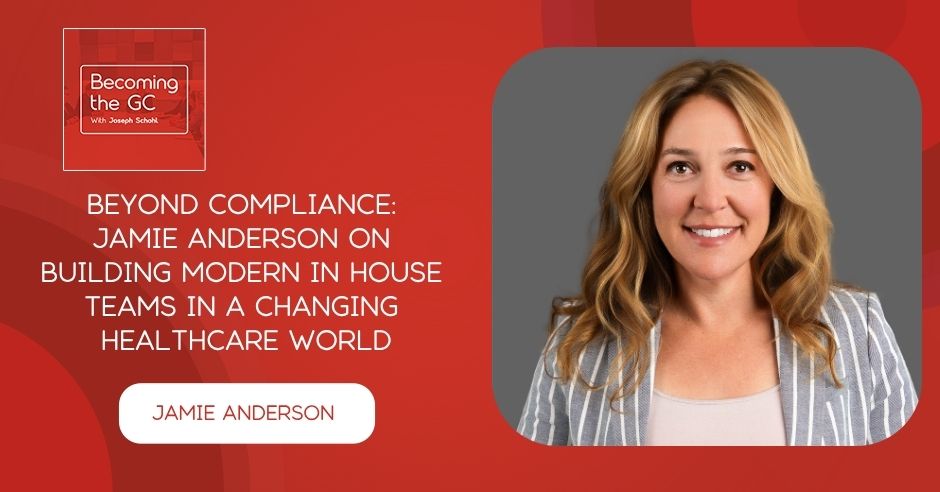
Jamie Anderson, CLO of Virta Health, is not your typical General Counsel. She’s a high-impact leader who has navigated a non-linear career path—from politics-obsessed DC student to Big Law at Aiken Gump, scaling teams at the healthcare giant DaVita, and finally leaping to the GC seat at the metabolic disease reversal startup, Virta. She also brings a deeply personal connection to her work as someone who has lived with type 1 diabetes her entire adult life.
In this exclusive interview, Jamie offers a masterclass on what it takes to thrive in modern healthcare law. She reveals why legal professionals must move beyond mere compliance to become true strategic partners, how she is rapidly scaling a small legal department using AI and automation (tools like GCAI are essential!), and the critical importance of being embedded with the business. If you’re an in-house counsel, aspiring GC, or simply passionate about the intersection of purpose-driven business and law, you won’t want to miss her candid insights on building a successful, efficient, and deeply satisfying legal career in a fast-changing landscape.
—
Watch the episode here
Listen to the podcast here
Beyond Compliance: Jamie Anderson On Building Modern In House Teams In A Changing Healthcare World
I talk with Jamie Anderson, Chief Legal Officer at Virta Health, where she leads legal strategy for a high-growth startup on a mission to reverse metabolic disease in one billion people. Jamie has spent nearly two decades in healthcare law with prior roles at DaVita Kidney Care and Aiken Gump, and she brings a deeply personal connection to her work as someone who has lived with type 1 diabetes her entire adult life. Graduate of American University, Washington College of Law, and George Washington University.
Jamie now lives in Colorado with her family, including two teenagers and a 90-pound Bernadoodle. In this conversation, we explore her nonlinear path into the GC, how she is building and scaling a modern in-house team with AI and automation, and what it looks like to craft a purpose-driven legal career in a rapidly changing healthcare landscape. Without further ado, I bring you Jamie Anderson.
Jamie, great to see you. Welcome to the show.
Thanks, Joe. It is great to see you as well.
I cannot wait to hear about your journey. I am going to take you back in time to the start of that. I always like to ask the question first. What do you like most about being a lawyer in 2026?
In 2026, I will talk about my personal experience. I do think there is a lot of looking with a skeptical eye towards what is coming and how things are going to change. Preparation for that is a big part of it. What I love about what I am doing right now is the team I have built and the company I work for. I just think that when you get to work for a company where you believe the mission is like your interests, and the company’s interests and your customers’ interests are all aligned. It is like the best place to be. Getting to advise on risk and business, and build teams, and be a mentor, like all of those things at once.
Tell us about your company.
I work for a company called Virta Health. It is a metabolic disease reversal company, which is a mouthful. The goal is to help people get healthy through nutrition. It started out with type 2 diabetes and recognition that so much of metabolic disease is created or exacerbated by inflammation and blood sugar, and the lack of awareness of how nutrition impacts all of that is such a fundamental piece of it.
We know each other basically from my work with DaVita, and I am a type 1 diabetic and have this place in my heart of just what we can do to help people and change care and make sure that people are doing what they can to impact their own stories. Working at DaVita is an amazing place because you can impact on someone’s end of life.
I am a type 1 diabetic, and I have a deep passion for helping people improve care and empowering them to take control of their own stories. Share on XWhen somebody gets to that ESRD place, you are too late to really change the trajectory of it, but you can improve their life and make sure they are getting treated well, which is what DaVita is about. The reason I made the jump was the idea that you can have an impact earlier and actually change, reverse somebody’s course. A lot of people are diagnosed with diabetes, especially type 2, and they are handed an insulin pen, and like this is your life, and you are just going to have medications, but it does not have to be the case.
Right in the conversation is like, “That is just the way it is.” There is no way around it, but it is good. There are medications, but you are going upstream. With nutrition, I read a lot, and you can reverse it solely through nutrition. Tell me more about that. That is hard. Not a lot of people do it that way.
It is hard, but it is amazing. I have been here for almost five years. Every Monday, we have an all-hands meeting with the whole company on Zoom. We get a member or patient who wants to show up every single Monday, a different patient in those five years, who has had their life changed so much by their experience with Virta that they are willing to come and talk to a thousand little squares on Zoom and explain how they had no idea until they did some research and came across us or their employer told them or their health plan or whoever it was.
It was never explained to them that this was an option that you could do because a lot of it is insulin resistance, and that starts with carb intolerance. There is a way to change the way your body metabolizes food and takes in food as information. It really is amazing. It is like the idea, especially as someone who has an endocrinologist, and type 1 unfortunately cannot be reversed, but I have changed the way I eat to this nutritional method. The number of units of insulin and my health have improved drastically. It is like there is a lot of opportunity there.
How does the business provide the service? Are there locations people go to?
Either your employer can offer it as a benefit or your health plan can. We will reach out to members when we engage a new employer or a new health plan. They will provide us with members who qualify, and it is either type 2 diabetes, obesity, or weight loss. Obviously, now we are expanding the things that we can help with. They will engage and enroll. We will do a full medical review to make sure it is safe. They will be given a doctor or a nurse practitioner, a coach, and lots of resources, and have the advantage of telemed, where it is not like you wait every three months to see your endocrinologist, but you can send a message and have a response almost in real time.
That is great. In some ways, you have been training for this job your whole life. That is something that you were born with, I presume.
No, I was diagnosed as an adult. I am just like a random insurance blood test. It is totally crazy. Most type one patients develop it much younger, but there is a sense that you are older.
Let’s go back in time. When did you first think about pursuing a career in law?
Early Career Interest In Politics & Policy
I did not. There were no lawyers in my family. I was not planning on it. I was in love with politics and policy and wanted that to be my life.
Where did you grow up?
I grew up in South Florida, and I had this amazing AP government teacher. It was around the time of Newt Gingrich and all this interesting stuff happening in Washington that opened my eyes towards it. I decided I was going to go to DC for college. I got a full scholarship to the University of Florida, and my parents were like, “You are not going to go there?”
It is a great school.
Totally. Instead, I went to GW, which is one of the more expensive schools. It allowed me to intern at the White House on Capitol Hill. I worked with Nina Totenberg at the Supreme Court and NPR. All these opportunities in Senator Ted Kennedy’s health office. I got to see how all this worked. I was like, “I am going to work on Capitol Hill. I am going to work on campaigns.” Right after college, I started working on campaigns, and then I had more access to what was happening on Capitol Hill.
I realized the most successful people, or the people who were doing the coolest work, were lawyers, like the legislative directors and the people. I was like, “I guess I will go to law school, but I am certainly not going to practice law.” I went to law school, and then that thing happens where you take on a lot of loans, and you are like, “I will work at a law firm for a few years.”
Unplanned Transition To Law School & Healthcare Practice At Akin Gump
My dad had been in the healthcare business throughout his whole career. I caught a lot of insight into that. I decided I would work for a few years to pay off loans at Aiken Gump. I got a job in their healthcare practice, and I was like, “Regulatory, learn a lot more about this, make myself even more marketable and valuable when I go back to work on Capitol Hill.”
I never in a million years wanted to do litigation or anything like that. I walk in, basically the first day, one of our biggest healthcare hospital clients gets handed a CID, an investigative demand from the government. I get on a train on the Amtrak to New Jersey and basically move there to work in this hospital, doing document review, helping plan the defense.
I do not think people realize this and I would tell any young lawyer this now, the best way to learn any area of law is to be steeped in either a transaction where you are doing diligence or litigation where you are doing diligence, because you have to dig deep and find everything and figure out what happened and what decisions were made and what kind of meetings were had. It was a great learning experience for sure.
It is like a puzzle. At some point, when you are a senior, you want to be able to see the whole picture. The best way to see the whole picture is to have pieced it together as a junior lawyer. Never thought of that before. When you said it, it made me think that you have got to organize the information that is seemingly random and disconnected into something that looks like a picture.
It was a great experience. The healthcare practice was growing at Aiken Gump at that point. I met some of my best friends who were also young associates. You spend almost every night at the law firm, and you all eat dinner together. You are stuck in a conference room and working on stuff. If you are lucky, you have great partner mentors. I did have one who is still in my life now, and is actually a really good friend.
Somebody who just focused on how important client service was and helped to understand the hierarchy of working in the company, because I spent so much time at the hospital. I was doing compliance reviews for different healthcare systems after that. Similarly, I would just go and spend a lot of time with the clients. I did not realize that it was occurring to me at the time that I would be really good in-house, being a part of the team and the customer.
If you go in as outside counsel and you are seeing a piece of it and you are helping with a part of it, but you are not exactly sure what they are going to do with it or how it ends. You try to form relationships with your clients so that you are the person that they pick up the phone and call. You really understand the context a lot more as outside counsel. One of the hardest things is not having that contact.
If you do not invest in those dinners with clients or in figuring out what is important to your clients so that they tell you more of what is going on, you are a lot less effective. I spent so much time with clients and customers learning what good looks like, what a real good compliance program looks like, what effective leaders of those in-house teams look like, and learning a lot from the head of the practice at Aiken Gump, who ultimately left to be a general counsel at a big client. I had already left.
You are working with inside teams and acting as an outside lawyer, but you like building those relationships, and you are thinking, “Maybe this is something I would like to be on the other side.”
Another client who was actually brought into the firm similarly had a situation where they were not anticipating it, but got hit with a CID. Because I brought the client in, I got to build the team to respond to it and really work on the strategy, create the plan, and oversee. I realized I am better at leading and organizing than I am at just being an individual contributor.
I was like, “I do not know that staying in a law firm is where I am going to get what I want or accomplish what I want.” In that time, I had two babies. Law firms are generous. I was super lucky with the leave. My kids at that point were turning two and turning four. That is a hard time to be at a law firm where most of what you need to do is hang out late and be available at that time.
Decision To Move In-House To DaVita & The Challenge Of The Role
Trying to protect, I made a point of leaving by 6:00 every day, no matter what, getting on the metro, going home, dinner, bath, bedtime, and then almost immediately back online to work for several more hours to make sure I was holding up my end of the bargain on that, which was hard. It really was. I was like, “It is time.” I started looking, and DaVita was hiring. It was fortuitous. They had just done that healthcare partners merger-ish, and they were building a lot of internal legal, and those stars aligned, and I moved to Colorado and joined the team.
Here is a question that popped into my head. Maybe some lawyers who are at law firms, if they are tuning in, or you are at Aiken Gump big firm, and you bring in a client that has CID, you were an associate. How did you do that?
It was a connection, like a family connection. They trusted you. Which was great. It was cool. It did not work out perfectly. Big firms are great for big companies, but for smaller clients, it is not necessarily an ideal situation, especially when you need that. The bills pile up. It was a good experience all around. Having the opportunity also changes the way you are perceived as an associate at a law firm.
Just having that entrepreneurial spirit and getting to lead a project like that is cool. Colorado, you are from Florida. You have lived in DC. This is a new adventure.
Yes. I have two sisters, and my mom was already out in Colorado. The two and four-year-olds have an idea of family reinforcements.
It makes all the difference. They were in Colorado. How did you become aware of the position?
I started looking.
Were they a client?
No, they were not a client. It is possible that the American Health Lawyers Association put it out. I did not have a recruiter. I was not looking that aggressively, but somehow I found out about it. I was also looking in DC because we were not sure what we wanted to do. I flew out to Colorado, met with two companies, and something was going well because they both made offers. I just decided between the two, DaVita was the bigger, more sure thing. I thought it would give me a lot more well-rounded opportunities. I took it.
In addition to it being an incredible training ground for lawyers, many of them have been on the show, and in 2012-ish, they have a beautiful headquarters right there in downtown Denver. It is attractive.
It was great. It was similar. The one thing I will say is that the time expectations, obligations, all of that stuff were not different. In fact, I probably worked harder at the beginning. You had David Shapiro on the program recently. He is the one who hired me. I remember sitting in a room with him where he said, “Just so you know, a lot of people go in-house because they think it is going to be easier. That is not what you are going to get here. You are going to learn a lot, and this is not a 9:00 to 5:00 job.”
This was during the interview or after you started?
This is during the interview. I do not know if he was trying to scare me, maybe, but I was intrigued. I was like, “I am not here for a 9:00 to 5:00. I want to build what you guys are building and learn and have these opportunities.”
The other thing is what I would tell people when I would recruit them is that it is also like you are going to have a lot more responsibility than being on the inside, the buck stops with you.
You have an opportunity sometimes to phone a friend, but definitely outside counsel.
They are helping you.
They are helping you, and you need to articulate what the need is, what the question is. You are the one who needs to explain it to the client or to leadership. We were building so small at that point, the internal legal team, that I just raised my hand to do a whole bunch of things that I had no idea what I was doing. I did not have much experience with dialysis.
I certainly did not have much experience with surveys and things that would happen. I remember I would get a call and somebody would be like, “There is a survey here, and they are threatening that they are going to give us an IJ,” which is immediate jeopardy. Basically, they can close the clinic. “Can you talk to them?” I am like, “First, tell me what IJ stands for.” You just figure it out, and you hope for the best.
You phone a friend when you need to, but so much of working in-house, especially in situations like that, where it is fast-moving. You, of course, have the subject matter expertise. That is table stakes. You have to understand healthcare regulatory law and where the big roadblocks and things that you can never do are. The rest, you just use your gut and the expertise that you have gained, and understanding of what the risk tolerance of the company is, and what you are trying to accomplish, and you just try to find the best answer.
Your reference there took me back because in healthcare at DaVita, the clinics are running six days a week, multiple shifts, and serious stuff is happening. Things happen, and they have to reach out. Somehow, my phone number was on a poster. For years after I had left DaVita, I would still get calls in the middle of dinner with somebody needing urgent help. I knew where to send them. For a long time, it was like you had to solve it. I or somebody on the team would have to solve it in real time.
That is fun. It is exciting. There are no two days that are the same.
You did not have to worry like, “Am I needed?”
You are always needed. There is always something to do.
You are always needed. There is always something to do. Share on XWhat caused you to want to move on?
Transition To Virta Health For A General Counsel Role At A Mission-Driven Startup
When we say there is always something to do, it does not mean you are always growing and learning. Throughout those years, I think I was there for almost nine years, building a team and bringing in the people to do a lot of the things. As we grew bigger, it was not like you just do all the things. Now we have a labor and employment team, and now we have a team that deals with risk, and now we have a team that deals with investigations.
A lot of it, you end up in your niche just dealing with those things. That becomes a little bit less exciting and fun. It is still super important where you are putting the right people in the place, and you are training them and being a leader, and you are cultivating talent and making sure that people are doing what they need to be doing, and that your internal clients are supported.
I kind of got a sense, and some of this was COVID and the separation that we all felt a little bit by not being in the office every day and being a little bit removed. Some of it was just looking around at where I could move up and how limited those opportunities were. Are you happy doing what you are doing, or do you want more? Do you want to try more? Do you want to take a risk? At some point, you are comfortable, and you know what you are doing, and it is not scary anymore.
That is a good thing. Sometimes it is fun to be scared and challenged, and you grow from those things. I fortuitously met a few people who work at Virta, the company I am at now. I went from a huge law firm to a huge company. The risk calibration that it takes to go join a startup was not me at all. I was like, “No way.”
I met these people, and I was just like, “It sounds like what you are doing is amazing. Good luck with that.” We had a few more conversations. I met a few more people. They completed their Series E right before I started. They were well capitalized, and it seemed like it was not necessarily as risky as you would think of joining a startup, though every day at a startup is a risk, really. You never know what is going to happen. I was just convinced by the mission.
I was convinced by the people that I met, who were just super talented and so passionate about what this company was doing and what it could do, and the opportunity to build again. I was going to be the first inside lawyer that they were hiring. They had a lot of outside and a couple of internal, smaller roles. I would be building the whole legal team. That seemed really exciting.
In what ways, when you stepped into the role, were you challenged in ways you had not been previously?
All the ways. As I said, I got uncomfortable. I put people on my team who were such rock stars, and things would happen at DaVita that I would know, “If I do not know this, I have this super talented person over here that knows this.” We would be able to gut-check and figure stuff out. Going from that, which is a team of 30-something doing all these things, to going back to being not only the person that is leading the thing, but doing the thing.
There was not a lot of process. There were not a lot of policies. There was a lot to do. A lot of opportunity, a lot of really cool, interesting work, way outside of my wheelhouse again, that whole gut check, find the best answer. Maybe it is not the right answer, and then you have to fix things, but the right answer with the information you have at the time. That was terrifying and also really cool and fun and rewarding and fulfilling.
There was a lot of appreciation for it at the company. When you work at a big company, and you want to do something, it is like six meetings, three months, and a committee. I was like, “There is this thing. I do not know if you are aware, but we are a healthcare company. We should have this thing.” They are like, “Great, go do that thing.” That was it. We did it. I got to build a team and hire great people. I love that.
Are you guys in an in-person environment or a hybrid?
I am. We have two small offices, one in the Bay Area and one in Denver. We use more meeting spaces, and there are a few of us who have actual offices, but it is mainly for co-working, meeting, and strategizing. Not a lot of in-person, but a lot of team meetings and off-sites and leadership meetings, and board meetings are in person.
Would you have only left DaVita for a GC job? Is that what you were looking for?
I do not think I was looking for any job. I really was not looking at all. The idea of being GC was enticing. What I learned when I managed the process at Aiken and then built the team and grew the team at DaVita, I realized that I really liked that, and I love training and being a leader and watching younger lawyers figure stuff out and being a mentor. The idea of being the one who is responsible for all of it, and also being much more of a partner to the business.
I still provide legal guidance every single day for sure. I also get to be a sounding board and participate in strategic decisions, work with the exec team, and think through problems that are not just legal. It is great. It is like constantly learning new things and being exposed to new things and sharing the burden of those decisions, which is also interesting.
What do you think about your personality or the way you practiced that set you up most for being in the role that you are in now?
I just love learning new things and getting to do new things. I love that more than I am scared by it. I loved school. I loved law school. I would go to school forever. I spent a good part of my day trying to keep on top of timing things change so much in healthcare, and between regs changing, we are in all 50 states and trying to keep on top of that.
Understanding what is happening from the administration and policy. I probably spend an hour or so a day reading and trying to stay on top of that stuff and constantly learning through CLEs and other things. It is the desire to not just be comfortable in the thing that I am doing, but always be curious, ask questions, and try to figure out how to get involved in that other new exciting thing that is happening.
Don’t just be comfortable in what you’re doing—stay curious, ask questions, and look for ways to get involved in new and exciting things. Share on XI totally relate to that because I can see there are some pros to being so deep in an area that you know exactly what to do. I would get bored. With the GC job, you never get bored because it is constantly evolving. There are constantly new things challenging you. People should spend more time reading and making sure they are staying on top of developments, not just the urgent thing that is put in front of them. Things are changing so fast with AI. It turns into a big topic when I interview people now that it did not a year ago. Is that something you explored, AI tools to help support, and any you found particularly effective?
Building & Scaling A Small In-House Legal Team With Automation & AI
I do not think you can be successful as a small in-house team without tools and automation. That is what we are learning, and my team is so sick of hearing me say, “How do we automate that? How do we create self-serve tools?” The company has grown so much, more than doubled in size since I have been here, and the legal team certainly has not gotten anywhere close to that.
What is the size of your legal team?
We are five lawyers now, including me, who are not necessarily doing as much of the day-to-day. It is essential. It is also amazing and terrifying at the same time what is happening. You look at it through the prism of how fast it is changing, how fast it is growing. We all need to be harnessing that and learning. The idea that we can stop learning right now is just that I am trying to impress this upon my kids, who I am a little bit concerned about their generation and what entry-level jobs are going to look like.
My CEO says all the time, AI is not going to replace humans, but humans using AI absolutely will. If we are not all learning and embracing these tools and trying to figure out how they can help us be more efficient, how we can scale more effectively, then we are just going to get left behind. One tool that we have employed is GCAI. You are familiar with it.
It comes up very often with in-house lawyers, and it’s a great tool.
We are working through now. That is a tool that is a great resource for every one of the attorneys to help give you a head start on drafting and point you in the right direction for researching, and help with a lot of what you would send to outside counsel. This is why I am concerned for my children. If you did not have time to do research, you would send something to outside counsel, like, “Can you tell me what Tennessee says about the corporate practice of medicine?” You can now do that so quickly. Of course, you have to double-check it and look at the source and all that stuff, but it helps everybody move faster.
Point you in the right direction. It gives you a huge head start. What other tools, AI or non-AI, have you found?
We are working on creating playbooks to help automate, and maybe the lawyers can create the playbooks on the ideal provisions and all of our customer agreements. We have legal support folks that can help at least go through the first draft or some NDAs and BAAs that are not necessarily these big negotiating exercises.
In some cases, how can we have the business folks take care of some of those, where if somebody is willing to accept our terms of an NDA? Here is where you find the template. Here is the information that we need from you. How can you self-serve? There are other internal tools that our other teams use to help with coding, to help even just on the member service side. A lot of support functions can easily be handled when there are low-hanging repetitive questions or tasks. There is so much opportunity.
What do you look forward to getting better at?
Me personally?
For your department.
We have a team of rock stars who are just focused on GSD, answering the question, and providing client service. When you are a small team, and you are taxed heavily on your time and need to move fast, that is important. We all can and should. One thing I emphasize a lot is that it is really important that we are embedded with our internal clients, that you are attending their meetings, that you are aware of what they are aware of, so that you can be a better partner to them.
Whether that is me learning more, I am one of the few that does not have an MBA on the exec team. Trying to keep up and make sure that I can be a part of the conversation and provide the right guidance. Same for the members of my team, whether it is advising the product team or the clinical team. Are you attending their meetings? Are you aware of all the initiatives that they are thinking of, what their goals are, so that you can be a resource and not just like, “This thing went wrong, we need you to fix it,” but “Can you help us think through how to do this the right way?”
You sound like a great coach and mentor to your team, and bringing folks along on the journey of being a truly effective in-house counsel. You have got to build those relationships and figure out a way that they want to include them in everything. It is one thing learning that for yourself, and then it is another to impart it to and empower your team to do that.
Especially when they do not have a lot of extra time, and they could be knocking out a contract in that time, or they could be sitting on a call and helping them find value in that is important.
If you were not a lawyer, what do you think you would be?
I would have found a way to suck it up and figure out how to be on Capitol Hill and take that path.
Maybe we would be voting for you.
I do not think so. Some more options in that area would be nice, but the behind-the-scenes, that is where all the fun stuff happens, negotiating drafts of legislation and figuring out how to get stuff passed.
The behind-the-scenes is where all the fun happens—negotiating drafts of legislation and figuring out how to get things passed. Share on XWhat is some career advice you have received along the way that stuck with you?
When I was at the law firm and had two young kids, several people who were further along in that journey would constantly say like little kids, little problems. Nothing would infuriate me more because when people have young kids, and they are trying to work and do all those things, minimizing and telling them that what they are experiencing is not very effective.
Now that I have big kids, I still do not agree with the guidance. When you have young kids, and you are trying to figure out how to be a parent, how to be a spouse, how to be a good employee, it is a crazy, stressful time. Especially when we are in this world where you get mixed messages about what you are supposed to be focusing on and what you are supposed to be doing, and whether you can or cannot have it all.
Everybody has FOMO, no matter which side you are on, not working, and all of that stuff. Are you making the right decisions, and are you doing the right things? What I tell young moms now is that there are almost no days when you are a rock star mom, a rock star wife, and a rock star employee. It is almost impossible. You do your best to triage, and some days you are going to be a kick-ass employee, some days you are going to be a kick-ass mom, and know that there are a lot of days where hopefully it all comes out in the wash, and you do your best.
That is an awesome answer. I am going to put in a plug for my partner Carrie’s podcast, The Mothers in Law. If you have not listened to that, tune in. You should be on her show to share that wisdom. It is exactly the conversations that are taking place over there, what it is like for working moms at law firms and in-house. All phases of the career present different challenges that are unique to women. Thanks for sharing that. What are you most looking forward to?
I have a senior in high school who is going off to college.
Congratulations.
Which is exciting and heartbreaking all at the same time. I am super excited for him. He actually now, despite the fact that his mother, who is a lawyer, and his father, who is a lawyer, have been trying to convince him otherwise, thinks he wants to go into law. We will see what happens there. My kids are at this super fun age where they are just actual people that are cool to hang out with, and they are super smart, and there is all this exciting stuff happening for them. I am looking forward to seeing how that goes and then whatever the next chapter is. There is lots of exciting stuff happening at my company, and there is exciting stuff happening at home. How all of this is going to change so quickly with AI is very top of mind.
Right on. It has been such a pleasure reconnecting with you and hearing your story. Thank you for coming on.
Thanks for having me, Joe. It was great.
—
Thanks for tuning in to my conversation with Jamie Anderson. Here are three quick takeaways from her journey. First, your career path does not have to be linear to be successful. Jamie went from a politics-obsessed college student in DC to big law at Aiken Gump, to an in-house role at DaVita, and then made the leap to a startup GC at Virta. Each pivot came from honestly reassessing what she wanted next. More ownership, more impact, more growth, not from following a preset script.
Second, great in-house lawyers embed deeply with the business. Jamie stressed that you cannot be effective if you only show up when something breaks. Sitting in on product, clinical, and business meetings, understanding goals and constraints, and building trust over time is what allows legal to be a true strategic partner instead of a last-minute fixer.
Third, tools and teams, not heroics, are how small legal departments scale. At Virta, Jamie is leaning hard into playbooks, self-serve templates, and AI tools to handle repetitive work and research. That mindset, “how do we automate this” instead of “how do I personally grind through this,” is essential if you want to grow your impact without burning out. If you enjoyed this episode, please subscribe and share the show with a friend. I would love to connect with you directly. Just search for me, Joseph Schohl, on LinkedIn and reach out. Until next time, thanks for tuning in.
Important Links
About Jamie Anderson
 Jamie Anderson is the Chief Legal Officer at Virta Health, where she leads legal strategy for a high growth startup on a mission to reverse metabolic disease in one billion people. Before Virta, Jamie spent nearly two decades in healthcare law, including roles at DaVita Kidney Care and Akin Gump Strauss Hauer & Feld. She brings a personal connection to her work as someone who has lived with Type 1 diabetes her entire adult life. She’s a graduate of American University Washington College of Law and George Washington University, and she lives in Colorado with her family, including two teenagers and a 90-lb bernadoodle.