
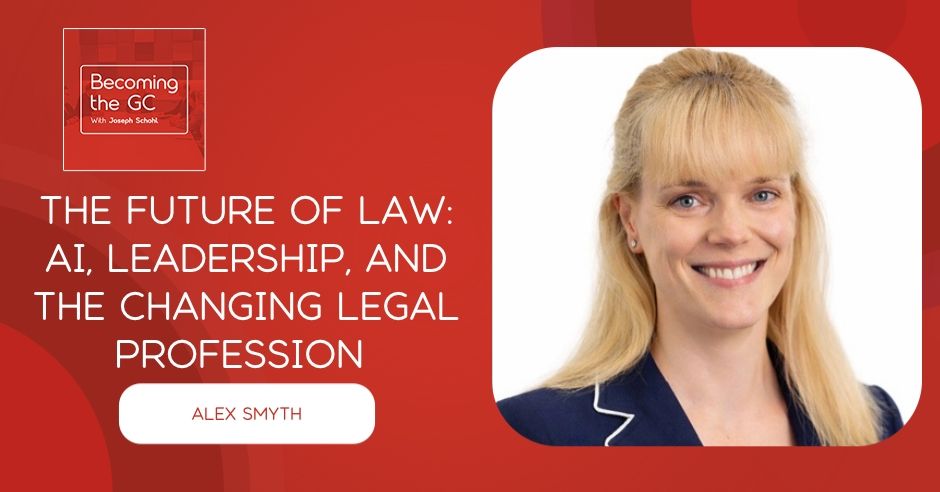
As technology rapidly reshapes the legal landscape, legal AI innovation is transforming how corporate legal teams operate and deliver value. Joining host Joseph Schohl, Alexandra Smyth—Executive Vice President and General Counsel for the LexisNexis Legal and Professional Division of RELX—shares her journey from private practice across Australia and the UK to leading complex global legal divisions. In this episode, Alexandra breaks down the real-world impact of AI on legal research, verification, and junior lawyer development, while offering a look at the future of law firm billing models. She also candidly discusses leading through crises, balancing multiple executive roles, and essential advice for legal professionals aspiring to become impactful General Counsels and strategic business leaders.
—
Watch the episode here
Listen to the podcast here
The Future Of Law With Alex Smyth: AI, Leadership, And The Changing Legal Profession
We are talking with Alexandra Smyth, and we cover a lot of ground. Alexandra is the Executive Vice President and General Counsel for the LexisNexis Legal and Professional Division of RELX, as well as for the Exhibitions Division of RELX. With a career spanning multiple jurisdictions, Alex brings a truly global perspective, having lived and worked in Greece, Australia, the United States, and the United Kingdom.
Her expertise spans corporate law, M&A, and finance, making her a strategic leader in complex legal and business matters. In this episode, you will hear about Alex’s legal career beginnings, navigating unexpected career opportunities, leading through COVID, AI’s impact on legal work and lawyer development, the future of law firm billing, managing multiple roles and priorities, and her advice for aspiring GCs. Get ready. It is my pleasure to share my interview with Alexandra Smyth. As usual, stay with me to the end, and I will share my biggest takeaways.
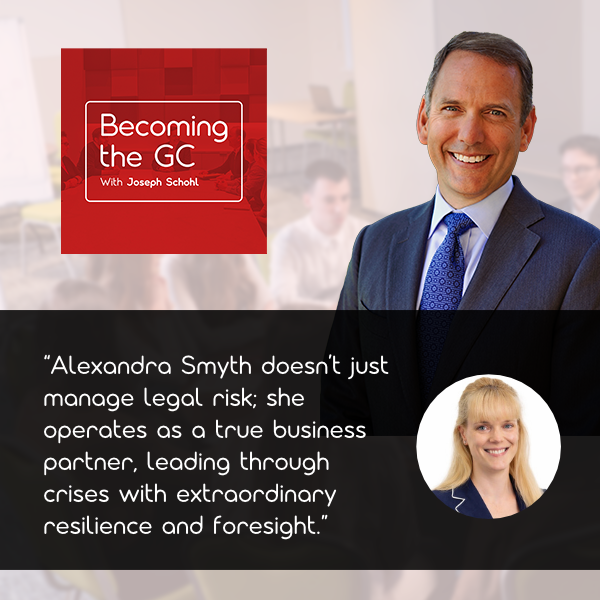
Alex, welcome to the show.
Thanks for having me.
I have had a guest from Australia. I do not think I have had anybody from England before.
From Sydney To London: Early Legal Career Roots
I am from Australia. I have lived in England now for nearly eighteen years. I will always be Australian at heart. I have been living and working in London for nearly two decades.
It is great to have you, and I so appreciate you joining us. I would love to hear about how you got your start in law.
It is going back a bit now. Basically, I was at school and did not know what I should study, and I ended up thinking law school seemed like a good idea. In Australia, you can do law school as an undergraduate. It is not the same as the US, where you have to do something else first. I did two degrees at once, which is very common in Australia. I did a finance degree and a law degree just because I thought it seemed interesting at the time. I did not have any particularly clear ideas about what my career would look like. I thought that studying law seemed fun and I went through uni, and then as I got towards the end of uni, law firms came to the law school and did recruitment days, and I thought this sounded fun, so I ended up working at a big firm in Australia called Allens.
You get an undergrad, and then you can sit for, is there a bar exam?
Not in Australia. The way it works in Australia is you get your law degree, and it is a separate degree. You do a year. It depends on the state in Australia, actually. In New South Wales, which is the state that Sydney is in, which is where I am from. You do a year of supervised work, along with training on trust accounts and that sort of thing. A couple of exams at the end of that first year, and then you get admitted. I guess it is halfway between what they do in the US and what they do in the UK. In the UK, you do not actually have to have a law degree to be a lawyer.
That one year, is it like an apprenticeship? Are you working?
It is. You are considered a first-year associate, and you work as though you are a first-year associate. You do have to sit the exams at the end on things like trust accounting and professional ethics. I guess if you flunked those, you might find yourself not working in the same firm. I am not sure. For us and for me, Alan’s sponsors, I do not know if they still do. They did back then. They sponsored their first-year associates to do this course, and you all did it together and sat the exams together and then got admitted a year later.
Are you doing client work during that time?
Yes.
Are clients paying for the firm for the work?
Probably at a lower, I mean, like any firm, your charge rate is dependent on your experience and your seniority.
Of course. What kind of work were you doing early on?
Early on, like in a lot of countries, I think you rotate through practice areas in Australia, where I spent most of my time in the corporate team. I also spent a year in the competition team, which involved things like antitrust, reviewing mergers, and some litigation, which is part of competition.
That is brilliant because we do not really do that here. When you go into Bitcoin, you are typically either corporate or litigation, or you go to the antitrust team or employment.
Really?
That is where you sit. It is interesting.
You stay.
The last time you may have, you may be late in your career and face issues, especially when you are a general counsel that you have not seen since sitting for the bar exam. No. That is different. Certainly a more well-rounded experience than. How long?
I was just going to say, I think being a litigator and being a corporate lawyer are really quite different. Especially if you are in private practice, I think we will get to it when you are a general counsel. You do a little bit of everything. When you are specializing in a path, they are completely different. Unless you have tried both, I do not know how you really know. I do not know how I would know which I preferred if I had not tested them both out.
In-house, it's much more about seeing opportunities, taking them as they come up. Share on XRight, for sure. They are complementary as well, because it is like later in our careers, when we have experiences, maybe with litigation, and we were not litigators. It totally changes the way we think about drafting contracts.
There is that long-running joke, isn’t there? That corporate lawyers, that it is an end-to-end service in a firm that the corporate lawyers do the deal and then the litigators help litigate it if it goes wrong.
If it goes really wrong, the bankruptcy department takes over.
I do not know who actually has that business model. It is a bit of a joke, you hear. Certainly, I hear it.
How long did you stay in private practice before you made the move in-house?
Transitioning In-House And Embracing Career Opportunities
I was in private practice in Australia for three years, and then I moved to the UK in 2008, just before the financial crisis. I did that because, basically, if you are an Australian lawyer, a corporate lawyer at that time in history, a lot of us came either to London or to New York. I did that. I moved to London, and then I worked in fresh fields in the corporate team there, I think for four years. Probably seven years in total. Actually, I was working for RELX.
I was one of the outside lawyers for RELX, and he is still my boss. He is the RELX chief legal officer. He phoned me up and asked if I would be interested in moving in-house into the first role. It was not something that I planned. It has worked out really well. It was not a long-held plan. It just happened. He phoned me up one night and asked if I had ever thought about it and if I’d be interested. I was like, “Why not?” I would be lying if I said that I had mapped it all out neatly and had really good plans about how it was going to go. Did not. I just took opportunities as they came.
How did you think it would be different when you started?
I did not know. I was not unhappy in private practice. It was all I had known in my career. I had lots of friends at the firm and everything like that. I thought the sell for me was the idea of being in the business more and being able to see the whole thing. When you are an outside lawyer, often you are in one lane, it is a bad phrase, you are involved in one part of it. Whereas when you are in-house, you see the whole thing. You see it before you get the external lawyers involved, and you see it after.
That was quite appealing to me. I went there thinking that if I did not like it, I could come back, frankly. I thought I would just go back to private practice if I did not like it. I did like it. It was heaps of fun. You feel like you have, for me, more of a say when you are an outside lawyer. Again, some people love this. It is not a negative. You give advice, and you give views, and you give opinions. When you are inside, you have a much bigger say over which way you actually end up going.
I love that attitude of, I am going to try this. If it does not work, I can always pivot back to what I was doing before, or maybe even something new. Especially a lot of lawyers because they have had success all along the way in academics and they were on a path and at each step successful, there is sometimes a little risk aversion to trying something new because, what if highly talented, highly educated, you will probably have a choice of doing a bunch of things that you like. You do not know if you do not try.
One thing that we talk about, and as I have got further along in my career, I talk about it now to more junior people, is starting out at the start of what is probably going to be a 40-year journey of a career, thinking that you can map it all out at age 25 or whatever you are when you are coming out of university. Just naive is harsh because I do not mean it as a negative. You potentially close yourself off to things if you are not open to what comes along because you are never going to know what comes along until it comes along.

Often in the in-house world anyway, you cannot necessarily predict where the opportunity is going to be because someone usually has to leave. Leave a position to make a position. It is different to private practice, where if you are good enough and there is enough work in the firm, you keep going up every year. In-house, it is much more about seeing opportunities, taking them as they come up. I have had a few opportunities that I was not expecting, that I was not sure I wanted to take and that, with hindsight, I am really glad I did.
So true. I often when people talk about potentially moving jobs, to me, the order of things to consider is, am I going to learn and grow in the new role? Number two, am I going to like the people I am working with? Am I going to enjoy it? Three is compensation. Sometimes people put that ahead of the other two, and some people suffer through, and that is okay. It is most important, even to your compensation long term or am I going to learn and grow in the position, because that is going to make you more valuable in the long run anyway.
A hundred percent. For me anyway, my career is a massive part of my life. You want to be doing something you enjoy and something that you feel like you are developing as a person in. No matter how much you get paid or do not get paid, whatever, that does not change it. There is that old saying that a pay rise is good for a week and then you adjust, and then you are back to the same usual. I am not necessarily talking about myself there. That is a truism that you hear a lot. If you are not stimulated, enjoy what you are doing. It is quite hard to have the level of commitment that you need to have a successful career, in my opinion.
Over the long term, it is good for sure. What growth opportunities did you have coming in-house?
I had never worked in-house before. That in itself was a growth opportunity coming in. My first job at RELX was that I was the general counsel for M&A for RELX, which meant that was an easier shift because what I was doing in private practice was M&A. I knew what I was doing. What I did not know, as I said earlier, were all the other bits that go into it. When you are an outside lawyer working on M&A, you are absolutely in the detail of the legal M&A, the legal bits, the stream, the diligence.
You are all over it. Not necessarily. Sometimes you do, sometimes you do not, depending on the client, see all the strategy behind it or all the commercial drivers, or why something that might be a big legal point is not really a big deal point in the end because there is something bigger over there that you do not know about. That was a learning point for me, an interesting one. I would also just work out how to manage big teams of people.
You do not do as much of that in private practice as you do in-house. I did not, maybe because of the level of seniority. I was not a partner yet. Who knows if I ever would have been. I was not at the partner stage, so I did not have a huge amount of managerial responsibility, whereas I do have that in-house. It changes. The biggest one that I laugh about with people was that my second job in RELX was actually being the GC of our exhibitions business, which asked if I was interested in it right in the middle of COVID.
I was like, “Why would I want to go to exhibitions in the middle of COVID? It is the only business unit in this whole company that has no revenue.” I was like, “That is a funny one. I thought about it, talked to people about it.” Actually, it was one of the most interesting experiences of my career. On paper, it looked like a terrible idea. It gave me experiences that were absolutely career-making in a way that hopefully I will never have again.
Really, like what?
Leading Through Crisis: Managing An Exhibitions Business Through Covid
Working for a company with no revenue, not through its own fault, because of COVID, for an unknown period of time, and having to keep the business going through that. That is not a normal day-to-day experience as an in-house lawyer. Actually, as part of that, I ended up, for a while, for three years there, doing HR as well, which I had also never done before. In that environment, there was a massive overlap between the legal function and the HR function, and I ended up over the top of both, temporarily. I had never done that. I am not an employment lawyer. There are all of these experiences.
If I had just looked at the tin and thought, “Business, no revenue, should I go there?” Absolutely not. I guess what made me comfortable with it was that it was another business within RELX. I do not want to overstate my bravery here. I did not go external, and I was still within the wider organization. It was an incredibly interesting experience, and hopefully we will never live through another pandemic again. I will not experience it again, to have a business go from performing really well to shutting down basically overnight. How often do you get to experience that?
For sure. The HR aspects of those were cross-border employees, so you are dealing with everything.
I do not, again, I do not want to overstate, I had a very strong team, a legal team and an HR team. I was not doing everything single-handedly, seeing how all of that worked and seeing the different considerations. Sometimes the legal answer is not the same as the right HR answer and vice versa. Just seeing that, and also finance as well. I was not the CFO.
Seeing how all of those things threaded together in such a tense environment was really interesting. It means, now, when I see things in my job now, which does not involve a business with no revenue. Everything is like, I have seen that, and I have seen it amped up to a factor of 100. It just feels like it has just been having gone through the fire of that. Most things are doable after that. Being able to have that experience. There are a lot of reasons on paper why I should have said no to that job.
What was it like coming out of the fire as things started to normalize?
It was great. You should have seen our growth rates.
It started right when you joined, right?
Yes. It was great. It was interesting because there was a lot of commentary just around the world about whether COVID would slow down face-to-face and whether it was dead. Was the office dead? Was meeting face to face dead? Do we all just meet each other on Zoom? That is it. That would have obviously if that had come to pass, that would have been catastrophic for an exhibitions business. What it did do was allow us to, very quickly. The strategy was always to get a little bit more digital in the exhibition.
We still have big face-to-face events. They have digital elements now. Actually, COVID gave an opportunity to do that much quicker than we maybe would have without that. Coming out of it was great. We were very pleasantly surprised by how quickly everything came back. It was almost like pent-up demand, the biggest shows ever in the year after. The idea that people would never want to do face-to-face again did not turn out to be a thing. It was great. How often do you get that experience in your career? Hopefully never. Hopefully once. Maybe once.
Sometimes the legal answer is not the same as the right HR answer and vice versa. Share on XVery good. Tell us what happened next.
I was working in exhibitions, which is another division of RELX doing HR and legal. The same person, the RELX CLO, approached me and asked.
What are some examples of events?
Some of the RELX events are New York Comic Con. We have one that a lot of people have heard of, London Book Fair. There are also jewelry shows. It is a massive portfolio, hundreds of events across all different sectors, which makes it really interesting.
All different sectors and all different geographies.
Correct. Big business in Japan, in China, everywhere. The Carn Yacht Festival is another one, Mipim, the property show. I do not know if you have heard of that in France. Paris Photo, there are a lot of really cool and fun shows. If you went to every show, I do not think you physically could go to every show in a year.
Did you go to some? Did you get to travel?
Yes. We often have management meetings around the show. We go there, and we also get a tour of the show. I have been to a show in Japan. I have been to a couple of shows in France. I went to the New York book fair that was relaunched this year. Javits, I have been to a few. There is Vegas as well. We have a lot of shows at the Venetian. It is a great business, and it is a lot of fun. I could have almost just been too loyal about it and thinking about the risk of going to a business that was really on its knees. I could have missed it all.
When did your portfolio then broaden after that?
After about four years doing that, the RELX CLO again, he has had a big impact on my career this man, he asked me if I would be interested in taking on the legal division because the person, which is LexisNexis, the person who was doing that was retiring. I said, “Yes, maybe. Why not?” Having learned from the past and having had discussions, I was lucky enough to be offered that role and told that I could also keep the legal part of exhibitions. That is how I ended up doing both of those, which has been really fun. Again, I could not do it without having a really strong team.
I gave up HR at that point. I was no longer doing HR for the exhibitions business. I am instead doing GC for two. I also have some responsibilities for the parent company. I do some company secretarial stuff there and treasury and public company-facing things, which are English law, which is an interesting mix. It is three very different roles, all the same company. It is a variety without having to, so I keep reading about these fractional GCs. I am sure you have talked to some of them who like a GC for like eight companies. I am not quite doing that.
It’s what I do.
Was it fun?
It is. It’s great to have the writing. Now I do it all within the healthcare space, so there’s a lot of commonality, but every company is different.
In all cases, we’ve just been talking about exhibitions, and that’s very obvious about what was going on. What is changing? LexisNexis as well. I joined at a point in time where we are right in the middle of AI, right in the middle of the explosion of that. This is an incredible time to be in the legal AI business, given what was happening there five years ago.
You're still responsible for your output, whether you've used AI or not. Share on XLet us go there, and by the way, I do this on the side. That is my main job. Everybody tuning in is going to be familiar with LexisNexis. We all want to hear what is happening in that space, how AI is impacting it, and how LexisNexis is embracing AI to better serve customers.
Legal AI Innovation: Transforming Modern Practice
That is like a multi-part question. I will answer that as best I can. Obviously, I think it is really exciting what is happening with legal AI just across the board. There has never really been a time when so many people, very clever, technical engineers, have been working on making a lawyer’s life better. I find that really cool. I think that is very exciting. Within LexisNexis, we are obviously right on the forefront of that.
We are now moving beyond a point of, I think, a couple of years ago, everybody was at the point of certainly legal teams experimenting with AI, seeing what it could do, doing single tasks. Now we are at a point where it is an end-to-end thing. You end up having the dream. For my team is to be able to go into the AI tool, ask it a question and have it do the whole thing end to end rather than one question, or jumping between tools. Now we are getting there on that.
LexisNexis has this thing called the legal intelligence engine, which is a whole big stack. It is how we describe our stack of technology, which includes everything. Suppose I want to ask something about the latest SEC rulings. I just ask it in one box, and it will look through IntelliGise. It will look through all the LexisNexis authoritative content, and it will give me an answer. Right from there, right from the tool, I can ask it to draft me something.
This is just a massive change in the way we work. I do not think it is just LexisNexis lawyers. There are a lot of lawyers. Most lawyers out there at the moment work out how they, how they deal with AI and how they incorporate it properly. Working out how to get a return on the investment, because it is to get measurable changes that you can repeat and that become a new way of working, is an end-to-end integration thing. It is not just some queries here and there.
You mentioned the authoritative content. I would think that one thing that LexisNexis has is access to content that is more proprietary than what the other models are training on.
A hundred percent. We have a huge corpus going back a hundred years that we have been building. I do not know if it is exactly a hundred. Many decades. That was the core of our business until five years ago. Getting confidence in that, for me, I keep coming back to the point, this is just me individually here. I am sure most lawyers like you as well. One of my biggest fears around AI is somehow using it and producing something that is fake, or that is a fake case or some hallucination. You see a lot of that in the press. One thing that I am really happy that we do is every time the Lexus tool cites a case, gives you a link so you can check, you can check that the case exists and you can check it yourself.
There are no guarantees in anything ever that there are never any hallucinations. We are pretty close to being able to say there is no reason you cannot check that this is all real because they are all linked back to our database, which I think is incredibly valuable in a world where I have seen general tools write things that look fantastic. It is just not right. Trying to find out where it has gotten it from, all of that stuff can actually take more time than just doing it the old-fashioned way. Our tool is cool because you can actually just check by clicking on the links that it gives you within the answer.
For sure, so much in there. Yes, because it can. I like to think that if you are doing it right, it may take the same amount of time. You may be doing different things at that time. The end product is superior.
That is how I think about it too.
It has helped make sure you did not miss anything. It is such an important step to make sure you are verifying the output because it is so tempting to rely on it because it is so competent. We have all had experiences where, especially if you are later in your career and you have seen a lot of things, and you are like, that is not quite right. You challenge it, and it admits that it is not right. “I did not think of that. I did not check that.” It is like, you just want to give it a general instruction. Check everything. It does not seem to remember. You have to remind it.
You are right. I am laughing because this is not just about the law. A good friend of mine asked for some movie recommendations, like one of the general LLMs. It said, “You have fantastic taste. Here are the movie recommendations.” It said, “I have really enjoyed this.” I went on, and I was like, “I have got completely opposite movie tastes.” Obviously, it also told me that I had fantastic movie tastes. There is a little bit you have to.
That is fine. That is absolutely fine. You do not want a tool that is going to be rude to you, and I have seen it with work, general tools, same as your thing. You say, “Is that really right?” It says, “Actually, no, it is not.” You do need to check because it always looks fantastic. That is one thing that is amazing about Protégé, which is the LN product, because it actually gives you the link citations for you to check. You know that it is not.
It facilitates your verification.
Exactly. It helps make it easier. Shepards Verify, I am sure you have heard of Shepards Verify, as we have improved it a lot recently. Now it actually, in an answer in our tool, Shepards Verify will tell you if, “It will be flagged red, orange, green, how confident it is that this is the case.” Again, you still have to verify. You still have to spend the time doing it. It does not stop you from having to do all those things.
It facilitates it and makes it easier, which I think for me, certainly in my professional life, is a great thing because I am sure you know the regulators that regulate me. There are three of them. They all say that you are still responsible for your output, whether you have used AI or not. It is not really going to help me if I do something, if I rely on AI and it is wrong. That is just not an answer. I think that is probably in a lot of people’s minds because there has been a lot of high-profile commentary on that.
For sure. Especially high-profile on the litigation side, because it is more obvious when it cites a case that does not exist. The next level is it cites a case that exists, but it does not support the point that you are making. It is not as obvious when it happens on the general advice and corporate side, but it happens just the same.
I was going to say, your point around things taking the same amount of time, I think the overall task might do. Exactly as you said, I think the output is a much higher quality. You can do the easier work that used to take forever very quickly. You can spend a lot more time on strategic things that are actually going to move the needle on the case. That is fantastic.
It is funny what you said about the movies, because obviously, like one of the elements of AI is that it flatters the user, because it has been trained by humans on how to flatter people to build rapport and get them coming back and whatnot. Just yesterday, I heard something I have not dug into yet. It was like, I think it was Robert Cialdini, the guy who wrote the book Influence. I saw that he was interviewed, and he was talking about how, if you ask the LLM models, he used the example, like, how do you make crystal meth?
It will tell you, like, I am not going to tell you. If you ask it something easier, I forget the example he used, something that it would want to tell you, and then it tells you, and now you have got whatever the principle is, reciprocity or something, now it is going to start warming up and giving you what you are asking for. I hope I am not doing a public disservice by spreading that. The point being that it acts human. Humans are not perfect. Humans manipulate, and humans do all kinds of things. The tools are no different because they are trained on that.
Ours is not.
Good.
Ours is trained on authoritative content.
I love that.
Hopefully that is it.
That is the whole game right there. If it is only being trained on authoritative content, you are so far ahead. You can see the value for sure. That is super interesting. You mentioned shepherding, which, for a lawyer like me, I have not done since I learned how to do it, but I am glad to see that it still exists in a different form.
It still exists. It is probably getting more and more important in a world different from other cases. Twenty years ago, there probably was no such thing as fake citations.
Totally. There is so much more volume. The universe is expanding in the number of cases. There are only so many books you can go back and forth between to do that. That is hopefully not the way people are doing it. Anybody who is tuning in. Great. What do you think was most important that you did as a more junior lawyer that helped you be successful? What is something you are glad you did not miss at the earlier stages?
Training The Next Generation: Junior Lawyers In The Age Of AI
That is an interesting question because I think about this. Quite a lot about this in the sense that some of the experiences that I most disliked as a junior lawyer, and I mean sitting there all night, verify your prospectus or do you remember the days where you had to go through, they had juniors and you had to find something to back up every sentence and you had these big tables you had to complete that or sitting all night, turning around comments on a draft contract that I had done and the partner had reviewed and sitting there typing them in and learning that way.
At the time, I am not going to say I really enjoyed that. I do think it was quite formative, and it was how I learned. It was how I would draft stuff, and I think it was really good until I would see how a partner made it better. I think now junior lawyers, because of AI, are not doing that task. We as a profession have, they are doing it with AI. It is not the same manual. Learning the nuts and bolts, and in some ways I am quite jealous of them because they do not have to sit there surrounded by thousands of documents piled up and manually fill in a table as I did.
On the other hand, I think we as more senior members of the profession, have a big responsibility to think about how we train the more junior ones now because those experiences, to your question they were things that, I think they shaped how I work, they shaped how I think and they taught me how to think and they taught me how to draft and if you now get a pretty great draft in 30 seconds, which you do, based on hopefully protege, but, using the firm’s tools, we need to find another way to train these juniors who are coming through now. Technology has always evolved.
I remember when I started, partners were lamenting the fact that they were not dictating things anymore and that they thought dictation was a really good way of learning how to give oral advice. Nobody was dictating, and things moved on. I am sure things will move on. There needs to be some deliberate thinking about how to actually train up the senior lawyers of tomorrow when they are not, they are not learning by osmosis in the same way. Maybe they are just different from what I did. Someone will have to teach them how to do the prompts, how to review the AI. None of those were skills that I had to have.
You are taking me back to sitting in the partner’s office while they are reading something that you wrote. Maybe it is a legal opinion. They are slowly staring at you, and maybe they are smoking a pipe, saying, “How do you know the shares are fully paid and non-accessible?”
The mistake is for people to think they can just avoid AI. That ship has long sailed. Share on XThat is a good question.
It is the prior form.
I know. Exactly. All of these, I mean, I think the profession is moving on from that because the world is, because now they will have a first draft that is pretty good.
The partner may just look at it and say, “That looks good.”
They will not have learned sentence by sentence the way we did. That does not mean it is a disaster. I have heard a lot of people saying it is a disaster, how a junior is going to be made, how we are going to get a future. They will have just learned in a different way, in the same way that I have never dictated anything. I have not needed to. Maybe they do not need to do that. They need to learn a new set of skills around what good looks like, how to prompt, reprompt, how to review, why it matters, what we are looking for. We will just have to find new ways of showing them that, I think.
I agree with that. In some ways, it is not as good. In some ways, it is better. Even in my own firm, when people on my team, whom I have seen more because I have been practicing longer, were introduced to a new area in the past. There are some things about that training process that are not as good. For the reasons we just said, in some ways they are better. In my own firm, when people on my team are introduced to a new topic that they have not necessarily had experience with in the past, they would have to come to me, and I would at least point them in the right direction.
Now, they have the ability to already educate themselves. Just like before, we might engage outside counsel as in-house lawyers. You are so much more informed about the subject area that you can ask better questions. You already have a baseline of knowledge because the LLM has given that to you. The skill there then is asking it the right question so that it can train you on what you need to know in a way that the partner might not have had time to do or might not have done in such a thorough way.
It will be all different. Some better, some worse. We are not going to be able to stop technology from moving on.
For sure. Great. Let me shift gears. I wanted to say one more thing. One more thing before we shift gears. Supporting LexisNexis, I was thinking, must be interesting because rarely, as lawyers, unless you are trying to think of what else, you are not just the lawyer for that unit. You are also the target market for what they sell. We are rarely in that position as lawyers.
Some days I think, “There are just lawyers everywhere because I am a lawyer, our customers are lawyers, we have a lot of lawyers working on products.” Other days, it is like, it is amazing because I actually, in this role and in no other role I have had, I play a bit of a role in the product. I get to test early iterations of the product and give feedback and see it change. That is incredibly exciting.
To your point, we rarely get to do that in our profession. To have a general counsel role, and I am definitely not in a product role, a general counsel who is involved with the product is fantastic. Also, I feel like I understand our customers because I could easily be one if I did not work here, a way that maybe I would not in another organization. Also, I do not want to say that Noble is wrong. It is really great to be able to play a role in shaping whatever the future of our profession is.
I am not saying that I am single-handedly doing that. Of course I am not. We are in the middle of a huge change for the profession that I have not seen in my career before. Everything that is written, not by me, but by others, says we have not seen anything like this in the profession before in terms of the way it is changing things, the speed of the change. It is pretty cool to be right in the center of it.
No doubt. What do you think the impact will be on the billing model for law firms?
The Evolution Of Law Firm Billing Models
This is an interesting one. It is one that I think about quite a lot. The billable hour will come under pressure. It has to, because the economics of a law firm have, for such a long time, been based on lots of hours of lots of junior lawyers. If you have a tool that can do the same thing in a very short space of time, that does not really work. They are not going to send you a bill for ten minutes of a junior’s time when in the past it used to be a hundred.
I obviously cannot predict exactly what everyone will do, I would not be surprised if it ends up being, and I have said this elsewhere as well, it will be much more value-based billing. There will be much more outcomes-based billing and how they achieve that outcome. Their incentive will be to achieve it as cheaply as possible for them. Our incentive will be to receive the same product, but for less. It will become much more. Things might be priced on it. This is how much the due diligence report will cost.
This is how much the discovery will cost rather than this is how many hours it took and exactly what that looks like. I am not sure. The other point that I think sometimes gets missed is that, for firms as well, they are now investing a lot in technology when they were not before. They have got costs. There is a lot of talk around law firms. They can do everything cheaply now, and the cost is going to come down. They have got a much bigger cost base in their use of AI. I cannot see how it remains billable hours only. I think it might be a little bit more bespoke than that.
That makes sense. They have to be thinking about what the things that allowed us to outside lawyers to charge what they charge, our expertise and ability to throw lot of manpower, womanpower at a problem in a way that inside you are not going to, the work is going to ebb and flow. You are not going to staff up for it.
AI challenges both of those because the expertise is more democratized. The inside lawyers have access to the same technology or much of the same technology. I know some firms are building their own. Kirkland, I think is going to build like super proprietary maybe. The throwing bodies at something, if you do not need to throw bodies at it, it takes them ten minutes to run it through the model. You can run it through the model in ten minutes.
In a way, that is exciting because it means that those jobs that were just throwing bodies at them were not necessarily the most strategic, interesting jobs. It frees up those external lawyers to be really value-adding and providing strategic advice and thinking about not just, “I am going to review this for twelve hours a day and draw your material contracts table,” which is a job I used to do.
I have said the same. No, I see it the same way.
It is much more about thinking about the strategy.
The table is a given now. It is like, “What are the takeaways from that? What is the synthesis?” Which I think was not always being done, particularly on diligence, because it was like so much effort into creating the memo and the tables. Here it is.
I can see that we might in the future, we do not today, we might do our own diligence at some point with our own AI tool as an in-house team. The value that the outside firm is giving is their advice on what is in the market and what they have seen on similar deals. We obviously, as a client, do not have that perspective.
Couldn’t AI have that perspective?
It might do. I do not know. I would rather hear it from a human who has done it. It is interesting because there is a lot of stuff said about it. It is a real threat. I do not think it is, if firms do it right. I think it just moves them to a different point in the value chain and maybe an interesting point for them.
No, I agree with that. There are a lot of smart people who have a vested interest in continuing to be valuable. They will figure out how to be valuable.
The mistake is for people to think they can just avoid AI. That ship has long sailed, and now it is about. It is like saying you are not going to use Microsoft Word. It is just not going to work.
Basically, you have three roles. All at the same time. Can I ask you, how do you manage that? Are you mostly in person in these roles, or virtual or combination? Who makes sure you are in the right place at the right time?
Combination. No one day is the same. There are some days where I am doing only one of the three, and there are other days where I do a little bit. It depends. If RELX was doing something like a bond issue, which I would do the legal support for, I would obviously spend more time with that hat on in the lead-up to that. If Lexus Nexus is doing a major product release, that is where I am at for at that point in time. Same for exhibitions. If there was something big happening over there.
Remember that you're also a member of management. You're a member of management who happens to have legal expertise. But fundamentally, you're also just a member of management. Share on XIt is a little bit about being able to judge for yourself where you should spend your time because I think in all three jobs, each of them would take up as much time as I gave it. It is not like I run the things to do. I have to think quite hard about where I can best add value. That is not always the same as just chomping through my inbox. I am lucky. It makes it more important for me to have strong teams. If I tried to do everything by myself without having a very strong team, it just would not work.
I rely on them a lot to tell me as well where I need to really be involved in where it is really fine and we can just let it go. I am not involved, for example, in every single customer contract that comes through in my two business roles. I might be involved in a few if they are very troubling or problematic or anything. There is no set rule because it might not even be what I think it is in the morning, depending on what happens in the day.
That is very you are in a unique role in that regard, everybody has that challenge in the GC role, particularly if you have strong teams where things that need to happen are happening without your input. It is a question of where can I add the most value? Maybe the answer to that is in your inbox.
Maybe not.
When you open it up in the morning, maybe it is not. How do you make sure you are stepping back and identifying the most important, maybe not urgent activities, as they say?
When things come across my desk, absent someone on my team saying to me, “I really need to talk to you or something.” Obviously, I always respond to that. About how this will move the needle for the business that it impacts? Is it something that is very important? If we are talking about LexisNexis, is it something that really will help push LexisNexis forward? Is it very important strategically? Of course, I will focus on that.
Sometimes there are things where they do not necessarily need me. It is great that people want me. I have to think quite hard about making sure that I am spending my time on things that actually push things forward in the most effective way and on things that are, as you say, might not be the thing that is taking up the most lines in my inbox. It might be something that is not that well known by a lot of people.
I spent a lot of time on that, and that is great. The answer to that does change depending on what is happening in the business at any given point in time. Through both of my business unit roles, I’ve been involved in businesses that are undergoing a lot of change. There are some days where it really is all hands on deck for everything. That is where I am at. There are other days where it all feels quite calm. This is really easy. It is just a judgment call. It is not scientific.
What advice would you give to somebody who is new to the in-house role and they are figuring out how to navigate that with AI and just everything, and they someday want to be a GC, what would you tell them to be thinking about and doing?
Essential Advice For Aspiring General Counsels
He might not thank me for this. When I move, I still think about this, so I am going to pass this piece of advice on because it was very useful to me. Your job is to use all of your skills and all of your knowledge and to help push things that are not necessarily legal questions in a direction that makes sense strategically. No one has all the answers to everything, including lawyers. Having legal training certainly gives you a train of thought and a skill set that maybe not everyone has. You also are just. If you want to be a GDC, you have to think of yourself as just a member of the team.
Just because something might not be purely legal does not mean you opt out and do not have an opinion. You are just as entitled to have an opinion on a business point as anyone else. Just remember you do not always win them, and that is okay. You do not always win them. See yourself as a member of the business team rather than the lawyer. If you want to be a successful GC, that is my view.
That is great. It is having more confidence to have opinions on things that are not just legal, balanced with having humility. You are not coming on too strong, which some lawyers can be perceived to do. It has got to be a balance.
Also, I think you need to remember as well. There are some things where it is like, no, you really cannot do that. That is actually illegal. You cannot do that. You have to be strong on that. The vast majority of things, it is not that it is illegal. It might just be that you think it is not a good idea. Sometimes it is perfectly okay for the business to decide, and I do not assume in ours, or any business, to decide, like, “I am prepared to accept that risk.” That is okay. That does not mean it is illegal or that it is a legal problem. Remember that and do not just get stuck on it.
It is what I think, and I am going to make you listen to me because you might win that once. They might not ask you back to the conversation next time. It is a little bit like cutting off your nose to spite your face, thinking clearly in your mind what is really a legal problem, because you have obligations. You have to do everything in your power to make sure that you comply with your legal obligations. There is a lot of other stuff that comes across your desk that is not really legal or illegal. It is just a risk assessment. You have to be comfortable with that.
Brilliant. Great. I have one more question. It is a fun one. If you were not a lawyer, what do you think you would be doing?
I actually know the answer to that because I literally could not decide at school whether to do law or medicine. Sometimes I wish that I were a doctor. That is probably what I would be doing, because I have got lots of my friends at school who are doctors. There is something quite noble about trying to save lives.
Certainly. I work with a lot of doctors in my practice. They are facing a lot of the same issues that we are talking about here in terms of AI. Every bit is present there. If you had asked me, I knew AI was coming. I never thought it was coming for us.
That is what everyone says. It is exciting for us. It is positive. We should see it as a positive.
I agree with that. I totally agree. It is an opportunity. I am at a stage in my career where it is like, “I am energized around it. I do not want to miss it.” This is going to be an exciting transformational time, as you said. That is exciting. Thank you so much for being a guest with us. Our audiences will really benefit from the conversation.
Thank you for inviting me.
—
Thank you for tuning in. I hope you enjoyed our time with Alex. I know I did. A few key things I will take from this episode are career choices and unexpected opportunities. Staying open to roles that were not part of a fixed career plan and weighing learning and enjoyment alongside compensation when considering new opportunities. AI and legal work. We learned about LexisNexis’s legal intelligence engine, end-to-end AI workflows, authoritative legal content, and the value of having linked citations that help lawyers verify results.
We also talked about AI and lawyer development, how AI changes junior lawyers’ learning, the value of traditional hands-on training, and the need to teach new skills, such as prompting and reviewing AI output. AI and law from economics, potential pressure on the billable hour, a possible shift toward value or outcome-based pricing, and the opportunity for lawyers to focus more on strategic advice with the time they have.
Finally, advice for aspiring GCs. See yourself as a member of management with legal expertise, contributing to business decisions, and distinguishing legal obligations from business risks the organization may choose to accept. Until next time, this is Joe Schohl. For more tips on accelerating your path to becoming a world-class general counsel, subscribe to the Inside Counsel Academy newsletter on Substack and connect with me directly on LinkedIn.
Important Links
- Alexandra Smyth on LinkedIn
- LexisNexis
- Influence
- Inside Counsel Academy newsletter on Substack
- Inside Counsel Academy newsletter on LinkedIn
About Alexandra Smyth
 Alexandra Smyth is the Executive Vice President and General Counsel for the LexisNexis Legal & Professional division of RELX, as well as for the Exhibitions division of RELX. With a career spanning multiple jurisdictions, Alex brings a global perspective, having lived and worked in Greece, Australia, the United States, and the United Kingdom. Her expertise spans corporate law, M&A, and finance, making her a strategic leader in complex legal and business matters.