
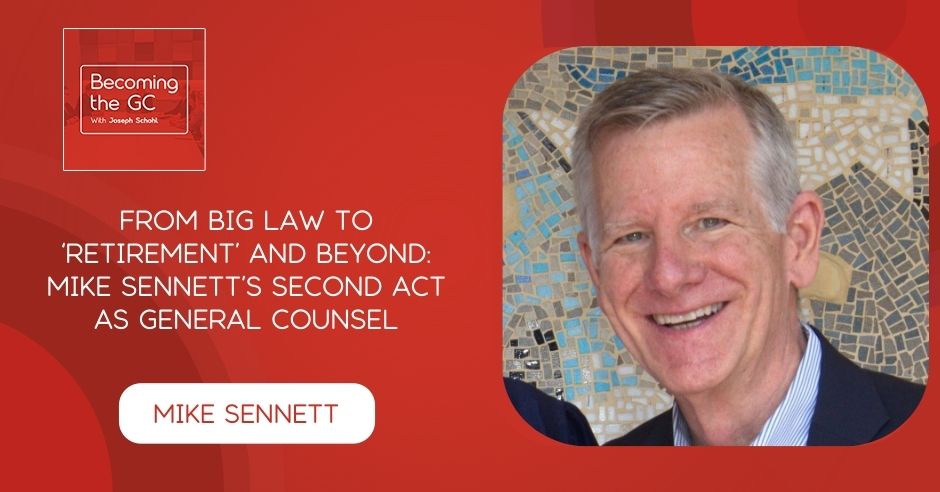
What does a “retirement” career look like for a Big Law antitrust partner? In this exclusive interview, we speak with Mike Sennett—former antitrust partner at Jones Day—about his unconventional transition to General Counsel of the Water Quality Association (WQA). After decades handling complex global deals, cartel cases, and evolving regulatory challenges, Sennett found a rewarding “second act” he jokingly calls his retirement years. He shares insights on the evolution of U.S. antitrust law, why qualitative arguments matter beyond the HHI index, and the skills needed to navigate global regulation. Most importantly, Sennett reflects on how senior lawyers can find meaningful GC roles that offer impact and responsibility—without running a massive legal department. Tune in. This is a thoughtful blueprint for experienced lawyers looking to scale back without stepping away.
—
Watch the episode here
Listen to the podcast here
From Big Law To ‘Retirement’ And Beyond: Mike Sennett’s Second Act As General Counsel
Mike, welcome to the show.
Thanks, Joe. I’m delighted to be here.
I can’t wait to go through your background because we met many years ago when I was a young lawyer at Baxter and you were a partner at Jones Day. You were outside counsel on antitrust. I learned so much from you over the course of several years in that area. It’s an area that isn’t always intuitive to a corporate lawyer.
When we were together then and many years after as you went into a number of different roles with Baxter, the experience with DaVida in a major way and all of that has just been delayed over the years then watching this transition into being in an inside lawyer if you will.
Tremendous services even those of us who aren’t antitrust lawyers. You can’t escape it. It’s been a important practice area and continues to be. I’m sure we’ll get into that more. This interview to me continues on a theme. This is not intention but the show has been about unusual paths to the GC chair. What I’m finding is everybody’s path is unique. Now, yours is certainly unique and comes later in your career. We’re going to spend a lot more time along the journey before we get to the GC chair because I don’t want to skip over anything. I’d love to even hear about what inspired you to pursue a career in the law generally.
Transition To Law From Academia
I’m very happy to walk into that because it was happenstance. As I was studying as an undergraduate and I intended to do, I was in in fields that led me into graduate school. As I was a going into graduate school and to a PhD program, I looked around and I wasn’t very happy with the ultimate career path of academia. It wasn’t terribly exciting to me. It didn’t push some of my buttons. I was looking for something to combine the academic aspects of what I had done. I love to read, think and study, but also to have the engagement with people and in business. I wasn’t going to get that in academia.
Even within the first to second quarter of that year afterwards into the program, I was taking jurisprudence course and a lot of Economics which was my going to be my discipline. I decided, “I want to go to law school.” I didn’t decide until very late and even in the process for applying. It was something that people didn’t put off quite the way they do now. In my time, it was a little bit less than yours. There was a lot more thought given but for mine, if you’re going to go to law school, you had to do it right away. Even though I skip one year between an undergraduate and law school, it was viewed as a big deal. “I’m going to law school later in life.”
How did you send that year?
That was in graduate school. I was taking courses and everything. I don’t think I applied and I applied very late. I remember going down at the time at the very famous dean at the University of Chicago. I had to stay in Chicago for some family and other reasons. I remember going down to meet with Dean Phil Neal, who is also a famous lawyer himself and saying, “Can I get in?” He said, “I tell you what. I’ll put you on a waiting list. You’re looking good.” This was in May or June. I applied to Loyola as well, and they were pretty quick with me because that was a little bit easier. Finally, in July or something, he says, “I don’t think we’re going to be able to do you.” I said, “Thank you.” I went through that.
I still remember from my first year in law school, ordinarily coming in Chicago. There were two sections in our law school at Loyola. One fellow was number one in section one. I was number one in section two. We could transfer the University of Chicago if we chose. He went ahead and did it. I don’t know why, but I had to say, these are our career paths. I said, “I can either be the superstar here, law review, be at the top of the class or I can go down in Chicago as a transfer student and treat me accordingly. Maybe I’ll do okay. Maybe they’ll be so smart that I won’t be able to compete.” He went and I stayed. It was probably in retrospect the right decision but it was the first career path decision.
Loyal to Loyola. What was your first job when you graduated?
Early Career & Focus On Antitrust
Again, I focused on my antitrust competition economics background in law school. My law review article was in that field. The professors that I work with and took courses with were encouraging. One was formerly with Chief of the Federal Trade Commission in Chicago. My first job was at Bell, Boyd and Lloyd, which as a since merged out. I’d worked at Sidley by summer between 2nd and 3rd year. Sidley did not have an antitrust practice and still didn’t for a lot of years. Now, it’s very different like a big time deal practice and it still didn’t. Which is how I got to work with Baxter and even while at Bell, Boyd.
Sidley would do the deal part but the GC there didn’t have confidence in their antitrust. He came in and I got a lot of that good stuff. That was my first job out. It was within that framework. It was everything with deals, travel, big litigation and everything from the Archer-Daniels-Midland one to United Nuclear and Uranium. It always major cartel things like fun things in Japan and Europe.
From my seat, I was at Sidney. Bell, Boyd was literally across the street. When I was at Baxter, as I said, we worked together but you worked on ADM like the informant.
I still had until a few years ago. I finally donated them somewhere. I had cassettes from the FBI’s recording. FBI both in Mexico as well as in Hawaii. I had use that and use quotes from that when I taught antitrust compliance, even Baxter and elsewhere. They’re even in my slides here when I teach antitrust within us. Some of the famous quotes that were funny quotes as the group got together. In Mexico, I heard a knock at the door. They call it the FTC. They are all joking around. If a waiter came in, what he was doing was coming into changed the tape in a lamp.
In Hawaii, the cartel was a US company and three Japanese companies. They got together in Hawaii because they didn’t want to meet in the United States. It’s these funny quotes because antitrust jurisdiction reaches everywhere as everybody knows.
For people reading who don’t know the story, go on Amazon and get the book, The Informant. There’s also a movie, which was entertaining. In the book, I learned a lot from it. It was learning, but also entertaining and informative way.
Fun times.
It’s quite a story. You’re at Bell, Boyd and Lloyd and you’ve got clients. I don’t want to skip anything, but I think of you as retired Jones Day partner. How did that come about?
The Shift To Jones Day & International Practice
That was a complex undertaking. Jones day was originally in Cleveland, but then expanded. It came to Chicago fairly early on and tried to recruit. At Jones Day, they did have antitrust practice and they who I was. They came for the first round or so, and then it came up again a few years after that. Jones Day’s big client in this space was Abbott Labs. Baxter lay lowed as a client and I said I can’t do it because in those days they both were in the same lines of business. Particularly in IV solutions and then they hadn’t diversified out.
I didn’t join Jones Day until after 2000. They’d come back every few years and finally, Baxter recognize and I would talk to the GC there at the time in each of these occasions. Tom Sabatino may have been the one that finally said, “I’ll go ahead and go,” because they had changed so much. When I went and took our group out of Bell, Boyd, a couple of other larger groups left as well and then emerged in the K&L Gates.
Antitrust was a major Bell, Boyd practice, but we didn’t without in the later years as it turned out, even with Baxter and a number of others. We did that practice without having to corporate clients, which was very difficult. You’re constantly selling against somebody who’s got all the corporate work and corporate relationships. The GC said, “I make one decision. How important is antitrust to this?” “It’s not that important. It doesn’t matter.” I had to convince them that it does.
In their mind too, if the corporate practice has a reasonably good antitrust practice, there are benefits to having it all under to one shop certainly for the GC.
Think about this, as you did in others. One of the things as an outside lawyer that was very important to me was to show my ability to work with the corporate lawyers. There are numbered Sidley that I work with closely, befriended and showed. The same thing turned out. Few of these others that would constantly be in the deals side like Simpson Thacher for the American Hospital Supply acquisition.
I worked very hard as an antitrust lawyer, not only with the client but with corporate law firm to a point where one of the transactions, one of the Kirkland later on of major transaction said, “Don’t bother with us. Go to my Senate. Go over there for antitrust. We get along fine.” That was a great compliment because it was a way to build relationships.
You must have had so many relationships with so many firms and still do, I’m sure. All the firms that you’re mentioning like Kirkland and Sidley, just blew up. They started in Chicago, but they exploded in terms of global reach, in size and scope.
As I went to Jones Day, that was a major advantage. I was able to do another one before that but it was because of the international footprint. I remember some of the Baxter transactions where I was spending weeks and weeks in Europe with the immuno transaction and gambrel. There’s a building that Baxter was building its business that kept saying, “You’ve got to go off and work with these firms.” We had some where we had outside relationships in some countries, but I needed somebody that could manage it globally. We’re down Brazil and doing all of that. It was a major big plus.
You traveled internationally quite a bit then for the role.
Quite a bit. That’s when I shifted later in my career. If I had to say, it used to be 50/50 or whatever deals to litigation or investigatory matters. It became much more deal oriented later because it was international. Oftentimes, it would be negotiating over in the Indiana trust aspects of it and then getting for the European commission. For a time, we must have had 40 different countries involved in some of the transactions that we would do.
The last big one I was on was not in the Baxter space but for PotashCorp. It was merging up in a Canadian company. China and India were the key hotspots and Israel. It was like spending time on the road basically and managing different offices that we would have or local council, as you’re going to have in India and elsewhere.
It became a lot of fun for me. It was why I went into antitrust. My concept and what I would tell to law students or others that want to get into antirust are non-repeatable. To me was very important. Don’t get something that’s repetitive. Don’t go in before the same judge and the same court and the Circuit Court of Cook County or whatever. You’re a great defense lawyer or you’re doing this, but it’s the same stuff. You’re never going anywhere interesting. Get something where everything’s different. The procedures are different. The courts are different. Your issues are different. The economists are different.
Don’t take something repetitive. Avoid going before the same judge or the same court. Choose cases where everything is different. Share on XTell me some differences between FTC and DOJ in the EU.
The EU is much more regulatory. Sometimes, in the US, some lawyers love to have these white papers that they would develop before the FDC with it or the DOJ. I was okay with them. I used to think you’re cutting off a lot of arguments sometimes or they haven’t raised those arguments. Let’s wait until we see. I was much more annoyed about how to do these things and didn’t want to create issues where there were any. Versus where the EU where everything is. Everything is regulatory. It’s a massive paper that you submitting. It’s submission after submission in a certain way to go through it.
At the end of the day, it wasn’t that different in terms of how they decided things. On the merits, it seemed to be pretty comparable, but the process was so different. I remember in India, going into myself. You can’t practice in India Council, but going into court in India was like a disaster in terms of the way courts are run. It was very different. You learn from that.
Ukraine at the time had a new statute. I went there for something and trying to make sure Eastern Europe was taken care of. Brazil was always different. You learn and you adapt as you’re going through it. Again, your depend it a lot in your either your local office or lawyers at firms that you’ve worked with before internationally.
Let’s talk about US Antitrust law over the course of your career and how it evolved or devolved, depending on one’s perspective. What changes did you experience?
Evolution Of US Antitrust Law
Probably the largest change over time was the emphasis on horizontal transactions, as being issued. Before that, they would have issues with vertical arrangements and conglomerate mergers and with odds of things. They then started focusing much more on just acquisitions and transactions between competitors. As as a result, you tend to have lots and lots of information.
I remember when we did one of the Baxter transactions. There were 400 banker’s boxes of documents that were submitting. Nobody’s going to recognize this, but we did everything on paper. Lots of that without data. You’d have some data, but you wouldn’t and without a lot of economists involved. The last ten years or so, with the Antitrust Division, the economic were critical. Having an economists and working with them, sometimes almost as expensive if not as more expensive than the lawyers involved. These are big law firms. Think of numbers and all that.
You would have strategic thinking economists. That became very critical. I’ve been away a little bit from my GC role. Now, I’ve just seen it become much more political. It was never political in my day. It genuinely wasn’t. You would see some differences of enforcement between one administration, the Democrats then the Republicans would come in and ease up just a little bit. When I say just a little bit, it was on the merits, on the law, and on the economics. Staff people, lifers or political appointees are not much different.
The antitrust division and FTC are all capable, smart and intelligent people. We would go through it on that. We always take a lot of pride in what we did unfortunately think and it’s not just the most recent Republican Administration but both the most recent Democratic and the Republican administrations became much more politicized like, “We’re going to take this case on because of the profile of the targets.” It’s very unsettling to antitrust lawyers.
Profile of the targets and more like ideological causes.
That ends up providing the answers before you even ask questions or gotten in the data. We were always data driven.
That’s what I was going to ask you. Before recent times and when you were fully practicing in the antitrust area, how important where the qualitative arguments in a world where they’re looking at HHI indexes and whatnot? We’d always spend a lot of time. The reasons for the deal with the White hat on that was we’re going to benefit everybody. How much did that matter to the regulators?
It mattered mutually of making a difference between transactions that were on the edge like the rationale why. Why are you doing this? Explain to us the future. Qualitative matters. I would say to a GC, “The quantitative tell you whether you’re going to have a headache or not. It’s basic bottom line. Are you going to have a headache with this transaction or not?”
Once you get to the answer of yes, then start working on the qualitative messaging. What is it? How are you going to contribute? Always remember it is all about consumer welfare meaning how this is going to benefit. Your customers always right. I want to say the client, “You preach to me that the customers always right. I believe you. Tell me how this is good for the customer.” Not how it’s good for you. Tell me how it’s good for the customer, then that will be the basis for the argument.
It’s all about consumer welfare—how this will benefit your customers, not how it benefits you. Share on XI won’t say it’s going to make the difference. In one case, that’s horrible, versus another. In a closed case, it does. I remember going through consent orders. We would do the best certain businesses. It would always be, we’ll get less or asked to do less if we get these arguments here for these business units. It worked because when they can come in and business people aren’t talking about data. Let the lawyers or let the economists candidly talk about the quantitative data. With qualitative, that’s the argument.
We always spend a lot of time and money on that, so I’m glad.
The mindset of all that was always so critical because you want business people to have it instinctively at their tongue when they’re speaking. I like to let business people speak in these circumstances. I’m not going to be there. The best argument you had was when they’re well prepared.
GC Opportunities & Self-Reflection
Where you at any time during these years thinking, “Someday I’m going to be a GC?”
I had a couple of different steps into it, but with Baxter. It would be a little bit like how I got the WQA. With Baxter, I had two opportunities. I was with younger children at the time and I even spoke to whoever’s running the American school in Brussels about how do I get my kids educated. The International Post had opened up. There were some excellent young people that ended up taking it over, but it was a major part of Baxter. They wanted a US presence over there and somebody willing to go over for three years and maybe shoot themselves in the foot and their career in the US, which it changed in terms of mindset. That was the case then and I did think about that very seriously.
Some years later while going through a process with one of the GCs that I was close to or close to all the GCS there, who is going to be moving on and said, “We’re going to be doing a search for a new Baxter GC. I think you should try that.” I remember at least talking a little bit about it and thinking, “That might be interesting.” I knew I didn’t have the skillset for it. A little bit of me was narrowly focused in the antitrust. I was not a corporate deal type.
I was not a not more of a corporate generalist. I had a bunch to learn, but I would look to my left and looked at my right. Sometimes GCs do come out of specialties in large law firms and do find. Sometimes, they’re not trained for it. At the end of the day, you’re great but you’re not quite what they’re looking for in terms of skill set. You manage a lot of lawyers but they’re all antitrust lawyers.
Since you’re so involved in the business and you have to understand the business more so than maybe any other specialty area.
It’s a great one for the business side, which is why I went in antitrust and not something else because I didn’t want to deal with finance. I get I get bored by accounting, finance and capital markets and all of that. I love dealing with the salespeople. I love dealing with the strategic thinkers. Those with visions and the rounding error and the numbers don’t matter. It’s an interesting time.
Before I jump ahead to your role, maybe you still are teaching.
I haven’t done that as steadily as I did a long way. I taught antitrust and antitrust law basic and the international antitrust. I did one and in antitrust M&A and another one in international antitrust M&A. It’s different kinds of seminars over some years but then I stopped doing it in terms of some little logistics front working. Plus, the professor there that had been going on Sabbatical was new in the beginning when I did it needed it. The law school needed the expertise and then he has some of his own books that he wanted on the actual faculty itself. I’m still involved with the institutes and that thing. Not quite what I was by a long shot.
I’m just thinking when you would come into Baxter and do the trainings, how different it was and how much better it was as the student than what antitrust that are in law school from some great professors. It’s much more of a hide the ball and make you find it. Whereas, you came and just laid it all out in a way that was easy to understand in a very difficult and sometimes complex subject matter.
That’s what you need to do with regulators. My few juries as well. I had fun doing that with some juries, too. I had a couple jury trials at Baxter in Delaware that was more counter out of patent. You get a lot of patent in antitrust. Sometimes if we’re pushing a patent, somebody is going to be pushing back on us and claiming that we’re going to monopolize or something or another. I had one jury trial in Delaware for Baxter. I still remember having so much fun before to jury with it.
Transition To An “Alternate GC Role” At WQA
Let’s talk about the transition now then to your current role. What did that look like?
The transition developed. Within a timeframe after I completed a very large, very complicated international transactions, a combination with Potash. I was exhausted from the global travels. This was all one that was Asia and India. I was like, “How many of these are going to do now?” I came to a crossroads within Jones Days. I said, “If I continue to go 1000 miles an hour and stay engaged, if I was willing to do that or you retire. Not unusual in these mega law firms.” At the same time, I would have 2 or 3 major New York law firms.
New York at first wasn’t doing what a Jones Day would do or even Sidley or Kirkland of globalizing because their economics didn’t work much of going out of New York. Occasionally, they would have a DC off office. New York was very late in this but they came to it. I was positioned where they came to me and said, “Do you want to do something in Chicago to open the office? It’s only for two or three years.” It sounded interesting.
In each discussion, what tugged at me was, I have a team both in Chicago and elsewhere but particularly in Chicago that I loved to death and trained and brought along. I said, “I can’t do that.” They wanted maybe me and they would send their people to fill in under. It would be me and then you get the clients that you’ve got and all your client relationships to come along and most probably would have. Again, it was starting something new as business development. I had it with that. People would say a lot about business development in a large law firm.
For me, you get to a certain point where it’s got to be reputational. You also can’t walk away from which what you had. I was not prepared to do that to my team. I was prepared to do that to Jones Day. Maybe if I could have had a person or two on the team, I was getting that a signal. When I left Bell Boyd, I pretty good card blanche to bring along who we wanted because that was the crew. It wasn’t going to be the case the second time. I wasn’t going to be viewed as much of an active practitioner.
You go around, you introduced people and you solidify that then your old and goodbye. As I was debating all that, I had this training association for this, which I only had one. It was this one and it started in the mid-90s over a major antitrust undertaking. When I engaged with this training association, I liked everybody so much in it. It was interesting nonprofit, but it was in the water space. It was Water Quality Association, lots of big companies, lots of small companies, and lots of local, but they also ran or at least thinking about a accreditation program for much like underwriters laboratories but for water at the time. That was very key.
I started working with them. I would just be there outside law firm. I’d send other stuff to either Bell Boyd or Jones Day. I would go to the board meeting and do the strategy and got to know everybody. We’d go to conventions and all the fun stuff I had. When I sat down in November at the board meeting, before I was going to retire effectively or do something else with a different firm, I said, “I’m going to retire on this or I’m going to go with a different place. It’s not going to be an ability to continue.”
A couple of the board people were like, “We can’t let that happen.” It went out with a big pow wow. They came back and basically said, “Why don’t you join the Water Quality Association? Bring your outside counsel and come inside. You can farm out what you like, do what you need to do, get it set, but become a GC here. We’ll do it on a schedule.” Basically, what they said was we can do it on a schedule that would let you lighten up your training association.
The lead of this was somebody that had gone inside, was on the board that I had a great lawyer from Foley and Lardner. We’d done some deals. A more adverse deals, but with our clients. He knew me so well and said, “I’m going to be supported. I’ll be the president in a couple of years, I’m going to support this and we’ll go from there. It’s a training association. You can practice as a GC. I can have a team that’s going to be a team like you’re used to, but go have at it and enjoy your retirement years basically.”
It’s a win-win. I’m sure they realize all the experience and wisdom that you’re bringing to it is such a gift.
It was an interesting decision immediately before COVID. My first month or two was then COVID hit. Most of my legal work and all of that was keeping our head above water. During COVID, I was helping our members and going through a process of how we keep the lab. The lab is all on-site and hands-on. You’ve got to be there. How do we do that? We’re running around the country getting regulatory rulings or otherwise that we are an essential operation.
More importantly, our members, because there’s water somebody’s pulling water out of the ground in Rural Kansas, they can’t get at this COVID or not. There’s going to be major consequences. That was a big will, “Tell us what you do. Get the regulatory regime going.” We had some people that were often had to go through the whole PPP process to get involved in the government. That worked and didn’t work. It’s very complicated.
The circumstances immediately gave you broad exposure to new issues you haven’t dealt with before.
It’s fun times.
Using the same skills because you had dealt in lots of governmental things.
Other things like that were not stranger. Plus, I knew what the legal issues were for the association anyway.
What advice would you give looking back on your career to your younger self?
I would think about my decisions, my decision paths, including this one. My advice is just be true to yourself. I thought through each of these. I don’t think I would change a thing, candidly. I wasn’t perfect by a long shot and a lot of things I did. In retrospect, it is doing something that you’re happy to get up with each day as a youngest associate and a partner in a law firm. You’re working like crazy, so you have to find something that you enjoy. If I thought back to my younger self, I’d say, “You’re on the path. Whether it would have steered a little differently each way.” Who knows? I had no regrets.
Just be true to yourself. Do something that makes you happy to get up each day. Share on XOne thing that I learned from one of the CEOs at Baxter during my time there, Harry Kramer. It was the importance of self-reflection. Without that, you can find yourself in places you don’t want to be or don’t know how you got there. As long as you’re doing that along the way, you should be steered pretty well.
I’m still on his email list and I read that stuff because I still learn such as his books, his writings and his teaching. That was always key to me.
What do you most looking forward to?
At this point, I’m probably looking forward to saying, “You have to transition this.” I’m probably looking forward to making sure I transition this into capable hands. I’m probably coming out of a GC role. This is at least my experience or advice here. It wouldn’t be for a GC looking for a mid-career, big undertaking of going from managing lawyers outside to managing lawyers inside or going inside as an associate and then rising in the corporation.
I can’t help with that. What I can do and what I would say is, for those looking to be a GC in a role that is GC without all those sorts of management commitments. If you’re looking for someone like my role, it’s not full-time. I behave like it’s full-time and everybody thinks it is, but no. It’s supposed to be 2 or 3 days a week of an age where I should be retired. They view that, but there’s a lot of what I’ll call alternate GC roles.
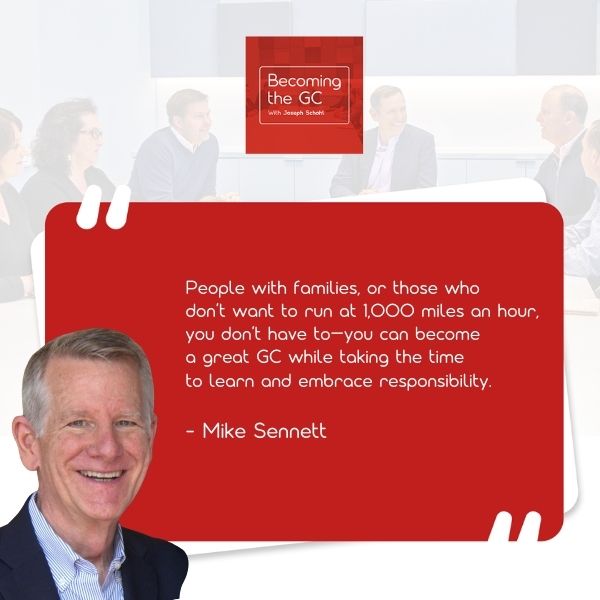
I think about people with families, those that want to do something other than hit the ground running 1,000 miles an hour. You don’t need to do that. You can become a great GC. There’s plenty of learning out there and plenty of responsibility. You can do it on a schedule that’s just different. Sometimes if you’re looking like, “What do I do on my senior years?” If you’re in a small law firm, a large law firm or in a major GC role, what can I do incorporations? Particularly publicly held companies. They look at it all and they say, “You’ve had enough here. You’re no longer at this level for us.”
What do you do? I still sit on boards for nonprofits, You give back, but you can also downsize it without losing the value. There’s like what you’ve seen. You’ve got an ability as you’ve done to also to support GCs that aren’t fully staffed to support training and education and to make this a road that that can be very positive no matter what your ambition. It’s to say you don’t have to be running 100 lawyer law department.
To make an impact.
Also to be great in your business and enjoy it and find a enjoyable day.
Have you read the book from Strength to Strength by Arthur Brooks?
I have not read it. I’ve had somebody recommended it.
I highly recommend it. You’ve done it. You’ve done what he says we should do in occupations like we have. It’d be good to read because it would be like, “That’s what I did and that reaffirm everything.” It’s been such a pleasure. I have one more question. I’m curious as you weren’t flying around the world and you had something that was more manageable. What did you spend more time doing outside of work? What have you been spending more time doing outside of work?
A couple of things. Professionally at least, I’ve spent quite a bit of time trying to learn lots of areas in law that I know nothing about. Somewhere in a large law firms put on these constant seminars or webinars. You sit and learn. I do that and try to engage in that way. I spend more time traveling than I did. I have five children all over. Most of them are East, but not they’re all over the place as well. I move my stepmother to Italy, so I get over to see her. I love her to death. She’s the last one in that range. She’s back up in Torino. A beautiful area of Northern Italy.
I sit on boards for what’s Children’s Home and Aid in Chicago. It’s Brightpoint. It’s a large human services thing with within the inner City of Chicago and then elsewhere within the State of Illinois for managing difficult children in difficult circumstances, early head start programs, and all of that. I value that very much. Within that, keeping busy. I’m trying to stay healthy, keep busy, and work out occasionally much more than I did before.
Do you still get out on Lake Michigan sailing?
I haven’t been sailing for a while. My friend and colleague had the boat. I would never get the boat because it would sit too much with me. He had it and he gave that up some years back. I haven’t been back sailing again, but I did make the Mac race several years in the past and a bunch of those. I love the sailing. There’s always exciting times.
Thank you so much, Mike, for sharing your wisdom and your story with our readers. I appreciated hearing it all myself and catching up in this way.
Thank you. I can’t thank you enough for this opportunity. It was great to see you and all the success and everything else. I wish you all of just very best. It is a pleasure.
Thanks so much.
You take care. Bye.
Important Links
- Mike Sennett on LinkedIn
- Jones Day
- DaVida
- Sidley
- The Informant
- Water Quality Association
- Strength to Strength
- Brightpoint
About Mike Sennett
 Mike Sennett serves as the Water Quality Association’s Chief Legal Officer and General Counsel following many years as an /trust and competition law partner with the global law firm Jones Day. WQA provides product and professional standards certification services, operates a fully accredited product testing and analytical laboratory supporting a certification program accredited by ANSI National Accreditation Board (ANAB) and SCC (Standards Council of Canada) to ISO/IEC 17065, manages an annual trade show and exposition and represents the residential, commercial and industrial water treatment industry in the United States and internationally. He also serves as General Counsel of the Water Quality Research Foundation, an independent foundation that sponsors scientific and academic research and education addressing a broad range of water quality issues.
Mike’s practice at Jones Day was international in scope with an emphasis on the competition law aspects of antitrust-sensitive mergers, acquisitions, and joint ventures, in addition to his long history of civil and criminal antitrust matters in courts throughout the United States. His clients were in a broad range of industries, but he had a special emphasis on medical products, pharmaceuticals, and health care antitrust.
He holds an A.B. with honors in philosophy and English from Quincy University and a J.D, cum laude from Loyola University Chicago, in addition to advanced graduate work in jurisprudence and competition economics at Northwestern University. He also is an adjunct faculty member at Loyola University of Chicago School of Law and serves on the boards of the Institute for Consumer Antitrust Studies and the Midwest Antitrust Colloquium. He has spoken widely on competition and consumer law topics and authored numerous articles on trade regulation and antitrust.