

Authentic leadership starts with knowing who you are and leading from that truth. C.E. Rhodes, General Counsel of Frost Bank, shares how purpose, empathy, and consistency have guided his journey from early influences to executive leadership. He reflects on the lessons learned from connecting the legal function to the business, mentoring others with humility, and showing up as the same person in every room. His story is a testament to the idea that authentic leadership isn’t about position or power—it’s about integrity, humanity, and staying grounded in what matters most.
—
Watch the episode here
Listen to the podcast here
Leading With Authenticity: C.E. Rhodes On Clarity, Service, And Solving Problems
Our guest is C.E. Rhodes, the General Counsel of Frost Bank in Texas. I know you’re going to love hearing his story. We talk about how a pivotal moment in his childhood and his love for his parents led to his pursuit of a career in law. We’ll also talk about how a serious football injury in high school led to his becoming a Jefferson Scholarship student at the University of Virginia. We’ll talk about how a pair of shoes led to his first legal job. Stay with me to the end, and I’ll share my biggest takeaways. Here’s C.E.’s bio.
C.E. Rhodes serves as Group Executive Vice President, General Counsel, and Corporate Secretary for Cullen/Frost Bankers, Inc. in Frost Bank. He leads both the legal and real estate departments. Mr. Rhodes has more than 25 years of legal experience. In addition, he has served on the boards of the State Bar of Texas, the Texas Bar Foundation, and the Jefferson Scholars Foundation. He holds a JD degree from Emory University School of Law and a BA from the University of Virginia. With that, let’s get to the interview.
C.E., welcome to the show.
Thanks, Joe.
It’s great to have you here. Where are you zooming in from?
I’m zooming in from Dallas, Texas. I have meetings tomorrow at one of our locations here. I just got in today, here in Dallas.
What’s your normal home base? Is that Houston?
The base is in San Antonio. Our process is headquartered in San Antonio, but I travel quite a bit across the state to both Dallas and Houston, primarily. I am the executive sponsor for the Dallas area. I get to Dallas generally about once a month.
The Kitchen Table Revelation: A Career In Law Begins
Take me back in time. What inspired your career in law?
In general, some people know they want to go when they’re young. Other people discovered later in life. I was more of the former. One of the memories that I have is probably about 8 or 9 years old. I grew up in rural Virginia, Blinchburg, just outside of Lynchburg, a small town called Edmonton, Virginia.
In the rural communities, it was common for someone to come out and sell you life insurance. I recall my folks sitting around the table, and Danny Landers, who was the insurance guy, came out to sell them life insurance. I remember my folks signing some documents, and Danny left, and they were still sitting around the table and just trying to really understand what they had just signed.
It was at that moment that I realized that I never wanted anyone to put a piece of paper in front of my folks and have them not know what it meant. My folks had some college education, but that just resonated with me. Although what I do today has nothing to do with interpreting documents for my mother or my dad, at least formally. I still am happy with the choice.
That gave me the chills when you said that. I think about our roles as GCs, where we have some ability to influence things. Does it impact your approach to what you’re putting in front of consumers?
Yeah. I go back to that initial reaction was to help my folks. In my role as GC, it’s the same. It’s just not helping my people. It’s helping others. In addition, to help my parents. I always try to approach it in that manner. From a very humble sense. When we’re writing contracts, are we trying to use plain language? A lot of times, you’ve got to have some disclosures and disclaimers in there, but is it plain language? Is it something, again, to your point, that I can put in front of my mother or father, and they generally get the gist of what it is that they’re signing? That’s what I want to do.
From Football Injury To Jefferson Scholar
Certainly, in the industry that you’re in, there’s a lot of mandated disclosures, etc., but it’s good to hear that you’re mindful of that when putting documents in front of people or deciding what’s going to go in front of people, etc. Take me from that kitchen table to your path through college and then law school in your first attorney job.
Prior to my senior year in high school, if anyone asked me what my path to college would be, I would have said football. I was a good football player. I’m also the oldest of four kids, and it’s seventeen years between me and the youngest. Same two parents. It was really important to me to go to school, and my parents didn’t have to pay for it. In my senior year, I broke my collarbone, which, back then in the ‘90s, you had to have a reasonably good senior year before they offered you a scholarship. It was pretty rare.
Did you get hurt playing football?
I did and had surgery the very next day on my seventeenth birthday. That was really tough. There was a guidance counselor, Kathy Kaplan, who came across the Jefferson Scholarship and said, “C.E., I read this, and I think you’re perfect for it.” It was a full scholarship to the University of Virginia based upon demonstrated excellence in leadership, scholarship, and citizenship.
It was an application process. You had to be nominated by your counselor. You had to go through interviews at your school and through the region, and ultimately, a final weekend in Charlottesville. I was one of 23 or 24. It’s roughly 1% of the entering class that gets offered a Jefferson scholarship. I did. I remember that week waiting. Back then, there was no email.
You had to wait, actually, for the envelope to come in the mail. I remember getting the envelope and going to my high school, because my mother worked at my high school. She worked in the library. She was a library assistant. I remember sitting out in the parking lot and opening the letter, being super excited, and then walking inside and opening it with my mother again. She was really excited.
You got the thick envelope.
That’s correct. I got the thick envelope. I ended up going to the University of Virginia, but when I made the decision and I found out about the scholarship, the football coaches at Virginia had stayed in contact, and they said, “Keep us posted. Have nothing to do with the scholarship, but we’d love to have you play. If you get the scholarship, we just don’t have a scholarship for you.” I did.
I contacted them. I was on campus several weeks before people got there, and was part of that immigrant class of ‘93. I went to the University of Virginia and got my undergraduate degree in history, and played football for three years. Bread shared in my first year, played and traveled, and ran the ball. In my second year, my third year played and traveled primarily on special teams. It’s a wonderful experience. Some of my closest friends are guys who played football with me.
Now, as a recipient of a Jefferson scholarship, did that mean you got to live in those cool dorms that are right around the quad there?
Several of my Jefferson Scholar classmates did live on the lawn. I did not. That’s an application process, and they take not only just the brightest of the brightest, but also some of the people who have done and made tremendous contributions to the university while they were there. I didn’t apply to live on the lawn. In fact, in my third year, I signed a two-year lease with two guys I played football with to live off campus, plus the idea of walking out in a towel in the middle of December to take a shower and to get logs just didn’t interest me. In hindsight, it’s a tremendous honor. I have friends who did it, and super proud of them and their accomplishments and what that means.
It’s a unique thing, but yeah, not a lot of privacy.
Not at all. There’s always somebody knocking on your door, and there always seems to be some type of event on the lawn and students running there after an adult beverage or around 1:00 or 2:00 in the morning. It could be difficult to get to sleep.
Right on. How did you get from there to law school? When did you decide that that was going to be your path?
After my, which would have been my 30 years at UVA, I decided, and I knew that all I ever wanted to do was play major college football. After about where everyone wants to go to the NFL, I really looked at it and said, “Football for me just to play major college football. I’ve done that. I’m very excited, and I want to go to law school.”
The football office had been great, and they helped set up internships during the summer because I was pretty far ahead. I didn’t need to take classes to graduate during the summer. I said, “Look, if you guys can help me with an internship, set me up with an internship at a bank.” I never would have thought I’d end up in a bank, 30 years later, but that’s life.
They set me up with an internship with a bank, and that went well. That also carried over the next year. I knew that I could work, my final year in school at the bank, and study for the LSAT, which I did. I took the LSAT without taking a prep course, which I do not recommend to any young person. If you’re interested in going to law school, take the prep course. I had a law school professor. He wasn’t my law school professor, but he’s a law school professor who used to work out in the football facility.
Alex was a funny guy, and I said, “Look, I’m thinking about going to law school.” He said, “Look, take these old exams, study these old exams. If you want to do a prep course, you can.” I was like, “Alex, I don’t have money for a prep course.” He said, “Study these little exams.” I did that, took the LSAT, and got to Emory. I ended up going to Atlanta, and that’s where it led me to law school. Ironically, it was also the last place where I played a football game in Atlanta. I was super excited to make the move.
I’m a few years older than you. I also didn’t take an LSAT course. I went to the, I don’t know, Borders bookstore or something and got the book and read through it in advance. Now it’s like a whole industry to get ready, and you can take it multiple times. The kids today have it so much easier.
Yeah. It was a one-shot deal for me. Like, “I got to save up my money, take this test, and then we’ll roll with it, and I will be where I’m supposed to be.”
Law School Unveiled: The Crucial Role Of Practical Experience
There’s something to that, to having that pressure and to perform at your best because you have to. That’s great. You went down to Atlanta, and then how did you find law school? Did you enjoy it?
Law school for me, and I went straight through. That’s the other thing I think that I would encourage young students to take a year off. I think you need that break, whether it’s the travel or just something just gives you a little bit of life experience. I think I was so focused on not getting a job by 25, but I wanted a career. I’m being driven to go straight to law school. In law school, I thought philosophically it was interesting, but in my first year, I really didn’t know how to study for law school.
I didn’t know any lawyers when I was growing up. No lawyers in my family. I mentioned Alex, but he had just helped me with the LSAT. I didn’t really know that and didn’t really understand legal writing. I did okay in my first semester. I could have done better. I did better in my second semester, an improvement, and I got it. That first summer, I worked in the DA’s office in Manhattan. I was able to get a job there.
Luckily for me, I had an aunt who lives in Manhattan, so I didn’t have to worry about living expenses. I think I was only getting like $6 an hour. Some public interest deal that they were giving me. I wouldn’t get paid a lot of money, but I had an aunt who was fixing my lunch every day and gave me a roof over my head. All I had to do was take the subway to the office.
That’s where I learned how to write, truly understand legal writing. The thing I would say to law schools and law school students. Law school is great theory, but it’s not practice. You really have to, it’s called practice for a reason. I think about football. If you want to perform well on Saturdays in college, our head coach would say, “You’ve got to practice perfectly Monday through Friday.”
Much of law school I thought was, “I gave you the theory, you need to understand the theory.” I tell students all the time, law school is a marathon, not a race. Don’t try to run out as fast as you can and burn yourself out. Just know that the end game isn’t necessarily to graduate from law school, but the end game is to pass the bar.
Once you’re licensed, it doesn’t matter whether you’re top of the class, whether you’re bottom of the class, after your name, and says JD or ESQ, Esquire. That is the name of the game. If you practice well and you practice good habits, the smartest lawyers aren’t always the best lawyers. The best lawyers are the ones who work the hardest. Intelligence matters. No one’s discounting that. If you work really hard, you can be very successful in this career.
How did you learn to write? You said you learned to write in that job. Was it from watching and emulating others, or did you have somebody willing to take the time to put red all over your paper and show you the better way to do it?
I was in the appellate section. They would ask me to write different things, and there would be templates and formats, and I would see that. That’s when it clicked. In the classroom, you’re just doing things, but to see it in practice, understand what we were doing and why it mattered on behalf of the state really resonated with me. I also had a mentor when I was there who was just great at marking up the paper.
The red provides me great feedback and says, “Think about saying it this way and here’s why,” or “What’s another way?” It’s challenging me to think differently, but really having those templates and just understanding how to write was immensely important to me and beneficial because I came back that second year. Whereas in the first year, I felt like I was crawling to run.
I was in full sprint second year. I got it. I could be in the classroom and I’m like, “I’m looking for and here’s what matters and take it.” I could write the exam. Much of law school is, for many first years, they’re the first gen, you’re trying to figure out, you’re reading cases, and you don’t know what you’re looking for. Someone says the holding. You spend hours reading the case or briefing the case, not knowing.
For me, it was like, “Let me read the holding first. Here’s what the court decided.” They don’t let me go back and understand how they got there. It took me a year to figure that out. Different people learn differently. For me, it was like, “Here’s the case. Here’s what it was about. Here’s what they held. What were the facts and the rationale to get them to the end game?” Once I started to do that for myself, it just clicked.
The Unexpected Connection: How A Pair Of Shoes Led To A First Legal Job
Your first non-internship job out of law school, tell me about that.
Again, I go back to a lot of things my parents and grandparents would say, but it’s not always about what you know. It’s who you know. Honestly, it’s been a combination of both for me. I got my first job in Houston, and people say, “C.E., how’d you end up in Houston when you had no family or no ties?” I had clerked there part of the summer. I tell people the short answer is a pair of shoes, and they laugh.
It's not always about what you know. It's who you know. Share on XI said, “I’m not trying to be smart, but the reality is, Emory had this trial techniques program that was mandatory for all 2L students at the end of their second year. They flew in lawyers and judges from across the country and Canada to teach 2Ls how to track cases. It was a trial by doing so. It’s very much the NITA method. The National Institute of Trial Advocacy Method. You’re on your feet doing a closing, you’re doing an opening, you’re directing, you’re crossing witnesses.
I remember in my 1L year, they had said, “Look, this takes place two weeks after classes end. If you’re interested, you should apply. It’s a great way to meet lawyers and judges.” By the 1L year, I said, “Let me look into this.” I did. We were assigned odd jobs, everything from slicing bagels in the morning for the lawyers and judges when they came in to teach the course, or driving a van that picked them up at the hotel, which is right down the street, and driving down to law school every day.
One day, I was driving the van, and this little lady with a strong Louisiana accent said, “Do you know where I can find a pair of sneakers?” I said, “Sure.” She probably didn’t say sneakers. She probably said shoes, but living down South. Sneakers more of, I guess, a Northern term. She said, “Do you know where we can find some shoes?” I said, “Yeah, there’s a mall right around the street. Technically, I’m supposed to take you from point A, the hotel, to the law school point B, but meet me here at this time and I’ll take you down there.”
Little lesson, sometimes okay to bend the rules, and not be so rigid. I picked her up and drove her down and drove her back. The whole time, we did not talk about the law. We talked about her family. We talked about sports. We talked about just a variety of things, but nothing that had to do with law school. What are your grades? What courses do you think? It had nothing to do with that.
As I was dropping her off, she said, “Here’s my card. I really like you. I would love for you to apply for my firm and my firm.” That summer, my first year, I was in New York. I called her up and I said, “I got my resume ready, send it down.” She was at a large law firm in Dallas that also had an office in Houston. She set up interviews at both places.
I went to the home office in Dallas, and then I went to the smaller office at the time, but a growing office in Houston that probably had 60 and grew to over a hundred when I was there. I came back and got the offer. For me, the opportunity was, I ended up going out there and clerking for part of the summer. I had clerked with the firm in and firm in Houston. It just felt like I remembered walking down the streets from the parking garage to the law firm.
First thing about Houston in the summertime is that no one walks down the street. Everyone’s in tunnels. Downtown is connected by an underground tunnel system. I remember walking down the street, and I’m like, “Man, it’s really hot and I’m sweating.” Two, there’s nobody on the street. On a visualization, visualize myself though, “Is this a place where I could be? Is this a place I can work?” I did that visualization every day that I was there. At the end of the summer, I’m like, “I could see myself there even without having any roots or ties.”
This is Haynes and Boone, right?
Correct. Since it worked out extremely well. That experience, later that summer, I figured out the tunnel system, at least I had to get to the frauds of my office. Just opened up a whole new world, but had great experiences, worked with great people. One of my mentors who took over that summer was phenomenal and really instrumental in helping me be the lawyer that I am today.
Were you in the litigation group or the corporate group, or something else?
I was a litigator. I joke with people and say, “Litigator by birth, transactional lawyer by choice.” I remember I had clerked at a firm in Atlanta, and I had a corporate partner tell me, “C.E., you really should look at corporate law.” I’m like, “No, I don’t want to look at documents all day. I want to be in the courtroom.” I wish I had listened because his words were to me, he’s like, “You’ve got the right mindset. You’ve got a business mindset. You want to get things done. You’re the type of guy that you don’t come across as being very adversarial all the time. You’ve got the right mindset that I think would be super for corporate.” I didn’t listen. I wish I had.
You did over time.
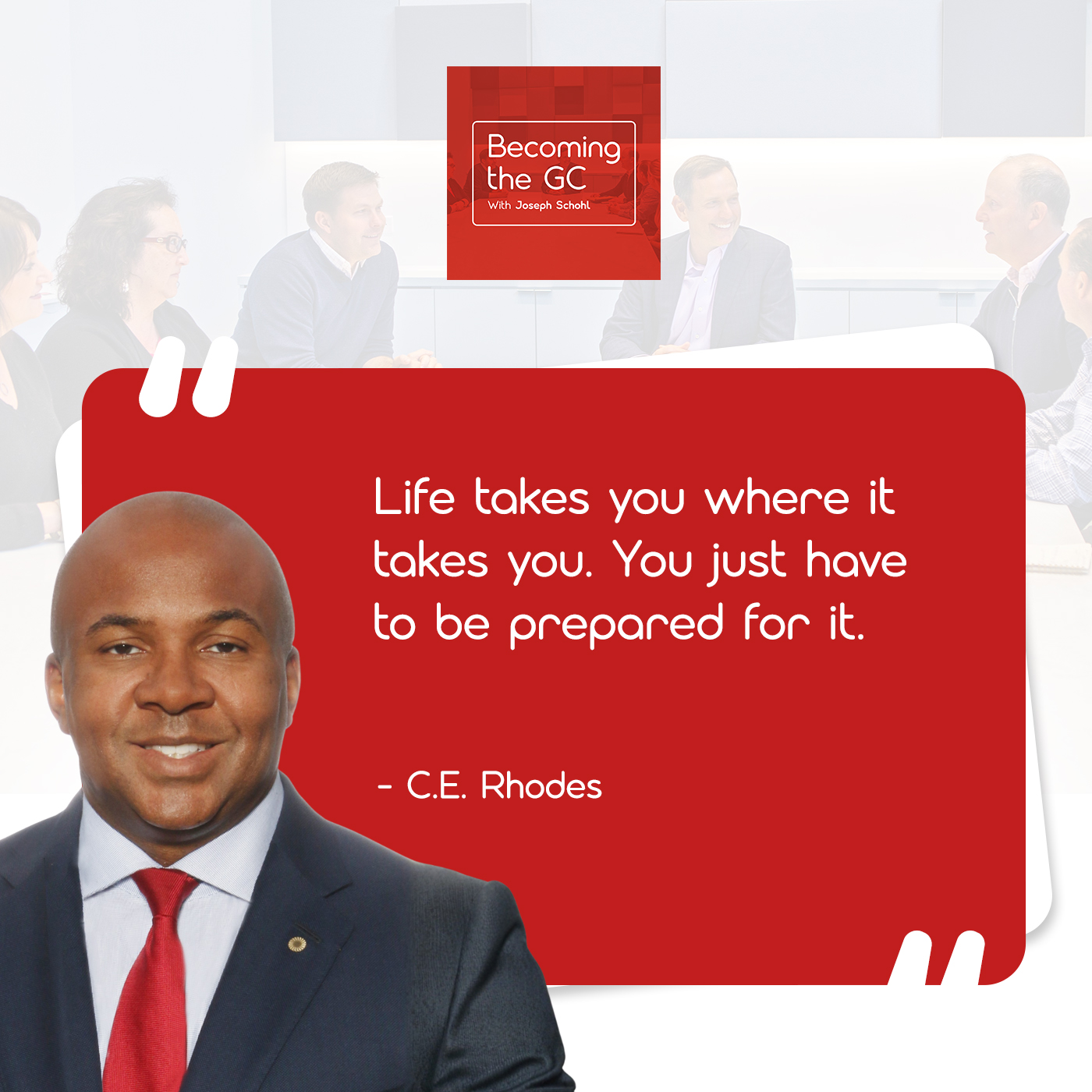
That’s right. I did. Life takes you where it takes you. You just have to be prepared for it. Business litigation that hangs about.
I’m sure that experience makes you a better corporate lawyer.
A thousand percent. I remember interviewing at different places or interviewing folks, and folks are talking to recruiters, and I said, “You’re a litigator. No one wants to talk to a litigator.” My mind said, “Also, look at the documents. I may not look at deal documents, but I do look at settlement agreements. I do have to critique the words, and I argue all day over language and over words.”
It makes me a better drafter because I know where the pain points are going to be. Also, from my perspective, I’m able to look at situations and advise clients. Here’s what you can expect. The issue will be down the road if it gets the litigation. No one wants to think about litigation. Not only here’s how it will be, but at Haynes and Boone, I was fortunate enough to get trial experience in the courtroom. I can say, “Here’s likely what the judge or jury will pick up on.”
I try to advise my client that we always want to be perceived as wearing the white hat from start to finish. It’s really important that you think about why you’re doing what you’re doing and are you’re doing it for the right reason from beginning to end. That helps you tell the story. If you ever have to get to a courtroom again, no one wants to get there, but if you have to get to the courtroom, you’ve got a great story to tell. People will relate to our jury will be able to relate to.
Beyond Litigation: Navigating Global Compliance And FCPA Audits In-House
That makes perfect sense. When you went from the law firm to your first in-house job, did you go in as a litigator, or was it a more general role?
No. I remember I just finished a very long arbitration, and I got a voicemail that said, “C.E., this is Rob Rowland, Journal Council of America. I’d like to talk to you.” I thought, “Maybe it’s a potential client.” I had no idea what Rob did. Rob was a recruiter. Rob said, “C.E., how would you like to work for a Fortune 500 company and travel the world?” I said, “Rob, where’s the job?” He said, “Houston.” I said, “Tell me more.”
Always wear the white hat from start to finish and make sure you’re doing what you do for the right reasons. Share on XThat’s what started a twelve-year career at Baker Hughes. The job I was hired to do was FCPA audits and investigations around the world. Foreign corrupt practices, my job was to make sure that our employees and agents did not bribe foreign officials. The coolest job I’ve ever had, but I’ll say, and I say this to young lawyers all the time, “Sometimes you’re not hired for what you’ve done, but you’re hired for the skills to be able to bring it to the job that they’re asking you to do.”
I had zero FCPA experience. I had taken a course on corporate crimes in law school, but I had written a paper at the request of a corporate partner at Haynes and Boone about, of all things, document retention. The title was like corporate compliance in a post-Enron world. After 2001, all the training documents between Enron and Arthur Anderson, all that stuff, we had written this paper that was published.
Rob, this recruiter, had run my name and saw C.E. Rhodes in compliance and called me. The compliance that I wrote about had nothing to do with the job I was hired to do. Like any lawyer, you start to prepare. I started reading about what the job was, and I read up on the FCPA, and I had this litigation skill set. I also had that skill set that had been identified by the lawyer before, and that I could talk to people and put them at ease, where it didn’t come across as being adversarial, where they didn’t feel like they were given a deposition, where they felt like they were sitting in the living room and we were just talking about these issues.
The ability to do that, one, and then the ability to appreciate and understand and really be curious about different cultures around the world. Baker Hughes literally did take me around the world. I think my first assignment was in China, and I’d been all through South America and the Middle East, and Southeast Asia, but being curious about people and their home and where they’re from and being authentic with that curiosity has just always helped me tremendously get more information.
When I was in that role, but then when I moved on from compliance to be a GC of one of our subsidiaries and then the US region and then over in Dubai, over the middle East, Asia and Australia, the ability to connect with people and to be authentic and be curious about them and what they’re doing and curious about the business and the challenges that they’re facing. Also not come at it from an American-centric point of view.
I said, “This is how we have to do it.” “No, I had team members and I had to rely on them.” “Help me understand the challenges and the hurdles.” Never anything unethical or illegal, but just understanding that not everything works like it does in the US. If you think it’s got to be done this way, you’ll never get anywhere. You have to be open to understanding how things are done differently.
Not everything works as it does in the US. If you think it must be done this way, you'll get nowhere. Be open to understanding different approaches. Share on XIt’s been an interesting year for FCPA enforcement generally, because I mean, Trump called the whole thing off and actually doesn’t know where it sits right now, but it’s a fascinating area, and the whole history behind that in the 1970s when the FCPA was passed. I find it very interesting because of, like you said, the cross-cultural considerations.
I was hired. Baker Hughes was building out its compliance program because it had stubbed their toe a couple of times. They had a GC that had been there, a couple of years. The chief compliance officer had just been brought on, maybe a year or two before, and they were really building out this team. It really was.
The time I was there, it was the best in-class compliance program. Jay Martin, our chief compliance officer, was there. Jay just built a phenomenal department and is very well respected by DOJ, very well respected by other CCOs, not just around the country, but around the world. We had one of the best departments. It is one of those situations where it was born out of a problem. You have the issue, you’ve got to fix it. We even had a government monitor for part of the time when I was there, and I was the chief liaison with the monitor.
That also just gave me, again, a different perspective on people and training, and understanding what the government thinks. The monitor was a former prosecutor, so he knew his mindset or working with them, being that liaison, I was able to give better advice to my clients because I spent so much time with the monitor.
The GC’s Blueprint: Mastering Business Acumen For Legal Leadership
For sure. Going from that role, which is pretty specialized, you’re now going to become GC of a business unit. What did you have to learn and learn quickly?
I’ll say this because I think this is important for folks who are thinking about the path. When I interviewed at Baker Hughes, my last interview was with the general counsel, Alan Crane. Alan, at the end of the interview, said, “C.E., do you have any questions for me?” I said, “Yes, Alan, just one. What do I have to do, not today, not tomorrow, but long term, be sitting on that sack of the table as general counsel, whether it’s here or somewhere else?”
He said, “Number one, do a great job for what we hired you to do. Number two, learn the business.” If you want to be a lawyer on the business side, but to give the best advice, you’ve got to know what the business does, how they make money, and what their pain points are.” That’s what I focused on when I went from compliance and went over to one of the other subs was just learning the drill and fluids business.
I said in the management meetings where they’re discussing the P&L and marketing efforts, and looking at competition, and looking at their customer base, and understanding the strategies strategically. How are we going to grow market share? What are our threats? What are our weaknesses? What’s our product mix? I spent a lot of time in this being just learning the business, which I think is very general counsel. You have to know the business.
I think the way you can learn it the fastest is by listening, asking great questions. As lawyers, we’re trained to learn a lot, take a lot of information, and condense it down. I think as a litigator, you get a case, you learn it, and you get a lot of depth. You’ve got to be able to get depth quickly. As a GC, you may not need as much depth, but you have to have enough, lot of breadth to be able to touch on a lot of things.
I don’t have to be the specialist in X, but I got to know enough about her business and about what the risks are to ask the right question, either of the business or my outside counsel or someone on my team to say, “Look, there’s a potential issue here. I think because of where’s what we’re trying to go. Here’s where I see the issues, and I need you to look into X.” Much of being a joint counsel isn’t about knowing what it is, but knowing what you don’t know. Knowing how to ask for help from an outside lawyer or from a teammate to get that information so that the team can make the right decision.
Much of being a joint counsel isn't about knowing what it is, but knowing what you don't know. Share on XI imagine your litigation training has stuck with you in terms of you now being in banking. You’ve been able to move around industries and learn different businesses quickly. Just like you would as a litigator, you’re getting up to speed on a new case, you’ve got to learn all that anew.
I think about the move pivoting to Frost, one of the biggest advantages I think I had was that I had a very seasoned leadership team. At the time, I think my CEO had been at the company for more than 35 years. Now he’s more than 40. I had a CFO who had been here around the same time, a chief banking officer who had been there more than 35 years, and the chief credit officer at the time. I would venture to say probably 300 years of experience.
What I did early on, of course, before I started, was to know who the outside lawyers were. I had a one-on-one with them to get what I am stepping into. What are some of the legal issues? Help me understand the entities and the structures. I read the K’s and the Q’s. A lot of the banking issues, I went and took my colleagues out to lunch.
When my CEO would take me out to lunch, it seemed like every other week initially for the first month, just to ask questions. I had read something and I want to ask questions, “How do you deal with this?” or “Tell me about your line of business? What are your challenges? What are your goals and objectives strategy-wise? What’s the plan to get there? Have you had any challenges with legal? What are they and how can I help?” Just listing. Taking a lot of stuff in. A lot of the industry knowledge I was able to learn from my colleagues, in addition to doing everything that one would do in terms of researching and reading, and doing all that stuff.
A Mission-Driven Culture: The Journey To Frost Bank
How did the Frost opportunity come about?
I was in New York City. I was working for a natural gas power company, and my wife is a native New Yorker. You can imagine getting a native New Yorker to leave New York. We had had a discussion because when I got that job in New York, I was a chief compliance officer, plus, because I was the chief compliance officer, but I knew it was transitioning from a startup to an operating company. I was doing a lot of different things, negotiating deals and a variety of other things in addition to being the chief compliance officer.
One of the reasons why I took that job was that it reported to the board. Now I worked every day with the GC, but on paper, I reported to the board. I had an opportunity to interact with the board. That was a skillset that, in my career up until that point, I had not had that experience. That was something that I felt like I needed and talking with recruiters, and for my own development. I needed that experience before I could make the move to the GCC.
With Frost, it’s all about timing. I’d love to take credit for it and say I did something great, but it wasn’t. It was simple. I got a phone call from a lawyer in Virginia. We had served together on a board. He was currently on a bank board in Pennsylvania. He said, “C.E., the GC is about to retire. I think you’re perfect for the job.”
I said, “George, I really don’t have that much banking experience.” He said, “I don’t care. You’ve got the right personality and you’re smart enough to figure it out.” I said, “Okay.” I hung up the phone. I called the only bank GC that I knew was James Waters, who was at Frost. James and I had known each other for more than twenty years from Haynes and Boone. When I had left Haynes and Boone, he was a corporate partner in Dallas. He ultimately thought that before he took the job at Tross, he was the managing partner of the Haynes and Boone Dallas office.
He was a banking and finance guy. He had a lustrous career. I called James up and said, “James, thinking about putting my name in the ring, a hat in the ring for a bank GC job, what can you tell me?” James talked to me for what seemed to be like two hours at the time, PPP, Paycheck Protection Program. He got me up to speed on that, hung up the phone. Two days later, they called me and said, “I’m leaving Frost, would you be interested in talking to them? I think you’d be interested in talking to you.”
You were calling him about a different bank job?
Correct. If I could not play in that way, then it worked. I knew Frost. I was familiar with them. I was familiar with their culture. I was familiar with their CEO. Everything worked out. I’m very happy with the more I read about Frost, the more I like it aligned with my own personal belief and mantra, and building long-term relationships. The more I talked to my CEO, he’s a man of tremendous faith and believes in extending grace.
That means giving people opportunities, maybe for folks who don’t deserve it. Nothing by their own merit. He wants to believe that the bank should be used as a force for good in people’s everyday lives. That really spoke to me that the bank is a tool to really help people do better in life. That was really important.
The bank is a tool to really help people do better in life. Share on XThe Power Of Authentic Relationships: Frost Bank’s Secret Sauce
Tell us more about that, the mission.
Our mission statement is we’re building uh long-term relationships with our customers. For us, it’s really important from our customer perspective that we are treating people fairly, we’re treating people irrespective of whether they’ve got a million dollars or whether they have a dollar in the bank. Our most important point is that we want everyone to feel significant. We treat everyone with significant.
I think part of what people wonder about our secret sauce it’s really around how we value relationships, or a place where people know that we’re conservatively managed and the assets are safe and sound with us. Those are a lot of the things that we talk about, not just in our marketing materials. We have a blue book that contains our philosophy and our mission statement, and our core values of integrity, care, and excellence.
Those are things that we talk about on a daily basis in management meetings. Every Monday morning, we met at 8:30 with our regional leaders and our executive team. We always start with a story. We’d start with a Frost story, and the stories are about how we’re making people’s lives better. It’s generally a customer story where a customer is called, and maybe they want to thank a teller who had a customer, just for example.
Maybe we had a customer whose husband had passed away, and our teller noticed that that person wasn’t coming to the bank. They reached out and called the customer and said, “Is everything okay?” She said, “I lost my husband.” A person delivered flowers to their home. A situation where someone’s having a really bad day and came to the bank, two minutes before we’re closing. Rather than say, “No, we’re not going to accept the transaction.”
We did it. Maybe there was fraud on their account, and they were having a really bad day because of the fraud. We treated them with dignity and respect and helped them through their problems. There are countless letters that not only go to the CEO, but also go to brands, managers. Where you hear examples of that over and over. People treating people the right way with no expectation of anything in return. We believe that if you treat people right, they will reward you. It’s not about finances and share price. All that stuff matters.
If you don’t treat your customers right, none of that will matter. You have zero customers, you have zero business. We just really, I think, as a management team. We try to walk the walk, but we have fantastic people. We got 6,000 people out there that didn’t give it. When people started Frost, we put them through a training program, and people said, “You just don’t throw them on the floor.” No, that’s what we call them, training about history or culture and our philosophy while we do what we do. That all lined up with, like I said, my personal mission and my personal goals.
The Future Of Leadership: Problem-Solving And Concise Communication
It really does. It’s a full circle story because you’re now on the leadership team of an organization that would treat your mother the way you want her to be treated, my mother. This is something to be proud of, and it’s unusual in today’s world. I could see why that would be attractive. It seems so mundane to move on from that high-level mission discussion, but I want to know, just getting to know you, you’re like a case study in professional development and learning. Where are you headed next? What do you see as your next opportunities to grow further as an individual in the GC role or outside the GC role?
It’s interesting. I think about it, I go back to my skillset, “What do I do every day in this chair?” It’s not so much that I practice law anymore because I don’t. I lead a team, and I’m part of an executive team that leads an organization. Setting the right tone and showing up every day as an authentic leader. One who listens to my people, one who supports my team, one who congratulates, and one who motivates.
One who motivates them, each team member to be their absolute best. I have a team of 23 people. I lead both legal and real estate, which is different because not all my team are lawyers or paralegals or whatever. I’ve got a real estate team of professionals, and their job is to go out and identify locations where we might build a branch or lease. That was different. That was a different learning curve that I had to go through with them. I love that. I have to lead that team.
Showing up every day, being a positive leader for that team, and dropping in to help them be their best every day. That’s my job, and to remove obstacles. That’s one. Continuing in a leadership capacity, whether that’s in this position or whether it’s in a business role, I don’t know what opportunities may come, but I look forward to that. I’m confident that I can do that. Two, in addition to leadership, I feel like what I do now is solve problems using my legal skills.
That’s a difference from practicing law from the standpoint of, now I’m at a point where I have a good understanding of our real business. What are our objectives? What I try to do is listen to my legal advice. Either from my team or from my outside lawyers, and say, “How do I solve this business problem?” I understand that the confines of the law, how do we bring this to bear? One. Two, how do I communicate that?
What you get from outside counsel or from your team might be three slides of information. You’re like, I don’t need three slides. I need three bullet points to get this across. The ability to communicate as a trial lawyer, people think, “You’re great on your feet and doing it orally.” That’s great. The written word is just as powerful.
What my experience has taught me is that you don’t have to have a lot of words. In fact, you want fewer words when you’re communicating to the board or the executive team, because you want each word to have meaning or have power and be able to articulate that. That’s a constant skill. Just in the business world. How do I communicate everything I need to communicate effectively and just in a bullet point or two?
You don't need a lot of words. In fact, you want fewer words when communicating to the board or executive team, so each word has meaning, power, and articulates effectively. Share on XI think in terms of it’s either a single bullet point or three, never any more than five. If it’s more than that, then I need to have a conversation. My CEO says, “Look, if you cannot explain to me,” his words, 21 words or less than, “Either A, you don’t know what you’re talking about, or B, you’re trying to trick your grandmother. I don’t want anybody that’s trying to do either one of those two things.” I’m not in the business of tricking grandmothers. I try to just really be noticeable about what I’m trying to say and use those words effectively.
I love it because the more words, the less you synthesized, which is really what the executives want from their head of legal synthesizing. They trust you.
I think a lot about life satisfaction. I think for me, I’m wired in that one, I want to win. I’m a competitor. Whether that comes from sports, I remember in elementary school, comparing grades with the next person, like not in an unhealthy way, but in a healthy way. We were just high achievers. It’s like, “I got a 99. I missed one. The person got a hundred. What can I do to get a hundred next time?”
That competition really fuels me. It does today in business. Business is the same thing. I want to win. I want our bank to be the best bank that we can be. I want people to bank with us because we’re the best. It’s our job to prove that every day to customers. Every day we have to prove it. Two, in addition to that drive to win, I think I’m most satisfied when I achieve something to help us achieve a business goal or objectives.
When they’re like, “Man, we’re negotiating a deal, the name and rights of the Spurs play.” It was a short amount of time, and we got it done within a time period. I remember the CEO from the team contacted our CEO to say, “Congratulations. If I really like the way that C.E. and his colleague, the consumer head of our consumer bank, not only got it done, but also how they did it with our team.”
That’s to say that sometimes you can have some really intense negotiations, but it’s not about kicking and screaming, turning over the table to get your point across, but more so about being authentic. You can be firm. You can be a nice guy, but you can be firm on this particular issue and get it across the finish line. I just go back to just being your authentic self, whoever you are, and show up as that person every day. People know who you are. I know how to deal with you. If you’re Tom one day, you’re picking up the desk and yelling and screaming the next, then I don’t know who I’m dealing with.
Which version of you am I dealing with? I try to be consistent with my management team. I give them great advice, be concise, so that they can, to your point, so they can trust you. I think that the best compliment that a GC can get from a CEO or her CEO is that this is really my conciliary. Not only do I go to C.E. about legal issues, but I talk to C.E. about business issues, or we make sure C.E. is invited in these business meetings, not because he’s got a big hat on that says legal, but he thinks about the business issues differently.
Given his experience, not only as a lawyer, but as someone who hasn’t been out of the bank for 30 years. He’s only been here for. Someone who’s a different age or other demographic. The value that you bring to the table. Those to me are the greatest compliments. That’s the most rewarding part of my job. Perhaps what’s next? I continue to look for that, too. Wherever that is, am I getting opportunities to showcase a different part of decision-making? Maybe using my legal skills and experience, or maybe using the business skills that I’ve acquired over now twenty years in the business world. I don’t know what’s next. Maybe it’s me doing that stuff on my own, who knows, or with a partner.
Authenticity, consistency, I cannot think of a better way to leave it. I’ve so enjoyed our conversation, and I cannot wait to see what’s next for you.
Thank you, Joseph, very much. I enjoyed your time, and I wish everyone out there the best.
Thank you, C.E.
Thanks.
—
Key Takeaways: Humility, Continuous Learning, And Authentic Leadership
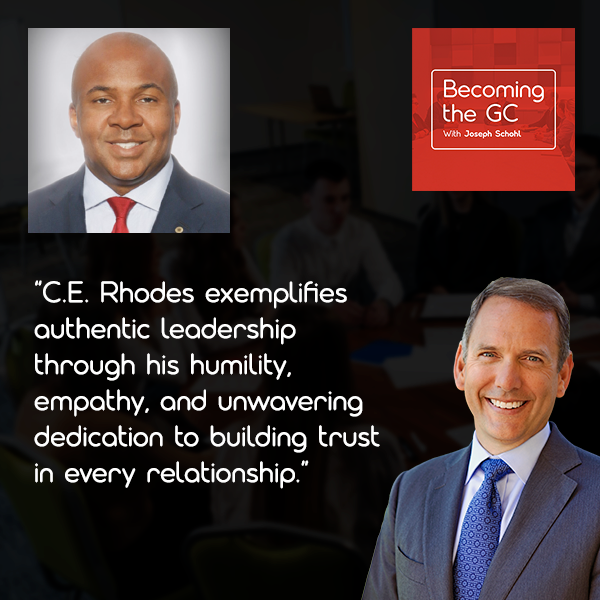
Thank you for tuning in. My takeaways from the interview with C.E. Rhodes are the following. I was struck by his humility and his appreciation for the people who helped him achieve his career success. I think that is what’s made him into the leader that he is. One who, as he said, listens, supports, congratulates, and motivates the people on his team.

His career evolution also highlights the power of continuous learning, networking, and curiosity, not only in how it advanced him but also in fostering meaningful relationships and driving organizational success. Ultimately, in his case, to make the world a better place. Until next time. I’d love to connect with any in-house lawyers or outside lawyers who serve in-house lawyers who are interested in maximizing their potential. Please reach out to me on LinkedIn and let’s start a conversation. Thanks.
Important Links