
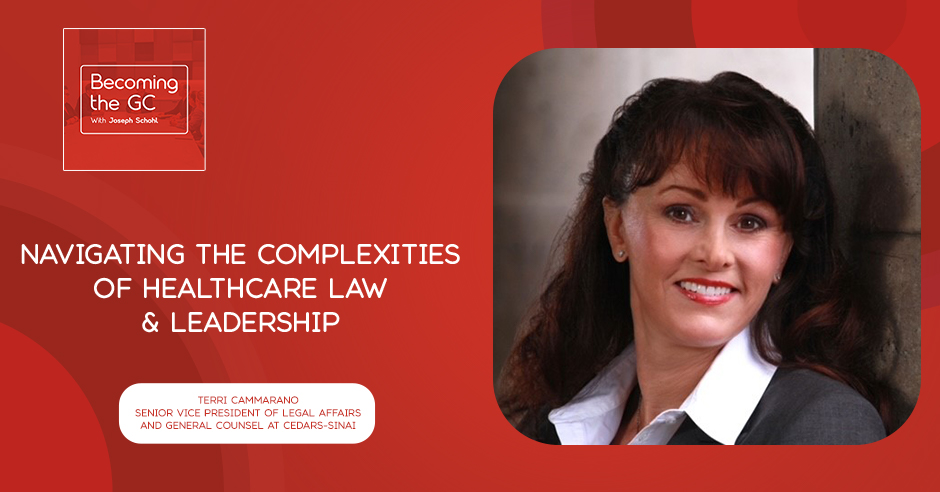
Blending legal expertise with strategic leadership is paramount in the complex realm of healthcare administration. In this episode, we’re privileged to feature Terri Cammarano, Senior Vice President of Legal Affairs and General Counsel at Cedars-Sinai, a distinguished figure in California’s healthcare landscape. Terri shares her extraordinary journey from law firm partnership to becoming a leading in-house counsel, discussing her hiring criteria for legal talent and the potential impact of the upcoming LA Olympics on healthcare. From her initial passion for policy and politics to mastering the intricacies of big law and the art of executive diplomacy, Terri’s story is an insightful exploration of career progression and leadership excellence.
—
Watch the episode here
Listen to the podcast here
Navigating The Complexities Of Healthcare Law & Leadership With Terri Cammarano
Our guest is Terri Cammarano. Terri has had a remarkable career and is a legend in the healthcare community here in California. We talked about her transitions between being a general counsel and a law firm partner, what she looks for when hiring a lawyer into her department, and the upcoming LA Olympics.
Stay with me to the end, where I’ll share my key takeaways from the episode. The show is sponsored by Inside Counsel Academy, where in-house council goes to elevate their careers while enhancing their lives. Also by GeneralCounselWest, a law firm that supports GCs of healthcare companies and their teams with an inside council mindset. Our guest is Terri Cammarano. She’s the Senior Vice President of Legal Affairs and General Counsel at Cedars Sinai.
Cedars Sinai serves more than a million people each year in over 40 locations with more than 4,500 physicians and nurses and 1,500 research projects in motion. Before joining Cedar, she was a partner with Hooper Lundy and Bookman here in Los Angeles. Prior to that, Terri held the position of Chief Legal Counsel and was a member of the executive leadership team of Memorial Health System in Fountain Valley.
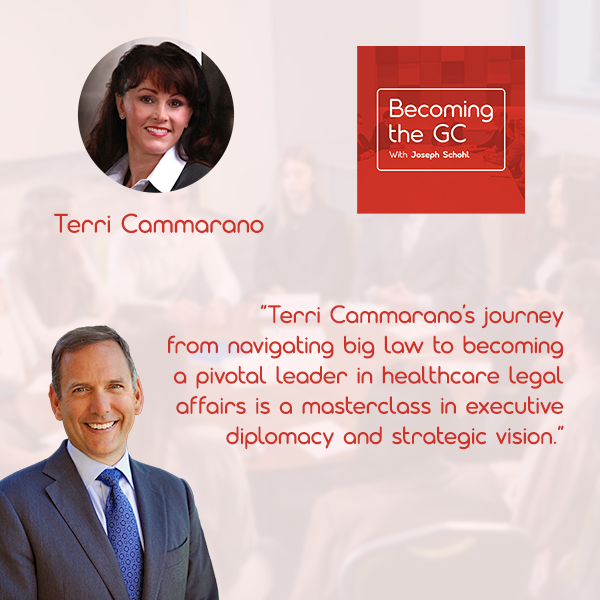
Terri, welcome to the show.
Thank you, Joe. It’s good to be here.
From Civic Dreams To Law School Grind: Terry’s Early Inspiration
I want to start at the beginning and ask you what inspired you to pursue law, and how did you start your career.
I always loved policy and politics and watching how legislation got made. It interested me. I was the kid who wanted to watch CNN. There were no lawyers in my immediate family. On my father’s side, for generations, there were lawyers, and it skipped a generation with him. I think it was partially interesting and maybe a little bit in my DNA.
You were civic-minded as a youngster, and no better place to be than law school to pursue that.
I love writing and reading. That focused me in on something where I would have the opportunity to write and read and really parse things through. I like details. I pay attention to them and think that’s a good quality for any lawyer.
Certainly. Did you enjoy the law school experience then?
I did. I was broke and had a lot of student debt, and was working two jobs while I was in law school.
Were you really? How did you do that?
I got some work at the law school library, and then I just did odd jobs and clerking. As soon as I got through my first year, I was able to clerk, but I had previously worked as a contract administration analyst at the Department of Defense. I took some odd jobs with defense contractors, clerical jobs, and just pulled it all together so I could get through.
There’s nothing like crunching the container to be efficient. You probably weren’t wasting a lot of time like the rest of us were.
Healthcare is a fee-for-service industry. Unlike many non-profits, healthcare providers can afford to pay their lawyers and have robust legal budgets. Share on XI had no time for anything other than sleep, work, go to school, and study.
Coming out of law school, what was your first job?
Big Law Beginnings: Building A Foundation For Excellence
Out of law school, I went to O’Melveny and Myers. I went straight into big law. I had been there over the summer, and they were kind enough because I told them I needed to work to supplement my scholarships. They were kind enough to let me work part-time during my third year of law school, which was unusual in those days. It was great. It was a big firm. I was in a smaller office. I had a lot of flexibility to work with different partners and in different areas. Those were great days. That was the heyday of big law when you would show up on your first day and they would give you a raise just for showing up. It was very competitive back then.
Take me through your early career into your mid-career, and what were some of the positive inflection points that helped you along the way?
I think the big law experience it’s hard, it’s a lot of pressure, but it trains you to be responsive, and it trains you to be timely, and it trains you to pay attention to detail. At our firm, typos could get you a write-up. Nobody wants that. The quality of the work that you develop in private practice when clients are paying big firm rates, I think, helps you focus on the fact that the client sees a typo. They might just wonder what else is an error in the message you’re sending. That has stuck with me.
Even though we all do it, everybody makes mistakes. We’re just human. It’s trained me to always be on important documents, and make sure I get a second set of eyes. “Could you just take a look at this and read it once through and make sure I didn’t say anything stupid or there’s not some errant comma in there.” I think that has stuck with me. The long hours and having to be available 24/7 are one of the prices you pay for big law. I think for any law, these days, people expect their lawyers to be available. That’s just something that comes with the territory of practicing privately.
You reminded me, I hadn’t thought about it in a long time, but I had a business and technical writing professor in college, and any assignment that we had, if you had a typo or a grammatical error, for each one, you got bumped down a whole letter grade on the assignment. Of course, we thought that was somewhat unreasonable at the time, but now, in retrospect, what a gift to have somebody set the standard like that. I feel like in today’s world, we don’t have those people as frequently who hold us to that high of the standard in our schooling or maybe even in our jobs. You really like could benefit from setting that for yourself. What happened next for you?
Healthcare Calling: Discovering A Niche In Non-Profits
I really enjoyed working with nonprofits because it was a small office, and I was able to straddle two departments, corporate and tax. My favorite work was with the nonprofit clients, universities, museums, and a little bit of healthcare, but at that time, O’Melveny wasn’t doing a lot of healthcare. This was a long time ago. One day, I was talking with a partner who had been just a great mentor on the tax side, and I said I like this nonprofit world.
He said, “If that’s what you like, you need to focus on healthcare because healthcare is a fee-for-service industry, unlike many nonprofits.” They pay their lawyers and are willing to have a robust legal budget as opposed to so many of these nonprofits that are small and don’t have the revenue for big law. I took that to heart.
At one point, that partner said to me, “Don’t take this the wrong way because this is about you and what you want to do with your career and how you can excel. There is a blind ad in the Daily Journal for a healthcare law firm. I think I know which one it is. If you went there, you would be working with a lot of nonprofit hospital systems. You should see what it is. If I’m wrong, I owe you a bottle of wine. If I’m right, you owe me a bottle of wine.” It was Weisberg and Aronson. One of the firms that created healthcare law as a specialty.
Listen, so you can be more thoughtful in responding. Share on XI went to Weisberg, and it turned out to be just such a fabulous move because I was all in on health care. I continued to straddle business law and tax, doing a lot of work with a lot of fun clients. Carl Weisberg was a force to be reckoned with, and talk about someone who demanded excellence. That was painful at times, but I am just so grateful that I had the opportunity to work with people like Carl and Peter Aronson. Many people and are still icons in healthcare law.
I know you have an LLM, but I don’t know whether it’s in tax or health law, which it could be either one, given your career. Which is it?
It’s tax.
It is.
I went back late in my career to do that. I had always wanted one. When I was at O’Melveny, the partner said, “You’re already in the tax department. What do you need an LLM for?” When I was at Weisberg, which had become part of Foley and Lardner in the process. I got a call from my alma mater, Loyola Law School, asking if I would be interested in teaching a tax-exempt works class in an LLM program. I knew the university had been looking at a tax LLM program. I didn’t realize it was fully baked. I said, “No, I want to get an LLM first.”
“Are you kidding me?”
My firm was very supportive, and we agreed to reduce my hours a little bit to allow me to get to evening classes on time. Going back to school, I took notes in law school on paper, and I went in with my notepad, and everybody around me flipped open their laptop. It was a paradigm shift for me, but it ended up just being a great way to exercise the green matter and become a subject matter expert.
When did you make the transition in-house?
Transitioning In-House: From Advisor To Executive Leader
I made the transition in-house I was probably a twenty-year lawyer when that happened. I had wanted to do it for a while, but I live in LA. My husband’s a practicing maritime lawyer in Los Angeles. We always need to live near a port and would prefer the port to be LA and not New York. Geography matters, and there are not a lot of openings for general counsel that just pop up when particularly in healthcare, in LA.
I had been working with a major public company that had a huge healthcare operation that encountered just a regulatory and business crisis. I got called in to lead the team on that. I worked closely with the general counsel, the deputy general counsel, and the executive team for over two years. I was at their facility probably three days a week over the course of two years, traveling with them to different locations and just working closely as part of that team.
I love that experience. They asked if I would be willing to come in-house at the end of the project, but the problem was that they were headquartered in a place that wasn’t by a port. We couldn’t really make that move, but it intrigued me and piqued my interest. I kept my eyes open, and the first in-house opportunity I had was with a healthcare system located in California that had never had a general counsel, and I had never been a general counsel, and they hired me.
This could have been a disaster, but we learned together. They were wonderful. It was a great experience. I built the legal department, and I credit that team, particularly the CFO, with giving me a lot of grace to learn how to become a legal executive. When you come out of a law firm where people are paying you by the hour, they generally don’t want you to sugarcoat things. They want a straight shooter who’s going to tell it like it is and do it quickly. That’s not the way executives work, I learned. There’s a diplomacy and a nuance that goes with being an executive. Learning to be and lean in as a legal executive was critical for this role. Again, they gave me a lot of grace to do that.
What did you do to master that new domain? Trial and error? Did you get a mentor or talk to others or what all went into that?
There was a lot of trial and error. I did a lot more reading on management styles and leadership styles so that I could do a better job of reading the room. I had to learn to keep my mouth shut, to resist the urge to interrupt, to resist the urge to say, “Wait a minute, the law says.” Instead of learning and disciplining myself to show up and listen carefully, not to multitask, not to try to in my head go three different places based on what they said. Just to listen so that I can be more thoughtful in responding if I’m asked a question or in weighing in the way that doesn’t sound like the lawyers, the bull in the china shop. I also looked at the people I admire who I thought had good executive diplomacy and tried to model some of the behaviors that I saw them entertain.
I think of you as quintessential general counsel. I’ve only known you in that role and with such executive presence. This is interesting for me to hear about your transition from law firm life to in-house. I didn’t realize that’s the path that I had taken. What did your department grow into over the course of that role?
It grew into about total of six attorneys. I was also responsible for risk management and compliance. One of the other challenges is that you cannot build an in-house team the same way you would build a law firm because they’re not the same beast. Learning that you go in-house, you don’t have all the bells and whistles of a law firm. Nobody’s going to hand you Lexis. You’ve got to fight to get that in your budget.
You don’t have these sophisticated document management systems. We didn’t have pleading papers. You learn to be creative. I found out that during that time, I was a member of the Hawaii Bar. If you are a member of the Hawaii Bar, they give you get free access to a Lexis-like database for all federal and state cases. I had to learn to look for those kinds of things so I could pull in those resources for the team.
Very scrappy. Tell me about during this period of time, what were some specific challenges that you faced and how did you overcome them?
One of the challenges of being in-house is you’re stuck with your client. If you’re in private practice and you have a client that’s a pain, you get to turn to another client, or you can decide that maybe you won’t take the next project, or you can ask a partner, “You may have a better personality fit for this client.” You can just say, “My rate just went up.” See if that drives it away. You cannot do that when you’re in-house. You need to identify the folks, or I needed to identify the folks that we weren’t gelling and either figure out how to gel or how to live and peacefully coexist with mutual respect.
“You don’t have to like me, but we got to work together.” That makes it sound like I didn’t get along with a lot of people, which is not true, but there’s always going to be someone who is going to be the pain or that you don’t jive with, or that just has a prejudice against lawyers. That was challenging because it required me to focus on, “Am I emotionally intelligent, and how can I improve where I’m not?” That was the first time I ever in my life thought about emotional intelligence as a quality and a trait that needed to be nurtured.
What did that mean for you personally?
I reverted to a lot more listening and a lot less talking, a lot of reading on emotional intelligence, which again was something that was not on my reading list before, and modeling the behavior of people who I’ve thought had high emotional intelligence.
You can't build an in-house team the same way you'd build a law firm. They're just not the same beast. Share on XAt some point, you go back to a law firm.
Back To Private Practice: Refining Skills And Emotional Intelligence
I did. I did two stints as a general counsel and just decided it was time for a change, and looked around, and there weren’t any general counsel openings that were a good fit for me or wouldn’t require me to move. I thought, “I’m going to go back to private practice.” I’ve learned a lot that I think would make me a better outside advisor because I know how it works on the inside. That was a lot of fun, and it was a break.
It was a nice break not to have the business pressure. It was a nice break to not have the same client all the time. It felt like a holiday in some respects and an opportunity to do that during that time, I got admitted to Massachusetts so that I could do some work with the Massachusetts Hospital Association. Things like that, where I did more speaking, working with some trade associations on some educational materials.
You don’t really have the time to do that in-house because in-house, you’re trying to save an outside spend, and that means the more you can do the work inside, the less you spend on outside counsel. It was really fun. I don’t regret going back to private practice. I think it ended up being a really good career move in terms of my emotional well-being, my professional skillset, and my mindset as well.
How did you go about selecting where you would go?
By this time, I pretty much knew who all the players were that I worked with, that I respected, that I valued, and that I thought were wicked smart in the healthcare space. It wasn’t hard to identify the firms that I might be interested in. A lot of them had either been the client or been across the table, or been on the deal team. Lawyers move firms. There were plenty of firms where my former partners were now partners. I was fortunate.
I had a lot of options. The economics are hard when you go from a regular salary back into a law firm where your production and your business development determine your salary. There was a ramp-up, and I’d forgotten the grinding, the minding, and the finding. It’s still hard. Fortunately, my former clients from my in-house days said, “We’d like to use you and keep you on some of these projects.” That made for a nice ramp.
Tell me how having spent all those years as a GC informed your advising as an outside counsel.
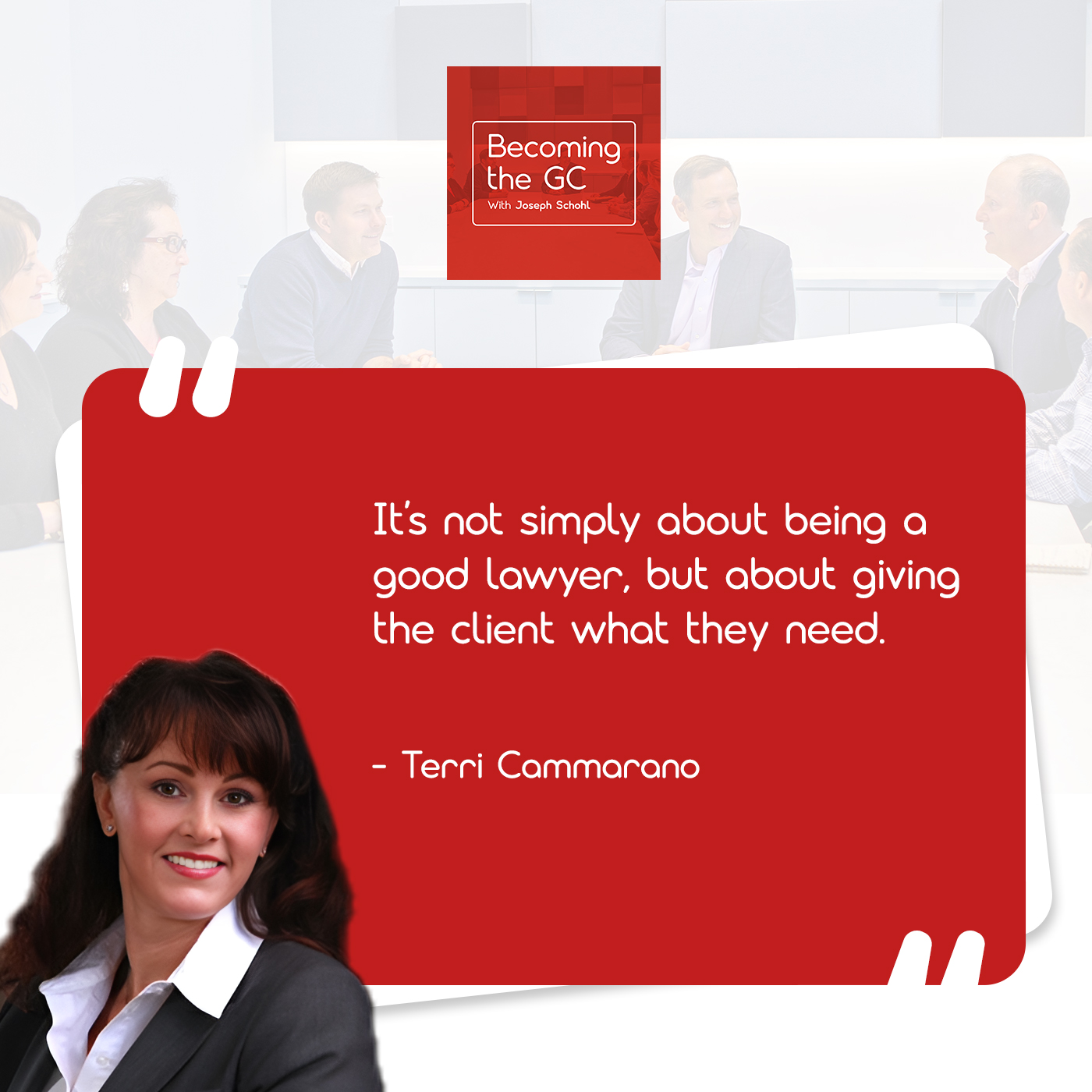
Lawyers love to give advice that sounds like lawyers. We were raised that way in law school. That’s how we analyze problems, and we want every detail to matter. I think my experience in-house framed my thinking about it’s not just about being a good lawyer, but giving the client what they need to either make a decision or do the deal in a way that they can understand it. My sense having been in-house is when a lawyer says in a memo or an email.
“Yes, you can, but.” Clients never read past the but. It framed my thinking and my practice around new projects and taking the time to talk with the client about what the project would look like, what they wanted the end product to be. Did they want a memo? Did they want a PowerPoint that they could share? Sometimes with the general counsel, maybe they want a memo for the law department, but they want a business-friendly, shorter version of the memo in bullet points that they can share with their colleagues who are not lawyers.
Spending time at the front of the engagement with the client to talk about the process and also about gating issues. If we do A and the answer is one, then where do we go? If the answer is two, do you want to just stop and take a pause and reevaluate, so that we weren’t running up bills because I was chasing down things to make sure I covered all the bases? Instead, ask them what bases do you want to cover and in what sequence do you want to cover them.
Healthcare is starting to recognize that price transparency is mandatory. Consumers and payers can't make good choices about their healthcare if they don't know what it will cost. Share on XLanding At Cedars-Sinai: A Legendary Institution
When the Cedars position came open, Cedars is such a historical, storied institution, and esteemed institution in Los Angeles. How did that role come about? Did that feel a little bit like the universe was conspiring in your favor right here in LA?
Very much so. I got a phone call about it, and I went home and I told my husband that Peter Braveman, my predecessor who had been in theaters for over 40 years, was a legend among the general counsel community in California, and was retiring. I said, “I think I know who’s going to apply for this position, and I’m not going to get this position because I know who’s applying for it, but I’m going to throw my hat in the ring because I’ve never done work for Cedars Sinai.”
That’s one client that was never in the portfolio of the firms I was with. It’d be really fun to meet these people and get the perspective and learn a little bit more, and understand the challenges of the academic medical center that Cedars Sinai is. It was a long and grueling process. It was many months, many interviews, and when I got the offer, I literally couldn’t believe it. I’m thinking, “I don’t know what happened here. How did this happen?”
I remember saying that to a friend who is a partner at one of the big national law firms, and she looked at me and she called me aside and she said, “Don’t you ever talk like that. No man would ever question why they got what they deserve.” That has stuck with me. She has been a mentor. I thought, it’s so true. We women tend to underestimate ourselves and engage in this self-deprecating humor. She reminded me that I was not being a good role model when I talked like that. It was a big moment, though.
I’m sure with your background and everything you had done up to that point, they were as excited to get you as you were as excited to get the job.
I hope so. I so enjoyed meeting people. Some of those folks I had met because I had been involved in deals where Cedars was a part of the deal. We had been across the table, or we had been at meetings. I was excited about working with the team. The board is amazing and thoughtful, and mission-driven. That resonated with me. I think that for me, always being interested in nonprofits and always having a soft spot for nonprofit healthcare. Cedars is the epitome, walking the talk when it comes to mission and being good stewards, but also being incredibly valued resources to the community they serve.
How has your development of your team been during your tenure at Cedars?
I inherited a fabulous team, and we’ve grown the team since I’ve been there. When I arrived at Cedars, there were some silo groups of attorneys that weren’t reporting to legal. We’ve coordinated all of that so that we have dual reporting relationships in some areas. We coalesced all the lawyers. It’s a little less siloed, which is great. We’ve spent a lot of time organizing ourselves. When I came in, it was all paper files. We made a big effort to get organized and adopt an electronic document management system like a law firm would have.
That has just been terrific. We implemented it just before COVID, which was fabulous because when COVID hit, our CEO said, “Look, if you’re not clinical, stay home. Get out of our way and let the clinicians deal with this.” Had we not gone to a paperless environment, we wouldn’t have been able to work remotely. We’ve stuck with that because now we spend time out at our affiliates, grab the laptop and go, and we can sit and be part of the affiliate management team for the day and be available to them. That’s been a game changer for the team.
Shaping The Future: Mentoring Lawyers & Cedars-Sinai’s Vision
When you’re bringing somebody into Cedars, a younger lawyer, let’s say, what are you looking for?
We’re looking for someone who has an interest in and some familiarity with healthcare. I wouldn’t say we’re necessarily looking for someone who is a deep subject matter expert, but somebody who has a lay of the land and an interest, because that’s the person who’s going to care about why these crazy, extensive regulatory requirements matter and how we can work with them. Also, I think it’s someone who understands that in-house comes with trade-offs. You are never going to have the upside potential that you’re going to have as a partner in a national law firm once you go in-house with a nonprofit. We don’t have equity to give you.
You are going to have a real sense of purpose. You are going to have the comfort of a regular salary. You are going to have the opportunity to do some cool things, like influence policy and work with people who are saving lives every day. Another one that I think is important is that you need to understand, as we talked about, that you’re going to have one client now. You need to get comfortable with and be willing to learn about the culture of that client and how they view lawyers. How do they like receiving information? How do they like meetings to occur? Are they okay with a virtual meeting, or are you always going to have to go to their office? Someone who understands that it’s just different than working in a law firm.
Great, Terri. I would love to hear about what you’re most looking forward to.
I think in healthcare, there’s so much to look forward to. It’s a challenging time. We have the continuing challenge of being expected to do more and get paid less for doing it. We have labor shortages, making it hard to fill the nursing positions and other positions that we need to operate. At the same time, health care is starting to recognize that things like price transparency are mandatory.
You cannot expect consumers and payers to make good choices about their health care if they don’t know what it’s going to cost. I think that’s exciting and is going to be a game changer in our industry. I’m getting to the point where I’m looking at retirement, not too distant a future. I’m excited about my team. I’m so thrilled that I see people. All of my team members could have to take my job and do it well. When I came in, that was my goal because there was no in-house candidate when I came in.
One of my goals is that when I retire, I want there to be a lot of in-house candidates for my seat. I’m excited about that. We have a new CEO. We had a fabulous CEO who was there for a total of over 40 years, who recently retired, and his legacy is remarkable. Our new CEO has just great perspectives and is willing to question why have we always done it this way? That’s exciting and has been just fun to work with him and get to know him and experience what his vision for our health system’s future is.
Should we add the 2028 Olympics to the list of things we’re looking forward to here in Los Angeles? I know you guys have, you’re working with the Olympics in some capacity. Tell us about that.
We are a sponsor, which is very exciting. Look, we treat people. That’s what we do. The opportunity to provide care for athletes that are performing at the highest level is an exciting challenge for us. We’re really looking forward to that, as well as just being a partner with many organizations that are using the Olympics as an opportunity to showcase what a remarkable city Los Angeles is, and what tremendous resources and values we have as a community. I’m very excited about that.
Terri, it’s really been a pleasure speaking with you. I thank you so much for joining us.
My pleasure. Thank you, Joe. I appreciate the time.
—
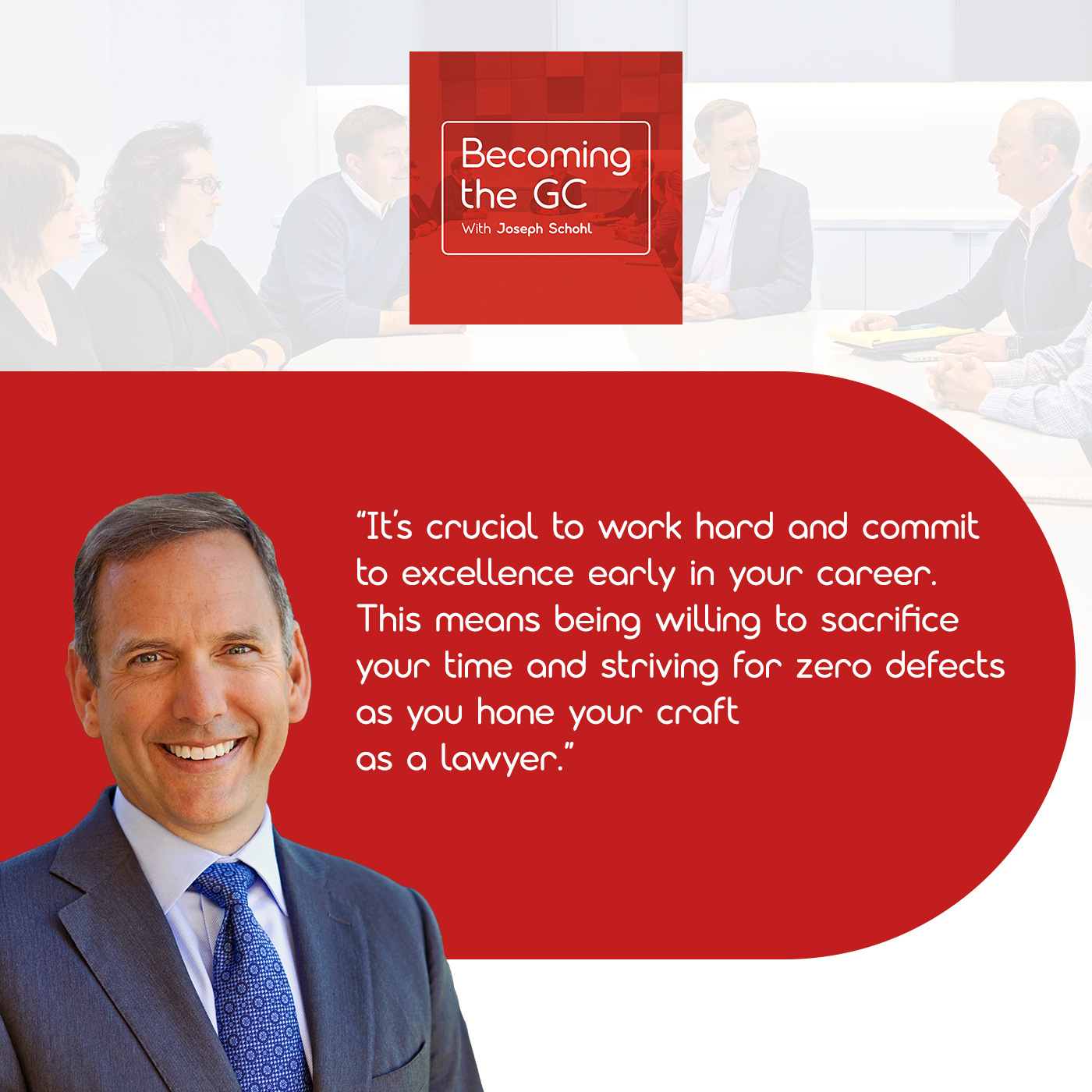
Thank you for listening. I hope you enjoyed our time with Terri. I know I did. A few key things I’ll take from this episode are how important it is to work hard and commit to excellence early in your career. That means being willing to sacrifice your time and commit to zero defects when honing your craft as a lawyer. Second, I was impressed by her commitment to developing the lawyers on her team so that they are viable candidates to be her successor when she decides to retire. That’s the leader people want to work for. Until next time, this is Joe Schohl. For more tips on accelerating your path to becoming a world-class general counsel, visit InsideCounselAcademy.com and connect with me on LinkedIn.
Important Links
About Terri Wagner Cammarano, JD, LLM
 Senior Vice President, Legal Affairs and General Counsel
Terri Wagner Cammarano, JD, LLM, brings considerable legal experience to Cedars‑Sinai, having served in private practice and in executive legal roles with major Southern California health systems. At Cedars‑Sinai, Cammarano advises the Board of Directors and senior management on legal and regulatory matters. She also manages the Legal Affairs Department and serves as a resource to internal departments seeking legal guidance.
Cammarano has represented health systems, hospitals, and other healthcare providers in all types of transactional matters, including mergers and acquisitions, joint ventures, joint operating agreements, affiliations, financings and strategic collaborations. She has managed attorney general proceedings, approvals, reports and investigations, federal and state tax audits, regulatory investigations, and licensure and certification matters. Cammarano has extensive experience with governance, executive compensation issues and strategic planning. She is certified in healthcare compliance.
Before joining Cedars‑Sinai, she was a partner with Hooper, Lundy & Bookman, P.C., in Los Angeles, where she counseled and advocated for health systems, hospitals, medical practice foundations and related service providers. Prior to that, Cammarano held the position of chief legal counsel and was a member of the executive leadership team of MemorialCare Health System in Fountain Valley. She was responsible for planning and coordinating legal affairs, government relations, litigation management and strategy, legal support for business transactions and oversight of all outside counsel.
Cammarano earned her Bachelor of Political Science with high honors from California State University, Fullerton, and her JD and Master of Laws degrees from Loyola Law School, Los Angeles. She is admitted to practice in California and Hawaii.